
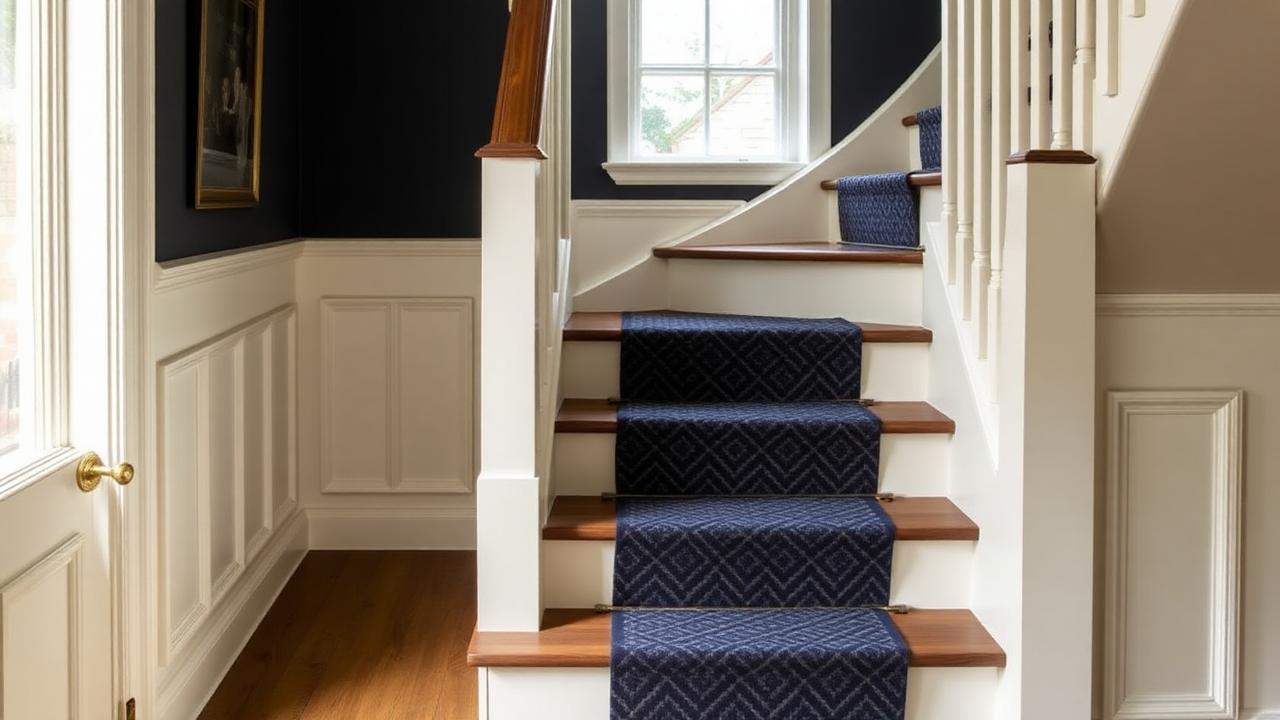
Why homeowners choose dark stair runners
Stairs are one of the highest-traffic areas in any home, taking direct footfall from every person who lives there, multiple times a day. Dark colours are popular here for a simple practical reason: they mask the everyday grime, pet hair, and light scuffing that would show up quickly on a pale carpet. A charcoal or navy runner can go significantly longer between deep cleans while still looking presentable, which matters most on stairs that see children, pets, or a lot of daily foot traffic.
Beyond practicality, dark runners also make a strong design statement. A near-black or deep espresso runner against pale painted stringers or light wood treads creates striking contrast, while a dark runner on dark wood can create a moody, cohesive look that reads as intentional rather than accidental. Because the colour reads as neutral in most schemes, dark runners also tend to age well stylistically compared to bold trend colours.
Downsides to be aware of
Dark carpet does show lint, dust, and pale debris more visibly than mid-tone colours, somewhat counterintuitively, since anything light-coloured stands out sharply against a dark background. Regular vacuuming becomes more of a visual necessity than with a mid-grey or patterned option. Dark runners in direct sunlight can also fade unevenly over time if one section of the staircase receives significantly more light than another, so consider window coverings if your stairwell gets strong afternoon sun.
Calculating runner length
Colour choice does not change the maths. For our 13-step flight: 10 in tread + 7.5 in riser + 0.75 in nosing wrap = 18.25 in per step. Over 13 steps that is 237.25 in, plus a 24 in finishing allowance, giving 261.25 in, or 21.77 ft. With a 10% waste margin, order approximately 24 ft. Metric: 25 cm + 19 cm + 1.9 cm = 45.9 cm per step, totalling 596.7 cm over 13 steps, plus 60 cm finishing, giving 656.7 cm, plus 10% waste, approximately 7.3 m.
| Step | US (in/ft) | UK (cm/m) |
|---|---|---|
| Per-step total | 18.25 in | 45.9 cm |
| 13 steps | 237.25 in | 596.7 cm |
| With finishing | 261.25 in | 656.7 cm |
| With 10% waste | 24 ft | 7.3 m |
Know your numbers in 30 seconds
Enter your step count, tread depth and riser height — the stair runner calculator gives you the exact length to order, in metres and feet, with waste included.
Open the stair runner calculatorBest materials for a dark runner
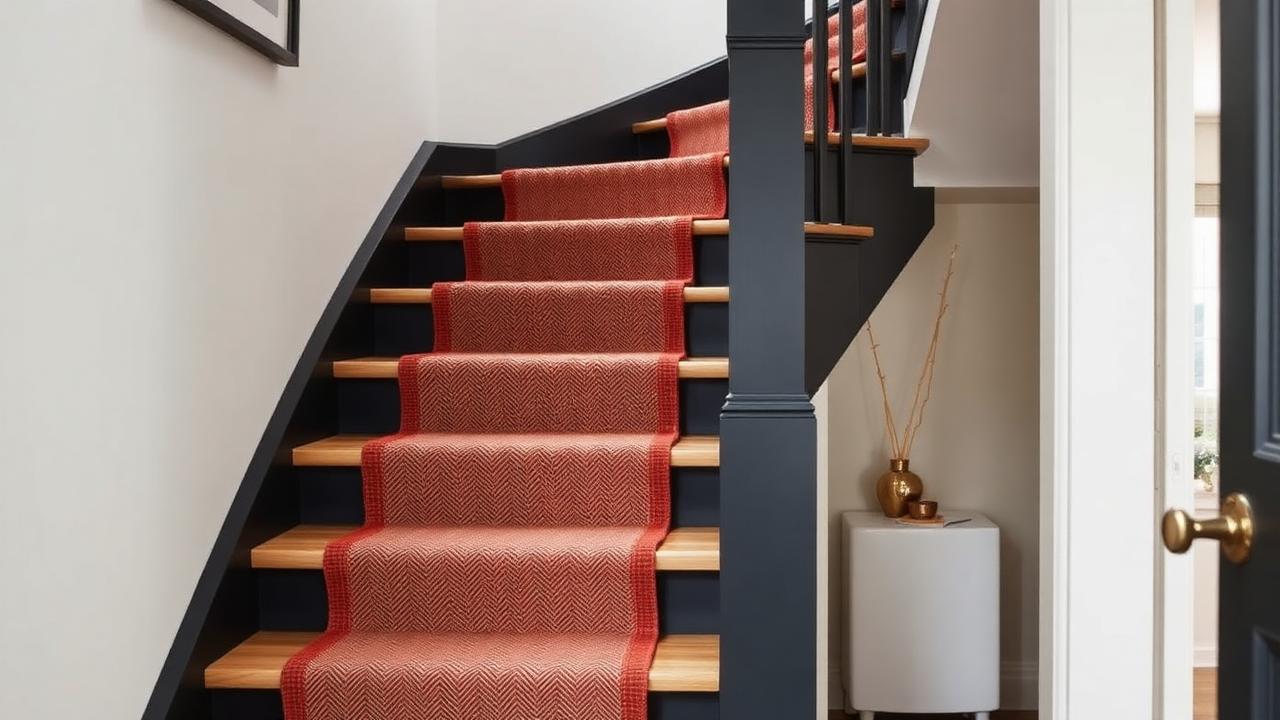
Nylon is a reliable choice in dark tones because it holds colour well through repeated cleaning and heavy foot traffic without fading or matting. Wool takes dye beautifully and produces a rich, deep colour with excellent durability, though it comes at a higher price point. Avoid very low-pile, budget synthetic options in dark colours, since they tend to show a sheen or shading pattern known as pile reversal, where the fibres catch light differently depending on foot traffic direction, creating a patchy, watermarked look over time.
Watch for pile reversal
Pile reversal is more visible on dark, solid-coloured carpet than on lighter or patterned options. If you are set on a dark runner, choose a denser, higher-quality pile to minimise this effect.
Pairing dark runners with borders and rods
A dark runner with a contrasting light or metallic border, such as cream, gold, or brushed brass binding, adds definition and prevents the staircase from feeling too heavy or closed-in, particularly in a narrow hallway. Brass or antique bronze stair rods complement dark runners especially well, echoing traditional Victorian and Edwardian styling, while matte black rods create a more contemporary, monochromatic look.
- Choose nylon or wool for the best colour retention in dark tones.
- Add a contrasting border to prevent a heavy, closed-in look.
- Expect to vacuum more frequently to manage visible lint and dust.
- Protect against uneven fading in direct sunlight.
- Confirm your runner length before ordering, regardless of colour.
Final thoughts on going dark
A dark stair runner is a low-maintenance, high-impact choice for busy households and design-forward homes alike. As with any colour, order a sample first to check it against your actual lighting conditions, and confirm your length using the stair runner calculator before placing your order.
Whatever you decide, get the numbers first: the stair runner calculator doubles as a stair runner length calculator, adding nosing wrap, landings, winders, pattern repeat and waste so you order the right length the first time.
Still deciding on material, width or pattern? Our hub on stair runners compares weaves, widths, backings and fitting styles side by side, then hands the numbers straight to the calculator.
Frequently asked questions
Do dark stair runners show dirt more or less than light ones?
They hide dirt and stains well but show lint, dust and pale debris more visibly, so regular vacuuming is important.
What is pile reversal?
A shading or watermarking effect where carpet fibres catch light differently depending on traffic direction, more noticeable on dark solid colours.
Which material holds dark colour best?
Nylon and wool both hold dark dye well through cleaning and heavy use without significant fading.
Will a dark runner fade in sunlight?
It can fade unevenly if parts of the staircase receive more direct sun than others, so consider window coverings if needed.
Does colour affect how much runner I need?
No, the length calculation depends only on your stair dimensions, not the colour or material chosen.
What border colour works well with a dark runner?
Cream, gold or brushed metallic borders add contrast and prevent the staircase from feeling too heavy.
Are dark runners a good choice for pet owners?
Yes, they hide pet hair and light staining well, though frequent vacuuming still helps maintain their appearance.
How much runner do I need for a 13-step staircase?
Roughly 23-24 ft (7-7.3 m) with standard 10 in (25 cm) treads and 7.5 in (19 cm) risers, including waste allowance.
Know your numbers in 30 seconds
Enter your step count, tread depth and riser height — the stair runner calculator gives you the exact length to order, in metres and feet, with waste included.
Work out your length with the stair runner calculatorReady for real prices?
Get quotes from vetted stair runner suppliers and fitters near you. Free, no account, no obligation.
Every guide is written from hands-on measuring and fitting experience, checked against the calculator’s own maths, and re-reviewed whenever prices or methods change. Read our editorial standards.