
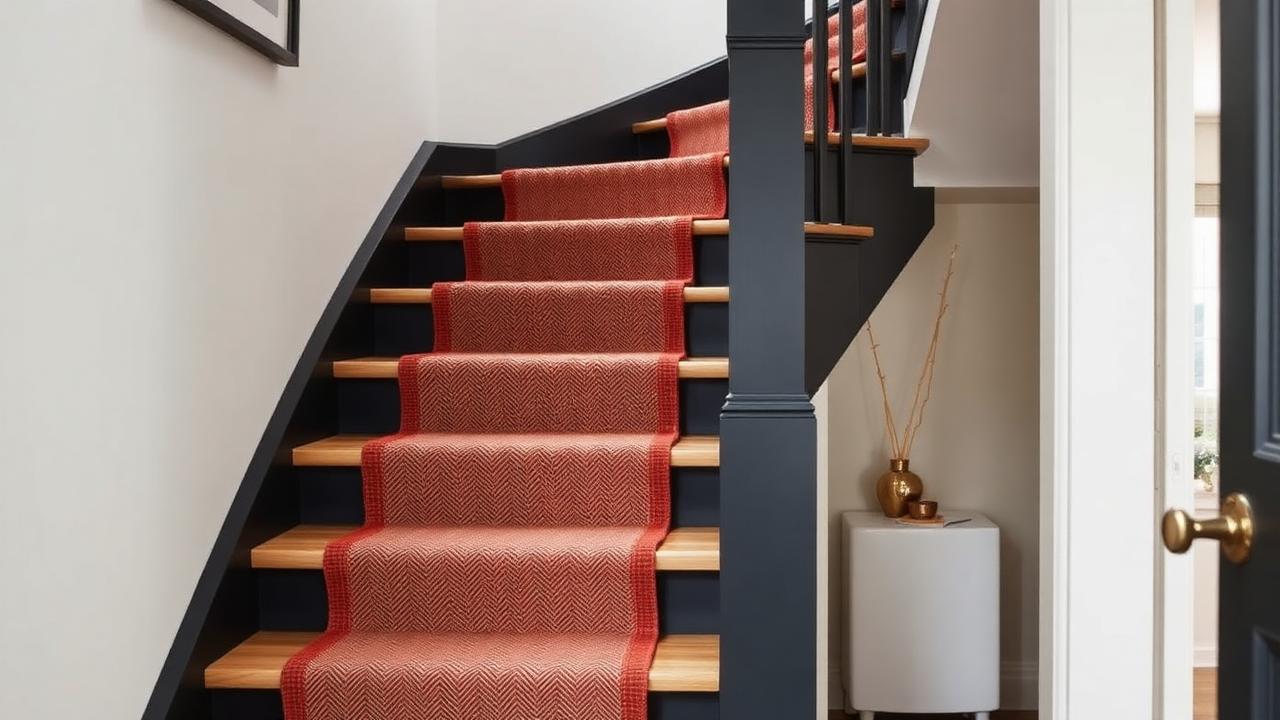
What makes a runner 'designer'
A designer stair runner is usually distinguished by three things: the origin of the fibre, the density of the weave, and the exclusivity of the pattern. Many designer collections are produced in limited runs using Wilton or Axminster weaving techniques, which allow for intricate patterns with tight, durable pile. Others are hand-loomed from wool or wool-blend yarns, giving a texture and depth that mass-market synthetics cannot replicate. Price alone does not guarantee quality, so it pays to examine the construction closely rather than relying on a brand name.
Designers often work with heritage mills that have decades of pattern archives, meaning you can source runners with a distinctive, less common look than the geometric prints found in big-box stores. This exclusivity is part of the appeal, particularly for period homes where a generic pattern can look out of place against original coving or panelling.
Choosing the right pattern scale
On a narrow staircase, an oversized motif can look cramped and awkward as it crosses each tread. Ask your supplier for a full pattern repeat photo, not just a small swatch, so you can see how the design will land across a full flight of steps. A stair runner calculator helps here too, because once you know the exact per-step dimensions, you can work out roughly how many pattern repeats will appear on each tread and riser.
How much runner do I need?
For a 13-step flight, add the tread depth, riser height, and nosing wrap: 10 in + 7.5 in + 0.75 in = 18.25 in per step. Across 13 steps that is 237.25 in. Add roughly 24 in for top and bottom finishing, giving 261.25 in, or 21.77 ft. With a designer runner, allow a slightly larger waste margin of 10% to accommodate pattern matching, bringing the order total to about 24 ft. In metric terms: 25 cm + 19 cm + 1.9 cm = 45.9 cm per step, 596.7 cm over 13 steps, plus 60 cm finishing = 656.7 cm, plus 10% waste for pattern matching gives roughly 7.3 m.
| Measurement | US (in/ft) | UK (cm/m) |
|---|---|---|
| Per-step total | 18.25 in | 45.9 cm |
| 13 steps | 19.77 ft | 5.97 m |
| With finishing | 21.77 ft | 6.57 m |
| With 10% waste | 24 ft | 7.3 m |
Know your numbers in 30 seconds
Enter your step count, tread depth and riser height — the stair runner calculator gives you the exact length to order, in metres and feet, with waste included.
Open the stair runner calculatorWidth and border considerations
Designer runners are often sold in a limited range of widths, so measure your staircase width before you fall in love with a pattern. A common approach is to leave 3-4 in (7.5-10 cm) of exposed timber or stained stringer on each side, which frames the runner and shows off the woodwork. If your staircase is unusually wide, ask whether the collection offers a wider bespoke width, since re-ordering a narrower pattern to fit later is costly.
Budget for underlay and rods
Designer runners deserve a quality underlay and, if you like the traditional look, brass or nickel stair rods. These finishing touches often cost as much as a mid-range runner alone, so build them into your budget from the start.
Working with an installer
Because designer runners are expensive and often difficult to reorder if the dye lot runs out, always use an experienced fitter who works regularly with high-end carpet. Ask for references and, ideally, see photos of a completed staircase installation similar to yours. A skilled fitter will also advise on pattern centring, which is critical for symmetrical geometric or floral designs.

Finally, remember that a designer stair runner is an investment piece. Look after it with regular vacuuming, prompt spot cleaning, and periodic professional cleaning to keep the colours vibrant for years to come.
Spec checklist before you place an order
Before you sign off on a designer runner, run through a short spec check with your supplier. Confirm the pile height and construction (Wilton, Axminster, or hand-loomed), the fibre content by percentage rather than a vague 'wool blend' label, and the backing type, since a woven jute backing behaves differently on stairs than a latex-coated one. Ask for the total roll width available and whether your chosen width requires an edge seam, which some narrow staircases can avoid entirely if the roll comes wide enough. On a 30-36 in (76-91 cm) staircase, most designer collections offer a runner width of 27-32 in (69-81 cm), leaving the 3-4 in (7.5-10 cm) of exposed stringer discussed above.
Also confirm the pattern repeat length in writing, in both inches and centimetres, since this is what your fitter will use to calculate exact cutting points at each tread. A repeat of 12 in (30 cm), for example, means the fitter can plan for roughly two repeats per tread depth on a 10 in (25 cm) tread once nosing wrap is factored in, keeping the motif visually consistent from the top step to the bottom.
Cost bands to expect
Designer stair runners vary widely in price depending on fibre and weave, but a rough guide helps with budgeting before you start browsing. Entry-level designer collections in a wool-blend Wilton weave typically run $60-90 per linear ft ($200-300 per linear m). Mid-range Axminster patterns with richer colourways often sit at $90-140 per linear ft ($300-460 per linear m). Hand-loomed or bespoke pieces from heritage mills can exceed $150 per linear ft ($500 per linear m) before fitting, rods, and underlay are added.
| Tier | US price (per linear ft) | UK price (per linear m) |
|---|---|---|
| Entry designer (Wilton weave) | $60-90 | £155-235 |
| Mid-range (Axminster) | $90-140 | £235-360 |
| Hand-loomed / bespoke | $150+ | £390+ |
| Underlay (all tiers) | $8-15 | £21-39 |
Styling rules that keep a designer runner looking intentional
A few simple rules separate a designer runner that looks curated from one that looks like an afterthought. First, keep the exposed stringer width consistent along the entire flight; an uneven margin is one of the fastest ways to make an expensive runner look poorly fitted. Second, match your stair rod or clip finish to other hardware in the hallway, such as door handles or light fittings, rather than treating it as a separate decision. Third, if your staircase turns or has a half-landing, ask your supplier whether the pattern is designed to continue cleanly around a winder, since some intricate motifs are not drafted with turns in mind and may need a simpler border treatment at that point.
- Confirm fibre content and construction in writing before ordering.
- Get the pattern repeat length in both inches and centimetres.
- Match stair rod or clip finish to existing hallway hardware.
- Ask how the pattern handles winders or half-landings.
- Budget separately for underlay rather than assuming it is bundled in.
Resale value and insurance considerations
A well-installed designer stair runner is one of the few soft furnishings that can genuinely register with buyers when a home goes on the market, particularly in period properties where a bare or worn staircase can drag down an otherwise strong first impression. Estate agents often note that a tidy, well-fitted runner in a neutral-leaning palette photographs better than an exposed staircase with scuffed treads either side. That said, don't over-invest relative to the rest of the property; a $150-per-ft hand-loomed runner in a modest starter home is unlikely to be recouped at sale, whereas the same runner in a period townhouse with matching cornicing and skirting can genuinely support the asking price.
It is also worth mentioning higher-value runners to your home contents insurer, especially hand-loomed or bespoke pieces that would be expensive or impossible to replace like-for-like. Keep the invoice, a note of the fibre content and mill, and a few photographs on file. Some insurers treat fitted stair runners as part of the building rather than contents, which can affect how a claim is assessed after water damage or a house fire, so it is worth asking the specific question rather than assuming standard cover applies.
Whatever you decide, get the numbers first: the stair runner calculator doubles as a stair runner length calculator, adding nosing wrap, landings, winders, pattern repeat and waste so you order the right length the first time.
Frequently asked questions
What makes a stair runner 'designer'?
Typically the fibre quality, weaving technique, and exclusivity of the pattern, often produced by heritage mills in limited runs.
Are designer stair runners worth the extra cost?
If you value longevity and a distinctive look, yes. The weave density and fibre quality usually mean better wear resistance too.
Can I use a stair runner calculator for a designer runner?
Yes, the measuring principles are the same regardless of price point; you still need accurate tread, riser, and nosing figures.
Should I add extra waste allowance for a patterned designer runner?
Yes, allow 10% rather than the standard 8% to account for pattern matching between steps.
Do designer runners come in standard widths?
Often a narrower range than mass-market runners, so check availability before choosing a pattern.
Is underlay included with designer stair runners?
Rarely. Budget for a separate high-quality underlay to protect your investment.
Can I install a designer stair runner myself?
It is possible but not advisable given the cost of a mistake; hire an experienced fitter.
How do I keep a designer runner looking new?
Vacuum regularly, treat spills immediately, and schedule professional cleaning every 12-18 months.
Know your numbers in 30 seconds
Enter your step count, tread depth and riser height — the stair runner calculator gives you the exact length to order, in metres and feet, with waste included.
Measure your stairs with the stair runner calculatorReady for real prices?
Get quotes from vetted stair runner suppliers and fitters near you. Free, no account, no obligation.
Every guide is written from hands-on measuring and fitting experience, checked against the calculator’s own maths, and re-reviewed whenever prices or methods change. Read our editorial standards.