
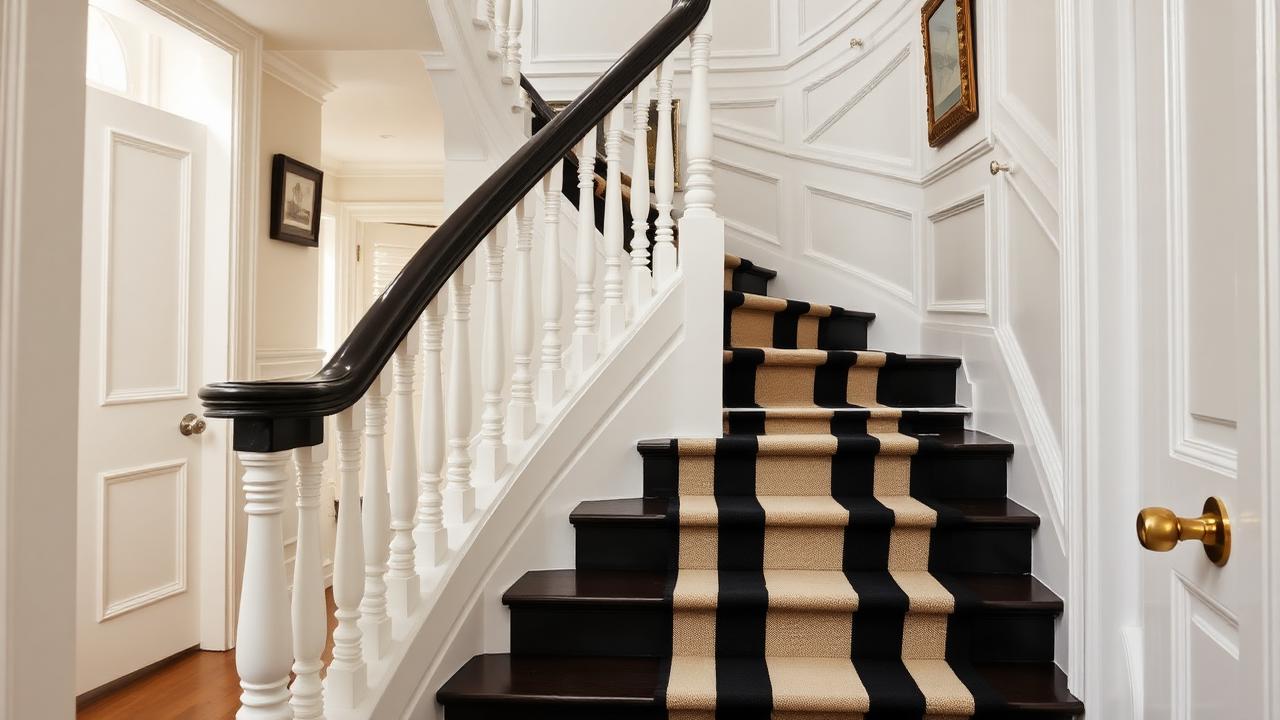
What houndstooth is, in carpet terms
Houndstooth is a two-colour broken check made from an abstract four-pointed shape, traditionally woven in wool tweed. In carpet, it appears three ways: woven into the pile in a Wilton or Axminster, formed from loop and cut pile heights in a sculpted tufted carpet, or printed onto a plain base. On stairs, the first two survive and the third does not, because the nosing takes concentrated abrasion that erases surface print.
The classic colourway is black and cream, but the pattern works in any two tones with enough separation: charcoal and oatmeal, navy and ivory, moss and stone, chocolate and camel. Tone-on-tone versions, where the two colours are only a shade apart, are the quietest way to use it and the easiest to live with long term.
Getting the scale right
Scale decides whether the staircase looks designed or chaotic. A micro houndstooth of 1 to 2 cm reads as a textured grey-brown from a distance and only resolves into a pattern up close. A classic 4 to 6 cm check is the balanced choice for most homes. Anything above 10 cm is a statement that needs a plain hall, plain walls and a wide staircase to carry it.
| Repeat size | Reads as | Best runner width | Waste allowance |
|---|---|---|---|
| 1-2 cm (micro) | Texture | Any | Negligible |
| 3-6 cm (classic) | Pattern from 2 m away | 25-30 in | One repeat |
| 7-10 cm (bold) | Graphic feature | 27-33 in | One to two repeats |
| Over 10 cm (oversize) | Statement | 30 in and up | Two repeats plus 10% |
The five-shape rule
Count how many complete houndstooth shapes fit across the runner width. Fewer than five and the pattern looks cropped rather than intentional. If your chosen carpet fails the test, either widen the runner or pick a finer version of the same design.
Contrast: how much is too much
High contrast — true black on cream — is the most photographed version and the hardest to live with. It shows every crumb because the cream half is effectively a pale carpet, and the sharp edges make any pattern misalignment obvious. Medium contrast, such as charcoal on oatmeal or navy on ivory, keeps the graphic quality while giving you a forgiving mid-tone average. Low contrast reads as a solid from the hall and as a pattern on the stairs, which is a genuinely clever effect in a small hallway.
There is also a safety argument. Building guidance in several countries discourages high-contrast patterns on stairs for anyone with impaired vision, because a strong repeating check can make it hard to read where one tread ends and the next begins. If an older relative uses the staircase daily, choose the lower-contrast version and make sure the nosing line is legible.
Matching the pattern across the flight
- Decide where the pattern should land on the first tread — usually a full shape centred on the nosing, not a cut one.
- Chalk a centre line on every tread and riser and mark the same centre on the back of the runner.
- Set the bottom step first and check the check is square with a level, not with the tread edge.
- Tension the runner into each nosing before stapling so the pattern does not stretch out of true.
- At a landing, cut a fresh piece and match the check across the join rather than folding the pattern round the corner.
- On winders, square the pattern to the front edge of each triangular tread and accept that the back edge will be cut through the design.
Material choices under the pattern
| Construction | Pattern quality | Stair durability | Typical cost |
|---|---|---|---|
| Woven Axminster / Wilton wool | Sharpest, colour through pile | Excellent | $60-130 per sq yd |
| Loop and cut sculpted tufted | Good, softer edges | Very good | $35-65 per sq yd |
| Flat weave wool | Crisp, low profile | Very good | $30-70 per sq yd |
| Printed tufted | Sharp when new | Poor on nosings | $16-30 per sq yd |
| Solution-dyed synthetic woven | Good, fade resistant | Excellent | $28-55 per sq yd |
Costs for a real staircase
Take a thirteen-step straight flight with a 10 in tread, 7.5 in riser and a small landing. The measured run is roughly 20 ft before allowances; add the tuck and one pattern repeat and you are ordering closer to 22 ft. At a mid woven wool price plus binding, underlay and fitting, most households land in the mid four figures in dollars or pounds. Run your own numbers through the cost calculator, because the pattern allowance and any winders move the total more than the headline price per yard does.
Styling a houndstooth runner
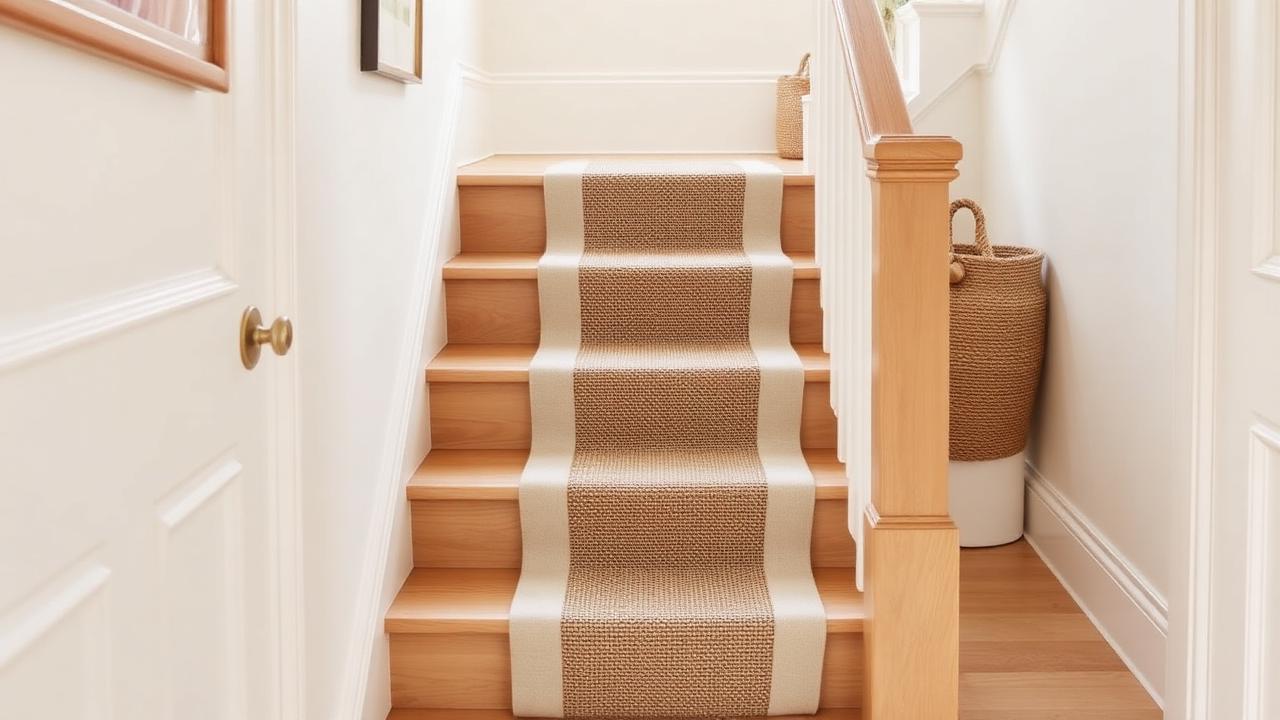
- Keep the walls plain. Houndstooth plus patterned wallpaper is one pattern too many in a narrow hall.
- Bind the edges in a solid colour drawn from the darker tone; a contrast binding fights the check.
- Brass rods suit warm colourways such as chocolate and camel; matt black or nickel suits monochrome.
- Paint the exposed tread margins and strings a single flat colour so the runner is framed cleanly.
- If the hallway floor is also patterned, run the runner in a tone-on-tone houndstooth instead.
Care and repair
Treat it like any wool runner: vacuum weekly with the beater bar off if the pile has loops, blot spills immediately, and have it hot-water extracted every couple of years. The one pattern-specific point is repairs. A patch in a plain runner is nearly invisible; a patch in a houndstooth must be cut with the check aligned, which means you need an offcut at least twice the size of the damage. Keep a metre of spare material from the original dye lot and label it with the date and colourway.
Know your numbers in 30 seconds
Enter your step count, tread depth and riser height — the stair runner calculator gives you the exact length to order, in metres and feet, with waste included.
Open the stair runner calculatorWhatever you decide, get the numbers first: the stair runner calculator doubles as a stair runner length calculator, adding nosing wrap, landings, winders, pattern repeat and waste so you order the right length the first time.
Still deciding on material, width or pattern? Our hub on stair runners compares weaves, widths, backings and fitting styles side by side, then hands the numbers straight to the calculator.
Frequently asked questions
Does a houndstooth stair runner date quickly?
The pattern itself is over a century old and has stayed in continuous use, so it dates far more slowly than trend geometrics. What dates is the colourway — a very high-contrast black and cream feels of its moment, while charcoal on oatmeal or navy on ivory stays quiet for longer.
How much extra material does houndstooth need?
One full pattern repeat on top of your measured length for a classic 3 to 6 cm check, and two repeats plus around 10 per cent for anything over 10 cm, especially if the runner has to be matched across a landing join.
Is it safe on stairs for older users?
Choose a lower-contrast colourway and make sure the nosing line stays readable. Strong repeating high-contrast checks can make it harder to judge where each tread edge is, which matters most for anyone with reduced vision.
Can a houndstooth runner be used with stair rods?
Yes, and it works well because the straight horizontal rod contrasts with the broken check. Position the rod tight into the crotch of each step so it does not distort the pattern across the riser.
What width suits a houndstooth pattern best?
Wide enough for at least five complete shapes across the runner. On a standard 36 inch staircase with a classic 4 to 6 cm check, a 27 to 30 inch runner gives the pattern room without crowding the exposed timber margins.
Is printed houndstooth ever acceptable on stairs?
Only on a very low-traffic flight such as an attic or a guest annexe. On a main staircase the print wears off the nosings first, leaving a pale line on every step within a couple of years.
Know your numbers in 30 seconds
Enter your step count, tread depth and riser height — the stair runner calculator gives you the exact length to order, in metres and feet, with waste included.
Calculate my runner lengthReady for real prices?
Get quotes from vetted stair runner suppliers and fitters near you. Free, no account, no obligation.
Every guide is written from hands-on measuring and fitting experience, checked against the calculator’s own maths, and re-reviewed whenever prices or methods change. Read our editorial standards.