
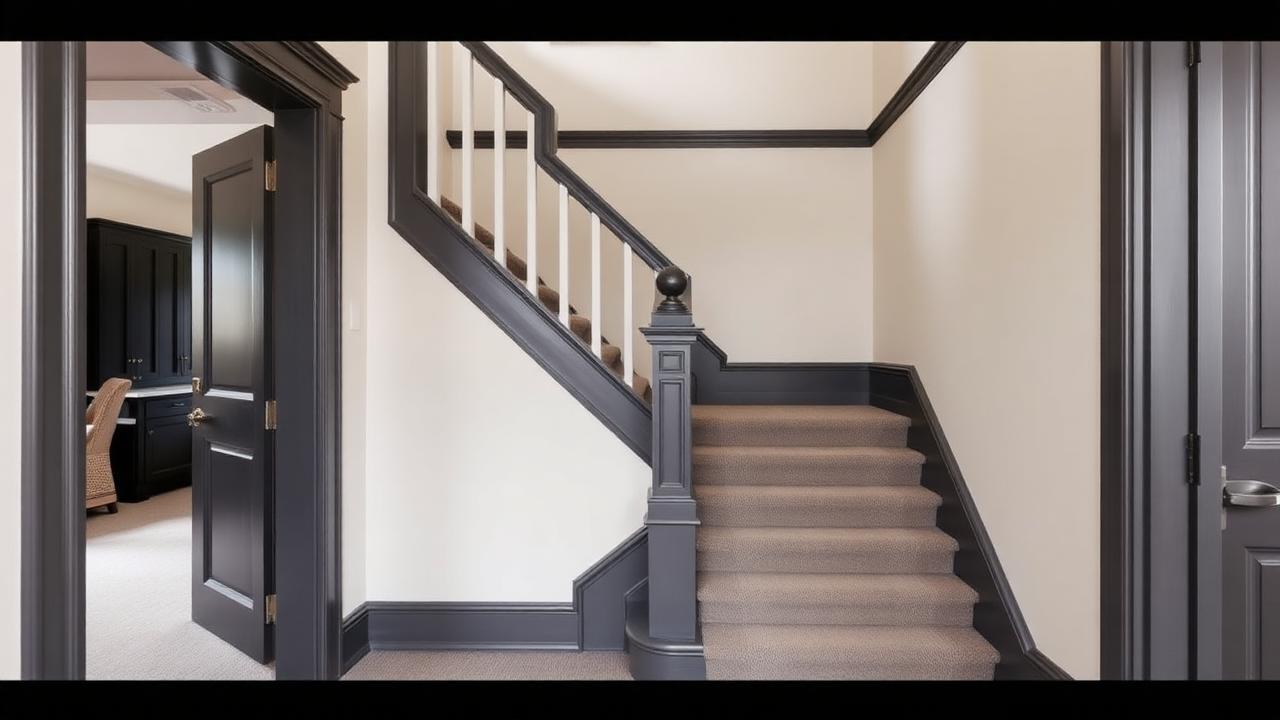
The geometry of the winder turn
Fitting a stair runner on winders—those triangular, tapering steps that navigate a turn—is widely regarded as the pinnacle of the carpet fitter’s craft. Unlike a straight flight where the runner flows in a predictable, linear path, winders require you to manipulate the fabric through a curve, managing the “excess” material on the narrow inside of the turn while maintaining enough tension on the wide outside. If you’ve ever seen a stair runner that looks buckled, twisted, or off-centre as it rounds a corner, you’re looking at a winder installation where the fitter didn’t respect the geometry of the staircase. To get this right, you have to move away from the idea of a single, continuous pull of carpet and instead think in terms of “fanning” and, in many cases, clever cutting and splicing. The goal is to keep the pattern or the weave of the stair runner carpet looking natural, as if it were born to follow that curve, rather than being forced into it.
Before you even think about picking up your knee kicker, you must decide on your method: the continuous fan or the cut-and-turn. On a shallow winder with plenty of depth on the narrow side, a continuous fan is possible. This involves kicking the carpet at an angle, essentially stretching the outside edge more than the inside. However, on most UK Victorian or Edwardian winders, the “point” of the triangle is too sharp for this to work without the carpet bunching up into a bulky, ugly mess at the inner stringer. In these cases, we use the “cut-and-turn” method. This involves installing the runner as a series of individual pieces, one for each winder, where the join is hidden in the “crotch” of the step (the join between the tread and the riser). By cutting the carpet at each step, you can reset the alignment, ensuring that the runner stays perfectly centred and the pile remains vertical. This is much easier to calculate if you use a stair runner calculator beforehand, as it helps you account for the extra “fitting allowance” needed for these individual segments.
Using templates for precision
The secret to a professional winder finish is the template. I never cut my expensive runner material based on a quick tape measurement. Instead, I use a piece of heavy lining paper or a scrap of old carpet to create a perfect “skin” of the winder step. You lay the paper over the tread, push it into the corners, and mark the exact shape of the nosing and the risers. You then transfer this shape to your runner, making sure to add at least 50mm (2 inches) of “extra” on the ends that will be tucked into the joins. This template method ensures that you don’t end up with a “short” corner—a mistake that is impossible to fix once the carpet is cut. It also allows you to align any patterns (like stripes or borders) so they flow gracefully from one step to the next. If you are working with a striped runner, the goal is to have the stripes meet at an angle that looks intentional, often referred to as a “sunburst” effect.
When it comes to the actual installation, you start at the bottom of the winder set. Because you are dealing with asymmetrical shapes, your gripper rods must be placed with extreme precision. I often use several shorter segments of gripper rod on a winder tread, following the curve of the nosing rather than trying to use one long straight piece. The gap between the rod and the riser must remain consistent—typically 12mm to 15mm—to allow for a clean bolster. Once the foundation is ready, you lay your pre-cut piece of runner over the step. You use your knee kicker to stretch the carpet from the inside corner towards the outside. This is counter-intuitive to some, but by starting at the narrowest point and stretching “out”, you ensure that the material is tight and flat across the entire tread surface. Any excess material at the narrow end is then carefully tucked and stapled into the riser-tread join.
Fitter's Tip for Stripes
If you are fitting a striped runner on winders, aim for a “sunburst” pattern where the stripes radiate from the inner corner. This looks far more professional than trying to keep the stripes parallel to the stringer.
How much runner do I need?
Calculating the length for winders is more complex than for a straight flight. For a 13-step flight with 10 straight steps and 3 winders in the US: The 10 straight steps (10 in tread + 7.5 in riser + 1 in wrap) take 18.5 in each, totalling 185 in. The 3 winders, however, should be measured along their widest point (the outside edge). A typical winder might be 18 in deep at the outside edge with a 7.5 in riser and 1 in wrap, totalling 26.5 in per winder. 3 winders at 26.5 in is 79.5 in. Combined with the straight steps, the subtotal is 264.5 in (22.04 ft). Add 24 in for finishing and a 15% waste margin (higher for winders), and you need approximately 27.6 ft of stair runner carpet.
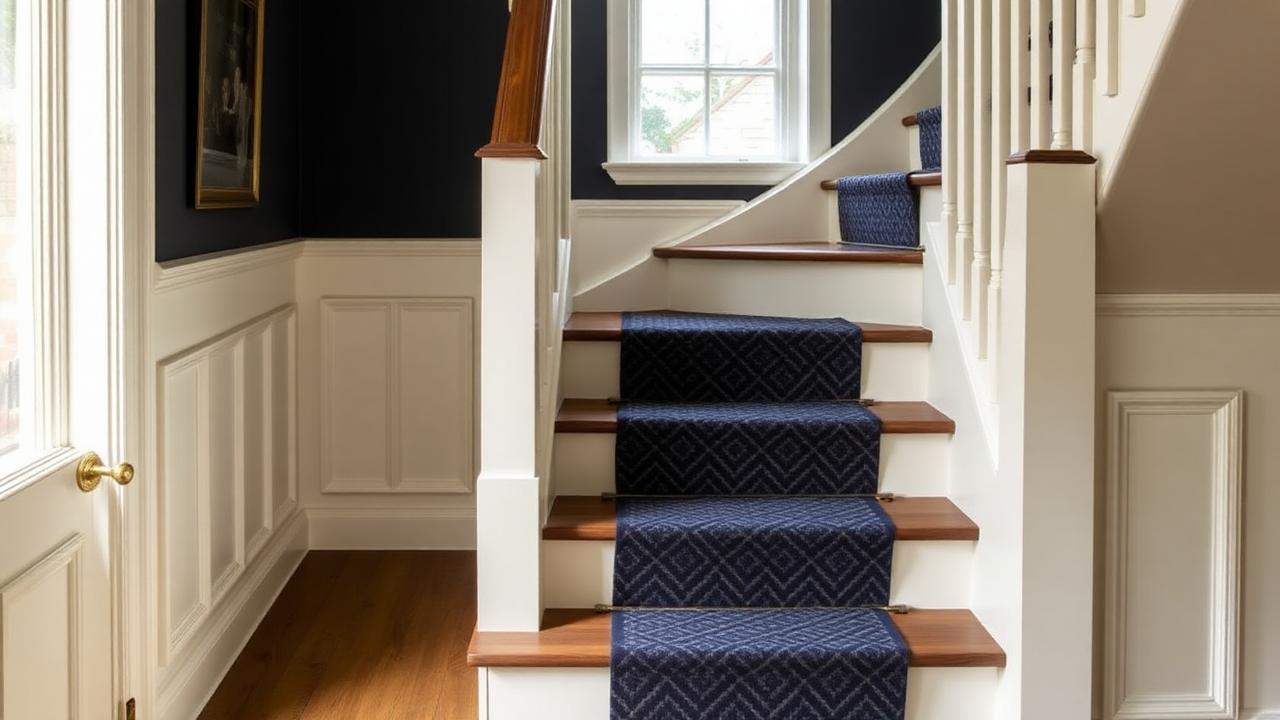
In the UK, for 10 straight steps (25 cm tread + 19 cm riser + 2.5 cm wrap) you need 46.5 cm each, total 465 cm. For the 3 winders, measuring 45 cm at the widest point plus 19 cm riser and 2.5 cm wrap gives 66.5 cm per winder, total 199.5 cm. Subtotal is 664.5 cm. Adding 60 cm for finishing and a 15% waste margin, the total order should be around 8.33 metres. Always use a stair runner length calculator to double-check these estimates based on your exact stair dimensions.
| Step Type | US Length (in) | UK Length (cm) |
|---|---|---|
| Straight Step (ea) | 18.5 in | 46.5 cm |
| Winder Step (ea, max) | 26.5 in | 66.5 cm |
| 10 Straight + 3 Winders | 264.5 in | 6.65 m |
| Total with 15% Waste | 27.6 ft | 8.33 m |
Know your numbers in 30 seconds
Enter your step count, tread depth and riser height — the stair runner calculator gives you the exact length to order, in metres and feet, with waste included.
Open the stair runner calculatorManaging tension and the “drift”
One of the most challenging aspects of winders is managing the “drift”. Because the carpet is being pulled at an angle, it wants to naturally slide away from the centre line. To combat this, I mark a centre line on the riser and the tread of every winder step. After every kick of the tool, I check my marks. If the runner has drifted even 5mm, I pull it back and re-set. On a 13-step flight with three winders in the middle, a 5mm drift on each winder would leave you nearly 2cm off-centre by the time you reach the straight steps above. This is why professional fitters spend so much time on the preparation and marking out. Using a laser level can be a godsend here, as it provides a constant vertical reference line that doesn’t get covered by the carpet as you work. It’s also worth consulting a stair runner calculator to ensure you’ve ordered enough material for these complex cuts, as winders can consume 20-30% more carpet than a straight step due to the waste produced by the triangular shapes.
- Always create a paper template for each individual winder step.
- Measure the runner length along the outside (longest) edge of the winder.
- Start stretching from the narrow inside corner towards the wide outside edge.
- Use a laser level or chalk line to maintain a consistent centre line.
- Increase your staple count on winders to manage the uneven tension.
Finishing and detailing the turn
The finishing of a winder is where the true quality of the job is revealed. The “tucks” where the carpet meets the stringers should be tight and clean, with no visible raw edges. I use a specialized stair tool or a heavy bolster to drive the carpet deep into the corners. If you are using stair rods, they can be a bit tricky on winders because the distance between the brackets will vary on the inside and outside of the turn. In some cases, you may decide to skip the rods on the winders altogether for a cleaner look, or you can use shorter rods specifically for the turn. Regardless of the aesthetic choice, the mechanical security of the runner is paramount. I use more staples on a winder than on any other part of the staircase, placing them every 30mm (1 inch) along the join to ensure that the uneven tension of the turn doesn't cause the carpet to shift over time.
Finally, let’s talk about the “wrap”. On the nosing of a winder, the carpet has to bend in two directions at once. This can cause the pile to “grin”—that’s when the backing shows through the fibres. To prevent this, I always choose a high-density, high-quality stair runner carpet for winders. If you are using a cheaper, low-density material, you may need to “double-tuck” the nosing or use a specialized adhesive to keep the fibres closed. Once the winder is in, take a moment to stand back and look down the flight. The lines of the runner should feel like they are flowing naturally around the corner. If anything looks “forced” or “sharp”, it’s usually a sign that the tension is uneven. Fitting a runner on winders is a slow, methodical process, but when done correctly, it transforms a utilitarian staircase into a stunning architectural feature that anchors the entire home.
Whether you are a DIY enthusiast or a professional, mastering the winder is about patience. It is the part of the job that cannot be rushed. By using the right tools—like a high-quality knee kicker and a sharp bolster—and following these professional techniques, you can ensure that your stair runners look as good on the turns as they do on the straight runs. Remember that the foundation is everything; spend the extra time on your gripper placement and your underlay, and the carpet fitting itself will become much more manageable. A perfectly fitted winder section is the mark of a true craftsman, providing not just beauty but the absolute safety that every home deserves.
In my twenty years of fitting, I have seen many people try to skip the templating stage on winders, thinking their eye is good enough to cut on the fly. It never is. The small variations in the timber of the stairs mean that each winder is unique. If you treat each one as its own mini-project, with its own template and its own tension plan, you will achieve a result that stands the test of time. Don't forget to check the overall length of your runner frequently; it's easy to get absorbed in the winder and forget that you still have a landing to reach. Keep your stair runner length calculator handy and keep checking those marks.
Frequently asked questions
Can I fit a stair runner on winders in one piece?
While possible on very shallow turns, it's generally not recommended for most UK winders. The carpet will bunch up at the narrow end. A professional “cut-and-turn” method, where each winder is a separate piece, results in a much flatter and safer finish.
How do I measure the length for winders?
Measure along the outside (longest) edge of the triangular step. Add the riser height and the nosing wrap to this measurement. Always add a 15-20% waste margin for winders to account for the triangular cuts.
What is the “fanning” technique?
Fanning involves stretching the carpet more on the outside edge than the inside edge to follow the curve of the stairs. It requires a knee kicker and significant skill to avoid buckling or twisting the material.
Do I need special tools for winders?
You need the standard kit (knee kicker, bolster, stapler), but a laser level and heavy lining paper for templates are highly recommended for achieving the precision required on winders.
How do I keep the pattern straight on a turn?
Use a centre line marked on every step and use a paper template to pre-align the pattern before cutting. Stripes should be “sunburst” from the inner corner for the best look.
Will a stair runner on winders be slippery?
If fitted correctly with high tension and quality underlay, it is no more slippery than on a straight flight. The key is ensuring the carpet is flat and has no loose sections.
Can I use stair rods on winders?
Yes, but they can be tricky. You may need different length rods for the winders, or you can opt for a cleaner look without rods on the turns.
How long does it take to fit a runner on winders?
Expect each winder to take 30 to 60 minutes, compared to 15 minutes for a straight step. The extra time is spent on templating, precise cutting, and managing tension.
Know your numbers in 30 seconds
Enter your step count, tread depth and riser height — the stair runner calculator gives you the exact length to order, in metres and feet, with waste included.
Use the stair runner calculator to plan your winder projectReady for real prices?
Get quotes from vetted stair runner suppliers and fitters near you. Free, no account, no obligation.
Every guide is written from hands-on measuring and fitting experience, checked against the calculator’s own maths, and re-reviewed whenever prices or methods change. Read our editorial standards.