
Holiday styling
How to hang garland on stairs (without damaging the banister)
A garland on the stairs is the fastest way to make a hallway feel festive, but it is also the decoration most likely to scratch a handrail or pull paint off spindles. The trick is to measure first, fix it with soft ties rather than tape or nails, and build the look in layers.
How much garland do you need?
Measure the handrail from the newel post at the bottom to the top post. Then decide on a style:
- Wrapped around the rail: about 1.5 × the rail length.
- Draped in swags: about 1.3 × the rail length. Deeper swags need more.
- Running straight along the top: the rail length plus 1–2 ft to hang over the newel.
A typical straight staircase with 13 steps has a handrail about 12–14 ft long, so a swagged garland needs roughly 16–18 ft. Garland is usually sold in 6 ft or 9 ft lengths, so plan to join two or three pieces. Overlap the ends by a few inches and hide the join behind a bow.
Not sure how long your rail is? Our stair calculator with diagram gives the stringer length, which is a close match for the handrail length on a straight flight.
Damage-free ways to fix garland
- Zip ties around a spindle or the rail. Use clear or green ones and cut the tails flush. They are the firmest option for heavy, real garland.
- Soft-wire or velvet twist ties: gentle on painted rails and reusable every year.
- Ribbon: ties that hold the garland and become the decoration. Use wired ribbon so the bows keep their shape.
- Command-style hooks under the handrail: only on smooth, sealed wood, and test one first.
Avoid nails, staples and sticky tape on stained handrails. They leave holes and residue that are hard to touch up.
Step by step
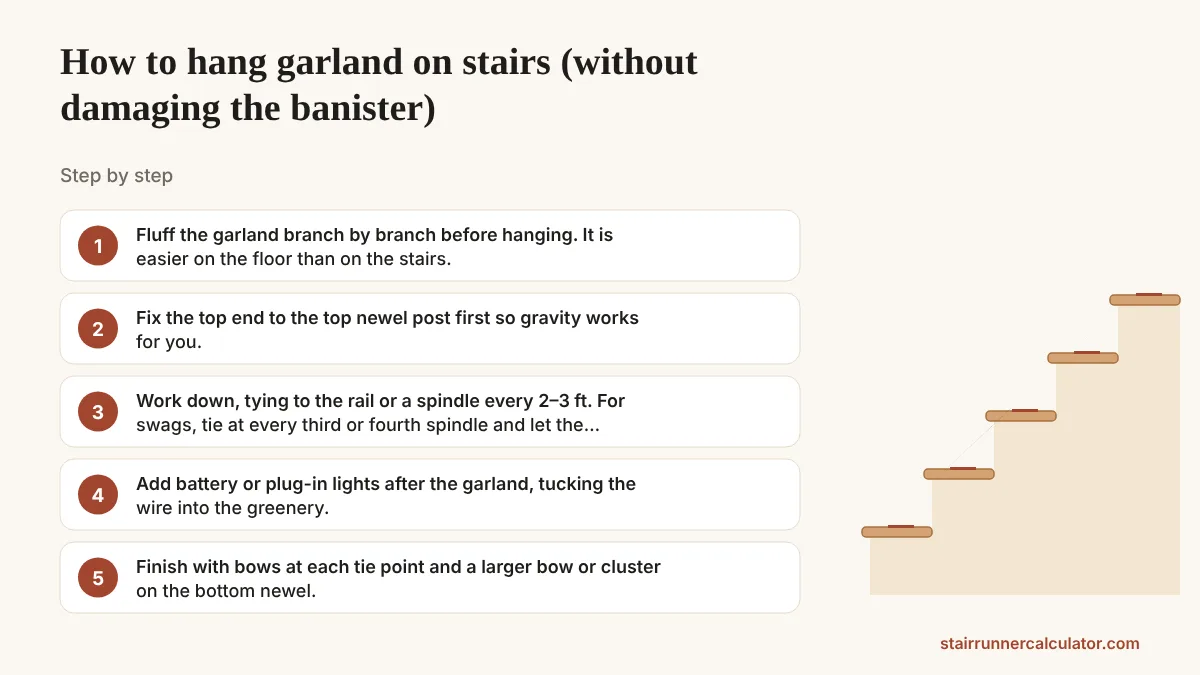
- Fluff the garland branch by branch before hanging. It is easier on the floor than on the stairs.
- Fix the top end to the top newel post first so gravity works for you.
- Work down, tying to the rail or a spindle every 2–3 ft. For swags, tie at every third or fourth spindle and let the garland dip 6–10 in between.
- Add battery or plug-in lights after the garland, tucking the wire into the greenery.
- Finish with bows at each tie point and a larger bow or cluster on the bottom newel.
Safety on a staircase
The handrail still has to work as a handrail. Keep the top of the rail graspable along most of its length by draping the garland on the outside of the spindles or under the rail. Keep cables away from the treads, and switch lights off when you are out. If you have a stair runner, check that no pine needles or ribbon ends are left on the treads, as they can be slippery.
Styling ideas
- Classic: fir garland, warm white lights and red velvet bows.
- Nordic: eucalyptus or cedar, no lights, linen ribbon.
- Modern: a single straight run with brass bells at each tie.
Planning a new stair runner for the new year? Try colours against your banister in the 3D stair runner designer.
Frequently asked questions
How do you attach garland to stairs without damaging them?
Use zip ties, velvet twist ties or ribbon around the spindles and handrail instead of nails, staples or tape. On smooth sealed rails, removable hooks under the rail also work.
How long should garland be for a staircase?
About 1.3 times the handrail length for swags and 1.5 times for wrapping. A 13-step staircase usually needs 16–18 ft of garland for swags.
Is it safe to put garland on a banister?
Yes, if the top of the handrail stays easy to grip, cables are kept off the treads and lights are switched off when unattended.