
Stair basics
Parts of a staircase: names explained with a diagram
Whether you are talking to a carpenter, ordering a stair runner or reading building code, it helps to know what each part of a staircase is called. Here are the main parts, from the floor up.
The steps
- Tread: the horizontal part you step on. Its depth front to back is the tread depth.
- Riser: the vertical board between treads. Its height is the riser height or rise. Stairs without riser boards are open-riser stairs.
- Nosing: the front edge of a tread that overhangs the riser below, usually by ¾–1¼ in. See what is stair nosing.
- Going (run): the horizontal distance from one riser face to the next. This is the number used in stair calculations.
- Bullnose step: a bottom step with rounded ends that sticks out past the stringer.
The structure
- Stringer: the long inclined board that supports the treads and risers. A closed stringer hides the step ends; a cut or open stringer shows the step profile. See how to cut stair stringers.
- Carriage: a hidden middle stringer under wide stairs.
- Landing: a flat platform between flights or at the top or bottom.
- Winders: wedge-shaped treads that turn a corner without a landing.
- Header: the framing at the top of the stairwell that the stringers attach to.
The balustrade (railing system)
- Handrail: the rail you hold, usually 34–38 in above the nosings in the US and 900–1000 mm in the UK.
- Balusters (spindles): the vertical posts between the handrail and the treads or base rail. They are spaced so a 4 in sphere cannot pass. Use the spindle spacing calculator.
- Newel post: the large post at the bottom, top or turn of a stair that anchors the handrail.
- Baserail (string capping): a rail on top of a closed stringer that the balusters sit in.
- Balustrade: the whole assembly of handrail, balusters and newels.
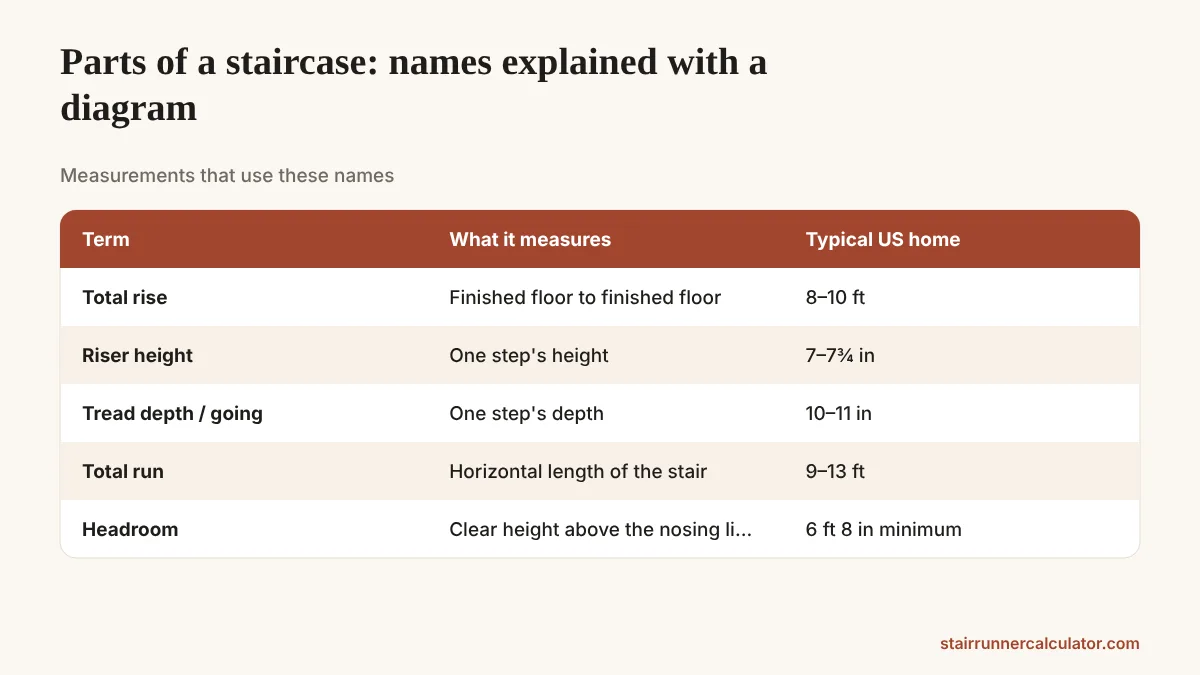
Measurements that use these names
| Term | What it measures | Typical US home |
|---|---|---|
| Total rise | Finished floor to finished floor | 8–10 ft |
| Riser height | One step's height | 7–7¾ in |
| Tread depth / going | One step's depth | 10–11 in |
| Total run | Horizontal length of the stair | 9–13 ft |
| Headroom | Clear height above the nosing line | 6 ft 8 in minimum |
Put the numbers together in the stair calculator with diagram, which draws every part to scale.
Frequently asked questions
What is the part of the stair you step on called?
The tread. The vertical board behind it is the riser, and the front edge of the tread is the nosing.
What are the vertical posts on stairs called?
Balusters or spindles. The large post at the bottom or top is the newel post.
What holds up a staircase?
The stringers, the inclined boards on each side (and sometimes in the middle) that the treads and risers sit on.