
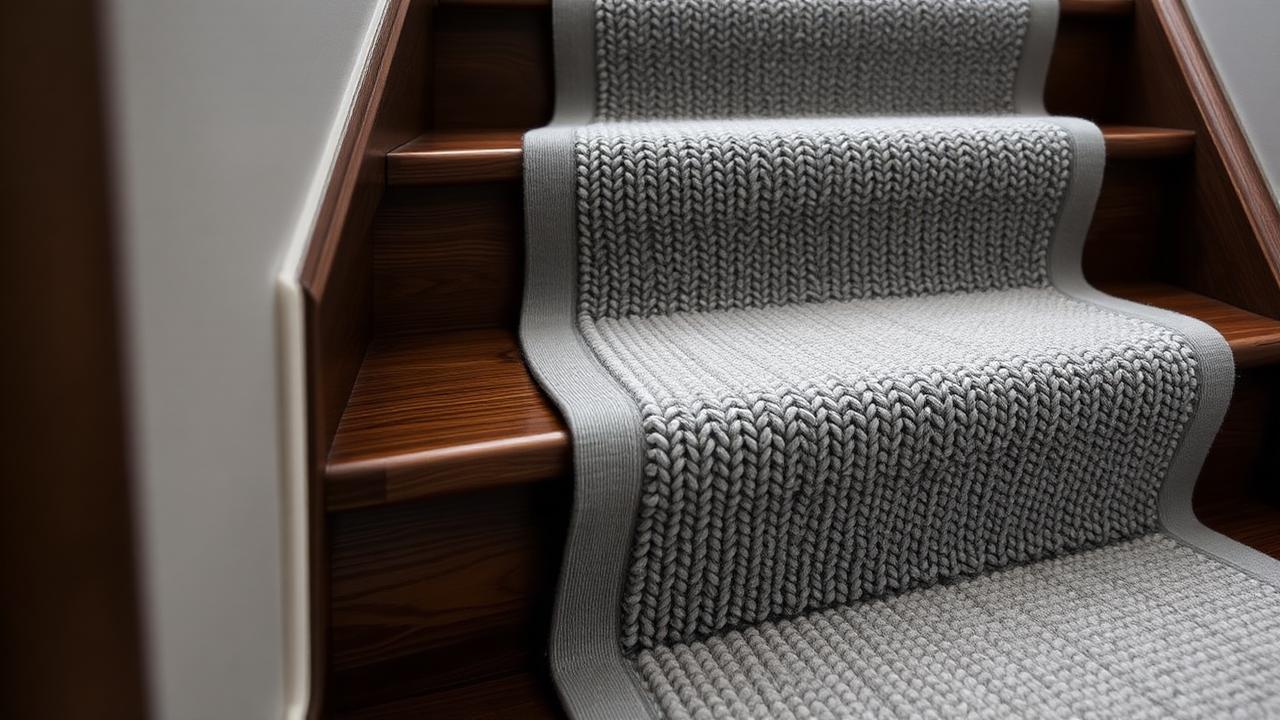
Why wastage isn't just a rounding buffer
It's tempting to treat waste allowance as a vague safety margin, a bit extra just in case, but on a real job it comes from specific, predictable sources: squaring off the ends of the roll, cutting around any flaw in the weave, and, for patterned runners, wasting length at each pattern repeat to keep the design lined up as it travels down the flight. Treating it as a specific calculation rather than a guess means you order close to what you'll actually use, rather than either running short or paying for offcuts you'll never use.
I've seen both mistakes cost real money. A fitter who orders with no waste allowance at all often finds themselves short by a foot or two on a 13-step flight, which means a delay while more material is sourced, sometimes from a different dye lot that doesn't quite match. On the other side, ordering a flat 20% extra “to be safe” on a plain, unpatterned runner wastes money on carpet that will sit in an offcut pile indefinitely.
Sources of wastage on a typical job
The largest single source of wastage on most jobs is squaring the ends of the runner where it starts and finishes, since a roll rarely cuts perfectly straight and a small amount is trimmed at both the top newel post and the base to get a clean, square edge. The second source is any flaw in the weave, a slub, a colour variation, or a manufacturing mark, which needs to be cut around and adds a small amount of extra length depending on where in the roll it falls.
- Squaring the top and bottom ends: typically 2-4% of total length
- Cutting around weave flaws or dye variation: typically 1-2%
- Pattern repeat alignment on patterned or bordered runners: typically 3-6% extra
- Winders and turns needing extra length to maintain a clean line: 2-4% extra on affected sections
- General handling and fitting margin: 1-2% as standard practice
How much runner do I need?
Start with a 13-step US flight: 10 in tread run, 7.5 in riser height, and a 0.75 in nosing wrap allowance per step, giving 18.25 in per step. Across 13 steps that's 237.25 in, or 19.77 ft, plus a 24 in finishing allowance for 21.77 ft. For a plain weave with no pattern, apply a 6% waste margin, bringing the total to roughly 23.1 ft. For a patterned or bordered runner on the same flight, apply a 10% waste margin instead, bringing the total to roughly 23.9 ft, nearly a full foot more on the same staircase.

In UK metric terms, a 25 cm tread run plus 19 cm riser plus 1.9 cm nosing wrap gives 45.9 cm per step, or 596.7 cm across 13 steps, plus a 60 cm finishing allowance for 656.7 cm. A plain weave at 6% waste comes to roughly 6.96 m, while a patterned runner at 10% waste comes to roughly 7.22 m on the same flight. That quarter-metre difference is exactly the pattern-alignment cost discussed above, not a rounding error.
| Runner type | Waste margin | US total | UK total |
|---|---|---|---|
| Plain weave, no pattern | 5-6% | 22.9-23.1 ft | 6.90-6.96 m |
| Textured or looped weave | 6-8% | 23.1-23.5 ft | 6.96-7.09 m |
| Patterned, repeat under 12 in / 30 cm | 8-10% | 23.5-23.9 ft | 7.09-7.22 m |
| Bordered or large-repeat pattern | 10-12% | 23.9-24.4 ft | 7.22-7.36 m |
Know your numbers in 30 seconds
Enter your step count, tread depth and riser height — the stair runner calculator gives you the exact length to order, in metres and feet, with waste included.
Open the stair runner calculatorAsk your supplier for the exact pattern repeat length
A large pattern repeat wastes more length per alignment than a small one. Knowing the repeat in inches or centimetres before you order lets you calculate wastage precisely rather than applying a generic percentage.
Wastage on flights with a turn or landing
Any flight with a winder, dog-leg or half-landing needs a separate wastage calculation for that section, since the geometry doesn't follow the simple per-step arithmetic used on a straight run. On a winder, the runner has to be cut and pieced to follow the tapering tread shape, which typically wastes more material proportionally than a straight step of the same width, often adding 2-4% extra to that section alone. Landings, by contrast, are usually cut from a single piece sized to the landing's actual footprint, and the offcut trimmed from squaring that piece can often be reused on the straight run if you plan the cutting layout before ordering.
Ordering the straight run and the landing or winder section as separate line items, each with its own appropriate waste margin, generally produces a more accurate total than applying one blended waste percentage across the whole flight. A stair runner calculator that lets you enter a landing or turn separately is worth using here, since manual arithmetic across mixed geometry is where measuring errors most often creep in.
What to do with genuine offcuts
Even with an accurate waste calculation, most jobs leave a usable offcut of a foot or two, which is where the “genuinely new” material savings come in if you plan ahead. A leftover length is often enough for a stair runner rug for a landing, a doormat, or a small hallway runner, so it's worth asking your supplier whether they can cut a slightly longer remnant piece deliberately rather than trimming waste to the absolute minimum. This turns what would be scrap into a usable second piece for very little extra material cost, since you're already paying for that length as part of the waste margin regardless.
Whatever the runner style, always calculate the true linear length first, using accurate measurements of tread depth, riser height and step count, before applying any waste percentage. A stair runner calculator does this base arithmetic reliably, and it's a much better starting point than guessing a round total length and then hoping the waste allowance covers any measuring error too.
Whatever you decide, get the numbers first: the stair runner calculator doubles as a stair runner length calculator, adding nosing wrap, landings, winders, pattern repeat and waste so you order the right length the first time.
Still deciding on material, width or pattern? Our hub on stair runners compares weaves, widths, backings and fitting styles side by side, then hands the numbers straight to the calculator.
Frequently asked questions
How much waste should I allow for a plain stair runner?
Around 5-6% is typical for a plain, unpatterned weave, covering squaring the ends and general handling. This is lower than patterned runners because there's no repeat to align down the flight.
Why do patterned stair runners need more waste allowance?
Keeping a repeating motif or border aligned down each step means wasting a small amount of length at each repeat point, which typically pushes the waste margin to 8-10% or more depending on the size of the repeat.
Does a winder need a different waste allowance than a straight step?
Yes, winders often need 2-4% more waste on that section because the tapering tread shape requires more careful cutting and piecing than a standard rectangular step.
Can I reuse offcuts from a stair runner installation?
Often yes. A foot or two of leftover material is frequently enough for a small landing rug or doormat, so it's worth asking your supplier to cut a slightly longer remnant rather than trimming to the bare minimum.
What happens if I don't allow any waste margin at all?
You risk running short by a foot or more on a typical flight, which means a delay while more material is sourced, sometimes from a different dye lot that won't quite match the original.
How do I find out my runner's pattern repeat length?
Ask your supplier directly, since repeat length is usually stated on the product specification. Knowing this in inches or centimetres lets you calculate wastage precisely rather than applying a generic percentage.
Should a landing be calculated with the same waste percentage as the straight run?
Not necessarily. Landings are usually cut from a single piece sized to their footprint and often produce their own offcut, so calculating the landing separately from the straight run tends to give a more accurate total waste figure.
Is it better to overestimate wastage to be safe?
Not by much. Ordering a large flat buffer like 20% on a plain runner wastes money on unused carpet, while an accurate 5-10% margin based on your specific pattern and geometry gets you close to the real figure without excess cost.
Know your numbers in 30 seconds
Enter your step count, tread depth and riser height — the stair runner calculator gives you the exact length to order, in metres and feet, with waste included.
Get an accurate length before waste with the stair runner calculatorReady for real prices?
Get quotes from vetted stair runner suppliers and fitters near you. Free, no account, no obligation.
Every guide is written from hands-on measuring and fitting experience, checked against the calculator’s own maths, and re-reviewed whenever prices or methods change. Read our editorial standards.