

Why New York staircases measure differently
A lot of New York's housing stock predates modern building codes, particularly brownstones and prewar walk-ups, so tread depths and riser heights are often less generous and less consistent than what you'd find in a newer suburban build. It's common to find treads closer to 9 in deep with risers as tall as 8 in on an older stair, steeper and narrower than the 10 in / 7.5 in reference most modern guides use, which genuinely changes both the total length you need and how comfortable a wide runner feels underfoot on a narrow tread. Measure your actual treads rather than assuming a standard figure, since even a half-inch difference per step adds up meaningfully across a full flight.
Co-op and condo buildings sometimes have building rules about what can be fixed to common stairwells, and even inside a private townhouse, a landmarked or historic building may have restrictions on visible fasteners or gripper strips on original stair treads. If you're in a co-op, a condo, or a designated historic building, check with your building management or landmarks office before assuming you can staple gripper straight into original wood, since some buildings require specific stick-down methods or restrict changes to common areas entirely.
How much runner do I need?
For a typical New York brownstone flight, steeper than average at 9 in tread run and 8 in riser height across 14 steps, with a 0.75 in nosing wrap, that's 17.75 in per step, times 14 steps for 248.5 in, or 20.7 ft. Add a 24 in top-and-bottom finishing allowance to reach 22.7 ft, then apply a 7% waste margin, landing at roughly 24.3 ft, a touch more than the standard 13-step reference figure because of the extra step and the steeper riser.
In UK metric terms, that's a 23 cm tread run and 20.3 cm riser height across 14 steps, with a 1.9 cm nosing wrap giving 45.2 cm per step, or 6.33 m across 14 steps. Add 60 cm finishing allowance for 6.93 m, then a 7% waste margin for roughly 7.41 m. If your building instead has a more standard modern flight at 13 steps with 10 in / 25 cm treads, use the more common 23-24 ft (7-7.3 m) figure instead, since brownstone-specific steepness doesn't apply to every New York property.
| Flight profile | Steps | Estimated length (US) | Estimated length (UK) |
|---|---|---|---|
| Modern standard flight | 13 | 23-24 ft | 7-7.3 m |
| Steeper prewar/brownstone flight | 14 | ~24.3 ft | ~7.4 m |
| Shorter half-flight to a landing | 7 | ~13.5 ft | ~4.1 m |
Know your numbers in 30 seconds
Enter your step count, tread depth and riser height — the stair runner calculator gives you the exact length to order, in metres and feet, with waste included.
Open the stair runner calculatorCheck building rules before you fit anything
In co-ops, condos and landmarked buildings, confirm what fastening method is allowed on the actual stair treads before ordering gripper strip or planning a staple-down install. Some buildings require stick-down or clip systems specifically to avoid damaging original wood.
Typical cost ranges in the New York market
Labour rates in New York City run higher than the national average for most home trades, and stair runner fitting is no exception, so where a national typical range might sit at $5-$15 per linear foot for installation, expect New York quotes to often land toward the upper half or slightly above that range. Material cost per square foot doesn't vary as much by region since it's largely driven by manufacturing and shipping rather than local labour, so the biggest local cost swing you'll see is in the labour line, not the carpet itself.
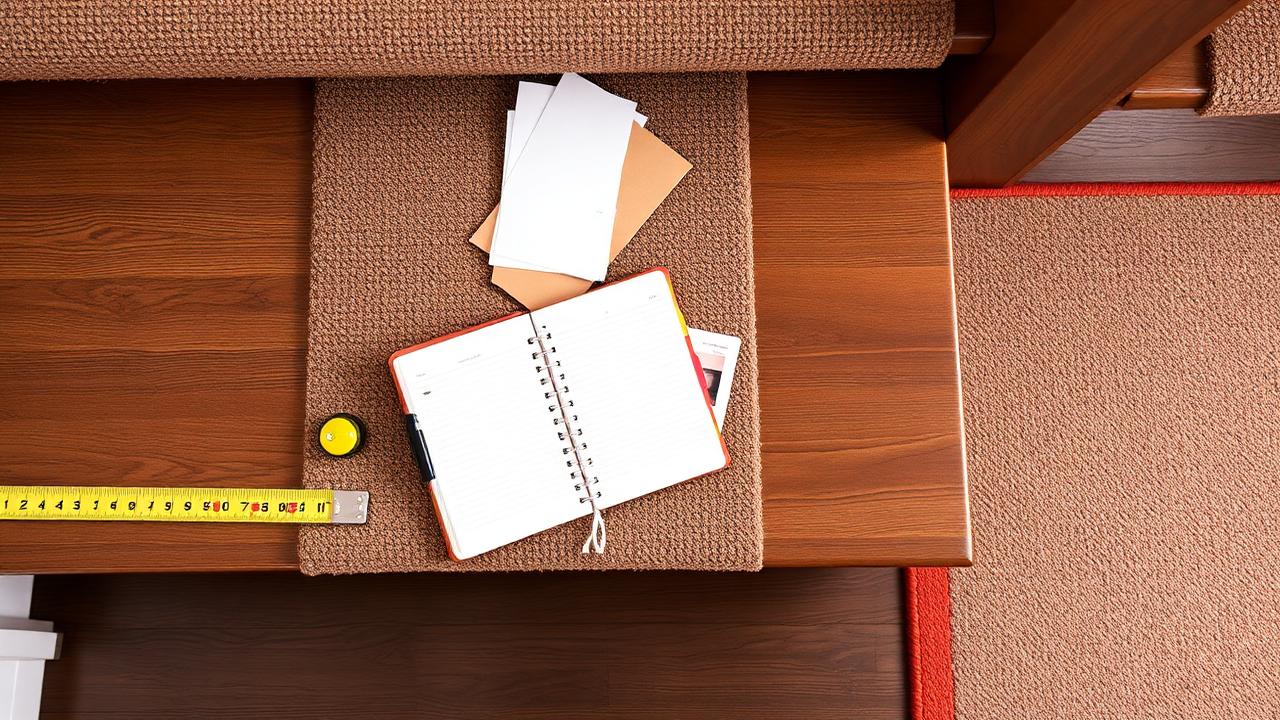
- Get at least two quotes from fitters who've specifically worked on older or prewar buildings if that's your property type.
- Ask whether the quote includes protecting original wood treads and banisters during the fit.
- Confirm whether building management needs to sign off on the work in advance for co-ops and condos.
- Ask what fastening method they plan to use on original wood, staple, stick-down, or clip system.
- Request a written itemised quote covering material, underlay, fitting and any old-carpet removal separately.
Vetting a local fitter properly
Ask any fitter you're considering how many stair runner installs they've done in older New York housing specifically, since the skills needed on an out-of-square, century-old brownstone staircase are genuinely different from a straightforward job in newer construction. Ask to see photos of previous work on a similar flight, ask whether they carry insurance in case of accidental damage to original woodwork, and ask directly how they handle treads that are out of square or uneven, since almost every prewar stair has some irregularity worth planning for rather than discovering mid-job.
Before any quote conversation, measure your own flight and run it through a stair runner length calculator so you walk into the discussion with your own numbers rather than relying entirely on the fitter's on-site estimate. It also helps when comparing two quotes, since you can check both fitters priced against roughly the same length rather than one guessing high and one guessing low. Stair runners in older New York homes are a genuinely worthwhile upgrade, softening noise between floors and protecting original wood treads, but getting the sizing and the fitter vetting right up front avoids most of the common problems people run into.
Whatever you decide, get the numbers first: the stair runner calculator doubles as a stair runner length calculator, adding nosing wrap, landings, winders, pattern repeat and waste so you order the right length the first time.
Frequently asked questions
Are New York staircases different from standard US dimensions?
Many are, particularly in brownstones and prewar buildings, where treads are often closer to 9 in deep with risers up to 8 in tall, steeper and narrower than the 10 in / 7.5 in figures used in general sizing guides. Measure your actual stairs rather than assuming a standard dimension.
Do co-op buildings restrict stair runner installation?
Some do, especially around fastening methods on shared or original wood staircases. Check with building management or a landmarks office before assuming gripper strip can be stapled directly into original treads in a co-op, condo or historic building.
Is stair runner installation more expensive in New York than elsewhere?
Labour costs in New York typically run higher than the national average, reflecting local rates for most home trades, while material cost per square foot doesn't vary as much by region. Get local quotes rather than relying on a national average figure.
How much runner do I need for a typical brownstone staircase?
For a steeper 14-step brownstone flight with 9 in treads and 8 in risers, expect to need roughly 24-24.5 ft (about 7.4 m), slightly more than the standard 13-step reference figure because of the extra step and steeper riser height.
What should I ask a New York fitter before hiring them?
Ask how many older or prewar buildings they've worked on, whether they carry insurance, how they handle out-of-square treads, and what fastening method they'll use on original wood. Ask for a written itemised quote covering every part of the job.
Do I need permission from my building to install a stair runner?
In many co-ops and condos, yes, especially for anything affecting shared stairwells or requiring approval for work in common areas. Check your building's rules before scheduling installation to avoid a delay or dispute later.
Can I fit a stair runner myself in an older New York home?
It's possible on a straightforward straight flight, but original wood treads that are out of square or already fragile make DIY riskier than in newer construction. A professional experienced with older buildings is usually the safer choice for prewar stairs.
How do I compare quotes from different New York fitters fairly?
Measure your flight yourself first using a stair runner calculator, then request itemised quotes covering material, underlay, fitting and old-carpet removal separately from each fitter, so you're comparing the same scope of work rather than different bundled totals.
Know your numbers in 30 seconds
Enter your step count, tread depth and riser height — the stair runner calculator gives you the exact length to order, in metres and feet, with waste included.
Get your exact length with the stair runner calculatorReady for real prices?
Get quotes from vetted stair runner suppliers and fitters near you. Free, no account, no obligation.
Every guide is written from hands-on measuring and fitting experience, checked against the calculator’s own maths, and re-reviewed whenever prices or methods change. Read our editorial standards.