
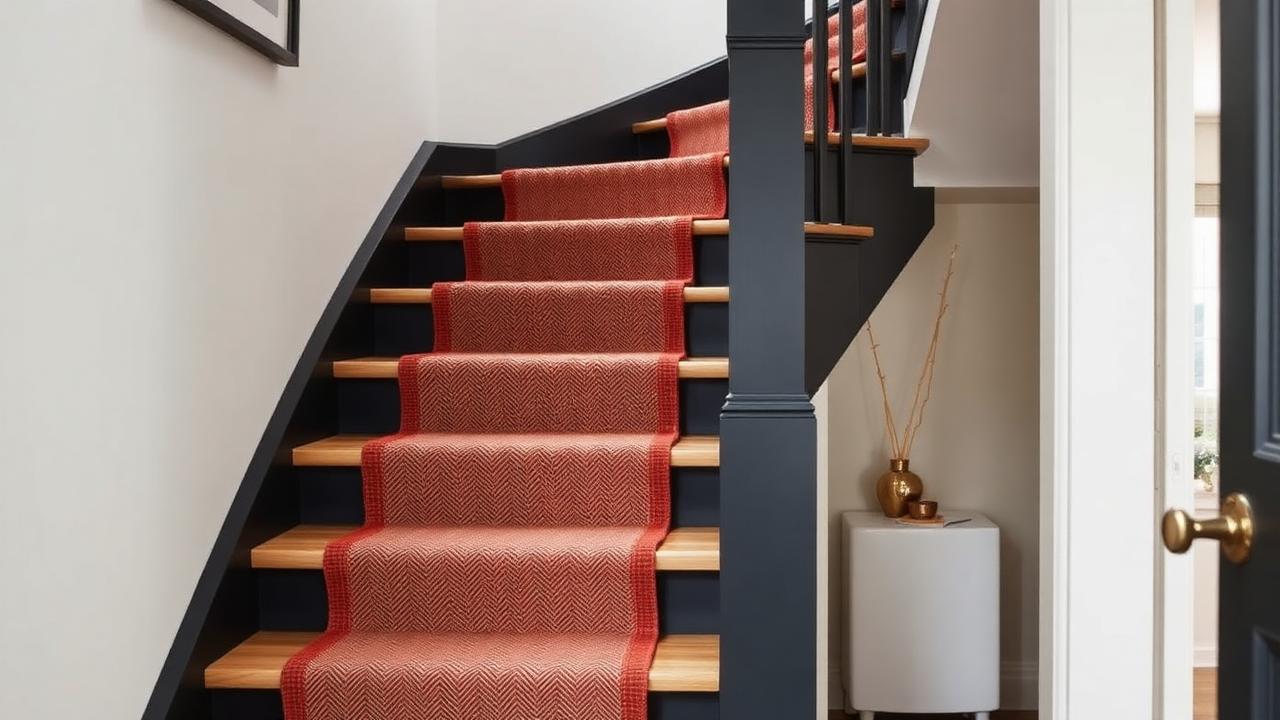
What makes ticking different from a regular stripe
Ticking is defined by narrow, closely spaced stripes, traditionally in two tones, with a repeat measured in millimetres rather than centimetres. On a stair runner this creates a fine textural line rather than a bold graphic band, which is why ticking suits period and farmhouse interiors that want pattern without visual weight.
| Stripe type | Typical repeat | Extra waste allowance |
|---|---|---|
| Ticking stripe (fine) | 1–2 cm / 0.5–0.75 in | 10–15% |
| Standard wide stripe (for comparison) | 10–15 cm / 4–6 in | 5–8% |
Fine repeats need more waste, not less
It seems counterintuitive, but the finer the stripe, the more waste you should budget: small misalignments are still visible at this scale, and cutting a very fine repeat perfectly square at every nosing uses more trial length.
Keeping ticking straight on the stairs
Because the individual stripes are so narrow, a slightly skewed cut is far more visible on ticking than on a wide stripe, since the eye reads dozens of parallel lines and instantly spots one running off true. Careful squaring at every nosing during fitting matters more here than with any other stripe style.
Know your numbers in 30 seconds
Enter your step count, tread depth and riser height — the stair runner calculator gives you the exact length to order, in metres and feet, with waste included.
Open the stair runner calculatorWinders and landings
Ticking on winders is genuinely difficult to keep looking deliberate, since the fine lines have to bend around the angled tread; most fitters recommend either avoiding a full winder section with ticking or accepting a visible change of direction at the pivot point, and budgeting the higher end of the waste allowance, around 15%, for that section.
Colours and where ticking suits
- Classic navy and cream or black and cream ticking suits farmhouse, coastal and period interiors.
- Tonal ticking (two close shades) reads as a subtle texture from a distance and suits transitional schemes.
- Avoid ticking on very narrow stairs where the fine repeat can look like a printed error rather than a pattern.
Cost
Ticking stripe runners typically cost $28-$58 per linear foot installed in the US and £45-£95 per linear metre installed in the UK, in the same range as standard stripes despite the higher waste, since the yarn and weave complexity are similar.
How a ticking stripe runner ages and hides wear
Multi-tonal and broken patterns like ticking stripe disguise the gradual shading that plain-colour runners show first on the nosing and centre of each tread. The pattern itself does not stop pile crushing, but it makes crushed and worn areas far less visible to the eye than a flat colour would, which is why a well-chosen ticking stripe runner often looks presentable for longer between cleans or replacements.

- Rotate a spare offcut into the worst-worn tread if the runner was fitted with a little extra length in reserve.
- Vacuum with a brush head rather than a beater bar so the pattern definition is not flattened prematurely.
- Professional cleaning every 12 to 18 months keeps the pattern's contrast crisp rather than dulled by ground-in soiling.
Budget tiers for a ticking stripe stair runner
Pricing for a ticking stripe runner depends mainly on fibre and weave complexity rather than the pattern name itself, but as a guide, entry-level synthetic versions, mid-range wool-blends and premium bespoke weaves fall into distinct bands worth knowing before you start pricing quotes.
| Tier | US price (installed, per linear ft) | UK price (installed, per linear m) |
|---|---|---|
| Entry synthetic | $18-$32 | £30-£55 |
| Mid-range wool blend | $35-$60 | £55-£100 |
| Premium bespoke weave | $65-$110+ | £110-£190+ |
Choosing a width and border for a ticking stripe stair runner
Runner width interacts directly with a ticking stripe design because pattern elements need enough field to read clearly without looking cropped. Leaving 3 to 4 inches (7.5-10 cm) of exposed stair tread on each side is the most common UK and US convention, and it also means the pattern is not sliced awkwardly at the runner edge. If your stair is narrower than about 32 inches (80 cm), consider a smaller-scale version of the pattern or a plainer border so the design does not feel cramped against the skirting.
- Measure the narrowest tread width first, since winders and half-landings are often tighter than the main flight.
- Order a wider runner than you think if the pattern has a large motif, then trim rather than risk a cropped repeat.
- A contrast binding tape in a coordinating colour reads as a deliberate border and helps disguise minor width discrepancies along the flight.
Underlay, grip and noise control
A patterned runner performs best over a dedicated stair-grade underlay of 8 to 10 mm (about 0.3 to 0.4 in) rather than a thick domestic pad, because thick padding lets the runner move under foot and accelerates edge wear at the nosing. A felt or rubber-crumb stair pad also absorbs impact noise, which matters more on hard tread stairs (wood or stone) than on stairs that already have a soft subfloor.
| Underlay type | Thickness | Best for |
|---|---|---|
| PU foam stair pad | 6-8 mm | Most household stairs, moderate traffic |
| Felt/rubber crumb | 8-10 mm | Hard tread stairs, noise reduction |
| Waffle rubber | 3-5 mm | Thin profile, rod-fixed installs |
Common fitting mistakes with a ticking stripe runner
Most complaints about a patterned runner looking wrong on the stairs trace back to the same handful of avoidable errors during fitting rather than the pattern itself.
- Cutting each tread piece separately instead of dry-laying the whole flight first, which lets small drifts compound unnoticed.
- Starting the fit at the bottom step, so any accumulated misalignment ends up at eye level near the top of the stairs.
- Ignoring the tread nosing radius when centring the motif, causing the pattern to appear to lean on rounded nosings.
- Skipping a proper stair pad to save cost, which shortens the life of both the underlay and the runner face.
- Not allowing for dye-lot variation when ordering extra length later for repairs.
Order a small offcut for future repairs
Keep a 12 to 18 inch (30-45 cm) offcut from the same dye lot when the ticking stripe runner is fitted. It lets you patch a damaged tread years later without a visible colour mismatch, since dye lots are rarely reproduced exactly.
Maintenance schedule for a patterned runner
A consistent care routine keeps a ticking stripe runner looking sharp for longer and protects the investment in fitting. Because the busiest treads (roughly the middle third of the flight) wear fastest, build your cleaning and inspection habits around those steps specifically rather than treating the whole run identically.
| Task | Frequency | Why it matters |
|---|---|---|
| Vacuum with brush head | Weekly | Removes grit before it abrades the pile |
| Check edges and rods/tackless strips | Every 3 months | Catches lifting edges before they trip or fray |
| Professional deep clean | 12-18 months | Restores colour contrast and removes ground-in soil |
| Rotate spare offcut into worst tread (if fitted with reserve) | As needed, 3-5 years | Evens out wear across the flight |
Whatever you decide, get the numbers first: the stair runner calculator doubles as a stair runner length calculator, adding nosing wrap, landings, winders, pattern repeat and waste so you order the right length the first time.
Still deciding on material, width or pattern? Our hub on stair runners compares weaves, widths, backings and fitting styles side by side, then hands the numbers straight to the calculator.
Frequently asked questions
What width should I choose for a ticking stripe stair runner?
Leave roughly 3 to 4 inches (7.5-10 cm) of stair tread exposed on each side as a starting point, adjusting narrower for tight stairs or wider for a grander look on wide flights.
What underlay works best under a ticking stripe runner?
A stair-specific felt or rubber-crumb pad of 8 to 10 mm gives the best balance of grip, noise reduction and pattern stability compared with thicker domestic padding.
Should I keep an offcut after fitting?
Yes. A 12 to 18 inch offcut from the same dye lot lets you repair a damaged tread later without a visible colour mismatch, since exact dye lots are rarely available again.
What is a ticking stripe stair runner?
A runner woven or printed with a fine, closely spaced two-tone stripe, based on historic mattress and workwear ticking fabric. It reads as texture rather than a bold pattern.
How much waste allowance does ticking stripe need?
Around 10 to 15%, higher than a standard wide stripe, because the fine repeat makes even small misalignments visible and requires careful squaring at each nosing.
Does ticking stripe work on winders?
It is possible but visually challenging, since the fine lines have to bend around an angled tread. Many installers accept a visible direction change at the winder pivot.
What colours does ticking stripe usually come in?
Classic combinations are navy and cream or black and cream, though tonal two-shade options are increasingly common for a softer, more contemporary look.
Does a ticking stripe suit a narrow staircase?
Yes, its fine, closely spaced lines are one of the most forgiving patterns for a narrow tread since there is no large repeat to visibly misalign.
Know your numbers in 30 seconds
Enter your step count, tread depth and riser height — the stair runner calculator gives you the exact length to order, in metres and feet, with waste included.
Calculate my ticking stripe runnerReady for real prices?
Get quotes from vetted stair runner suppliers and fitters near you. Free, no account, no obligation.
Every guide is written from hands-on measuring and fitting experience, checked against the calculator’s own maths, and re-reviewed whenever prices or methods change. Read our editorial standards.