

Why 26 inches is the default US stocked width
US residential building codes and long-standing carpentry convention converge on 36 inches (3ft, 91.4cm) as the standard clear width for a straight residential staircase. IRC R311.7 sets a minimum stair width of 36 inches above the handrail height for new construction, and the vast majority of American production-built and custom homes from the mid-20th century onward were framed to this exact clear width, sometimes a touch wider. Because so many staircases share this one number, US carpet mills and runner retailers standardised on 26 inches as the width that gives the best-looking, most universally applicable reveal on a 36 inch stair: (36-26)/2 = 5 inches of exposed tread on each side, a proportion widely regarded as the classic, timeless stair runner look. This is why 26in is stocked, pre-bound and ready to ship by more US retailers than almost any other width, and why it is often simply called out as the 'standard' size in catalogues without further explanation.
It is worth being precise about what '36 inch staircase' means in practice. Framers and inspectors measure clear stair width from finished wall surface to finished wall surface, or from handrail to opposite wall if a rail projects into the stairway, and this is not always identical to the distance between the outer edges of the treads themselves if there is base moulding, a half-wall, or a baluster and skirtboard on one or both sides. Always measure the tread itself, wall to wall or string to string, at several points up the flight, because older or hand-built stairs can vary by half an inch or more from top to bottom.
26 inches in metric and UK-equivalent terms
26 inches converts to 66.04cm, universally rounded to 66cm. This does not map neatly onto UK broadloom roll widths, which are conventionally 68cm and 70cm — a UK retailer asked for a '26 inch' runner will typically supply from 68cm roll stock trimmed down, or offer their nearest catalogue size, commonly 65cm or 67cm, as the closest match. If you are ordering from a UK supplier for a US-style 36in staircase, it is worth explicitly stating 66cm rather than relying on the retailer to interpret '26 inch' correctly, since UK stock sizes are numbered differently.
| Region | Nearest stocked width | Typical roll source |
|---|---|---|
| US | 26in (66cm) | Broadloom, 12ft/15ft wide rolls, cut to length |
| UK | 65cm or 67cm | Narrow broadloom, 68cm/70cm rolls |
| Custom/bespoke (either) | Any width in 0.5in / 1cm increments | Cut and bound to order, longer lead time |
Reveal maths across common tread widths
The 26 inch runner earns its 'standard' reputation on a 36 inch stair, but it works across a range of tread widths, not just that one number. On a slightly narrower 32in (81cm) stair, common in some older or secondary staircases, a 26in runner gives (32-26)/2 = 3in per side, still a workable and attractive margin. On a wider 40in (102cm) staircase, the same runner leaves (40-26)/2 = 7in per side, which starts to look generous rather than balanced — at that width many designers prefer stepping up to a 28in or 32in runner instead so the runner does not read as undersized against a substantial staircase.
- Measure clear tread width wall-to-wall or string-to-string at the top, middle and bottom of the flight.
- Subtract your chosen runner width (26in / 66cm) from the smallest measured tread width.
- Divide the remainder by two to get the reveal on each side.
- If the reveal is below 2in (5cm) or above 7in (18cm), reconsider the runner width before ordering.
- Confirm the final figure using the stair runner calculator, which will flag unusually tight or loose reveals automatically.

Buying a 26 inch runner: what to expect
Because 26in is the most heavily stocked size in the US, it is also usually the cheapest and fastest to source: many national retailers carry wool, wool-blend, sisal, and synthetic options pre-bound at 26in with short lead times, sometimes ready to ship same-week, compared with 3-6 week lead times common for custom widths. Typical US fitted pricing for a 26in runner in mid-range wool or wool-blend sits around $22-40 per linear foot including pad and installation, with budget synthetic options starting around $12-18 per linear foot and premium wool or wool-silk blends running $50 per linear foot or more. UK equivalents, ordered as 65cm or 67cm stock, run roughly £30-55 per linear metre fitted for comparable quality, though UK retailers rarely stock the exact 26in/66cm figure as a named size, so expect either a slight width compromise or a custom cut with the corresponding delay.
Standard does not mean universal
26 inches is the most common stocked width in the US specifically because so many staircases are built to a 36in clear width. If your stairs measure noticeably more or less than 36in, do not default to 26in just because it is the easiest to buy — measure first and choose the width that gives the best reveal for your actual tread.
Length planning once width is confirmed
With width settled, move to length using the stair runner length calculator: add the going plus the riser height for every step in the flight, add extra for any landing the runner crosses, and build in a 6-12in (15-30cm) waste allowance for pattern matching and end finishing. On a typical 14-step US flight with a 10.5in going and 7.5in riser, that is (10.5+7.5) x 14 = 252in, or 21ft (6.4m), before waste and finishing allowance, a figure worth confirming against your specific stair geometry rather than assuming it applies universally.
Why 91cm and 68/70cm rolls shape US and UK stocking differently
The 26in standard did not emerge in isolation from how carpet is actually woven. UK broadloom for stair runners is conventionally produced in 68cm and 70cm narrow rolls, both narrower than a 26in (66cm) finished runner would need if cut with minimal waste, which is part of why UK retailers rarely stock 26in as a named size and instead round to 65cm or 67cm. US broadloom, by contrast, is typically woven at 12ft (3.66m) or 15ft (4.57m) wide format and cut lengthwise into whatever runner width is ordered, so a precise 26.00in cut costs the mill nothing extra compared with 24in or 28in — the roll's width is simply divided differently. This structural difference in how the two countries weave carpet is the real reason 26in became the definitive US 'standard' size while having no direct UK equivalent: American manufacturing makes exact-width cutting essentially free, while UK narrow-roll weaving ties stocked sizes to the roll widths themselves.
It also explains why importing a US-style 26in runner into a UK project, or vice versa, is rarely as simple as converting the number. A UK installer working from a US spec sheet calling for a 26in runner should specify 66cm explicitly to their local supplier rather than asking for '26 inches', since the supplier's own catalogue is built around 65cm and 67cm, and a literal 66.04cm cut will usually incur a small custom-cut charge and a longer lead time than picking a stocked size.
36in versus 42in staircases: how the reveal shifts
Not every US staircase is built to the 36in code minimum. Grander entrance staircases and some higher-end production homes are framed to a 42in (1070mm) clear width, and the 26in runner behaves very differently there. On a 36in (914mm) stair, 26in gives the classic (36-26)/2 = 5in reveal per side. On a 42in (1070mm) stair, the same 26in runner leaves (42-26)/2 = 8in (20cm) per side, which most designers consider too wide a margin — the runner starts to look like a narrow ribbon lost on a broad tread rather than a proportionate feature. On a 42in staircase, 32in or even 36in runners are the more usual recommendation, restoring a 3-5in reveal instead.
| Staircase width | 26in runner reveal per side | Verdict |
|---|---|---|
| 32in (813mm) | 3in (7.5cm) | Workable, slightly tight |
| 36in (914mm) | 5in (12.7cm) | Classic, best-proportioned |
| 42in (1070mm) | 8in (20cm) | Too wide — step up to 32in+ |
Installation notes specific to a heavily-stocked standard width
Because 26in is manufactured and bound in high volume, it is also the width most likely to be pre-bound with serged or tape-bound edges ready to fit straight from the box, rather than bound to order after a bespoke cut. This matters for installation timelines: a pre-bound 26in runner in a popular colourway can often be fitted within days of ordering, while a custom width in the same range may need two to three weeks purely for cutting and binding before it ever reaches a fitter's van. When a flight has winders or a half-landing, ask specifically whether the pre-bound stock length is sufficient or whether the winder sections will need a separate, custom-bound piece seamed in at the landing, since standard pre-bound runners are cut to common straight-flight lengths and do not automatically include extra fabric for a turn.
Pre-bound stock moves faster than custom widths
If your project timeline is tight, ask suppliers whether your chosen colourway is available pre-bound at 26in before considering a custom width — the lead-time saving can be a week or more, and 26in is stocked more widely and in more patterns than any other size.
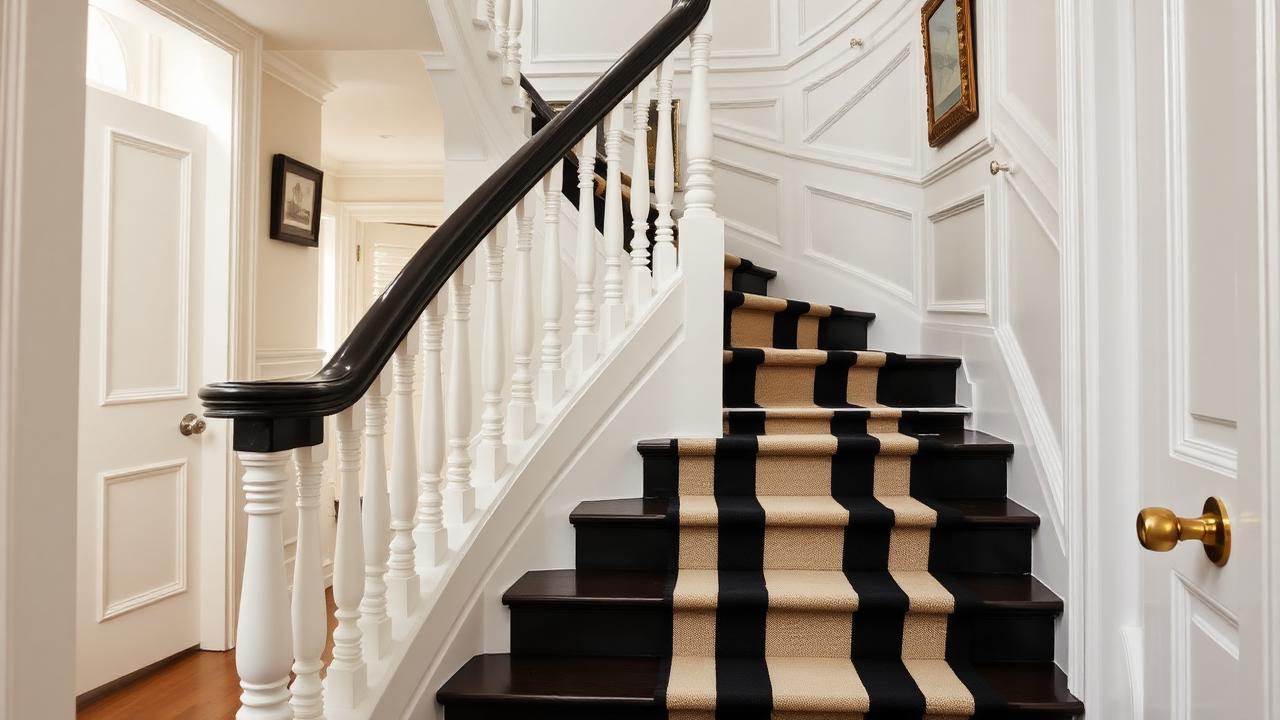
Pattern and border scale at 26 inches
Because 26in is the most widely stocked width, it also carries the widest selection of pattern scales, from fine pinstripes to bold Greek-key borders, and choosing the right scale for this specific width matters more than it might on a bespoke custom cut. A wide, dominant border pattern designed for a 32in or 36in runner can look cramped when squeezed onto a 26in width, with the border consuming a disproportionate share of the visible carpet and leaving very little field pattern showing down the centre. When shopping a 26in range, check the border-to-field ratio shown in the product photography against your own staircase width rather than assuming a pattern that looks balanced in a showroom photo will read the same way on your specific flight.
Directional patterns, such as a herringbone or chevron weave, generally translate well to 26in because the repeat is small enough to sit comfortably within the width without needing to be stretched or compressed to fit. Large-scale florals or oversized geometric prints, by contrast, are more often designed with a 32in or wider runner in mind, so always ask a supplier whether a specific bold pattern is available, and looks proportionate, at the narrower 26in stocked width before ordering.
Humidity and seasonal movement in wool runners at this width
Wool and wool-blend runners, the most common material choice at 26in, expand and contract slightly with seasonal humidity changes, which can occasionally cause a runner fitted tightly in a dry winter to feel very slightly loose by a humid summer, or vice versa. This effect is rarely dramatic enough to require refitting, but on a 26in runner secured with stair rods rather than grippers, it is worth checking rod tension seasonally, since rods hold the carpet by friction and pressure rather than a fixed mechanical grip, and a few millimetres of seasonal movement can be enough to let a rod work slightly loose over a year of use.
Know your numbers in 30 seconds
Enter your step count, tread depth and riser height — the stair runner calculator gives you the exact length to order, in metres and feet, with waste included.
Open the stair runner calculatorWhatever you decide, get the numbers first: the stair runner calculator doubles as a stair runner length calculator, adding nosing wrap, landings, winders, pattern repeat and waste so you order the right length the first time.
Frequently asked questions
Why is 26 inches the standard stair runner width in the US?
US staircases are conventionally built to a 36in clear width under IRC guidance and long-standing carpentry practice, and a 26in runner gives a classic 5in reveal on each side of that width, which is why US mills and retailers stock it more heavily than any other size.
What is 26 inches in centimeters?
26 inches converts to 66.04cm, generally rounded to 66cm. UK retailers do not typically stock this exact figure and will usually offer 65cm or 67cm as the nearest catalogue size, or cut to order at 66cm for a small custom surcharge.
Will a 26 inch runner fit my staircase?
It fits best on staircases with a clear tread width between about 32 and 38 inches, giving a reveal of 3 to 6 inches per side. Measure your actual tread width at several points on the flight and check the resulting reveal before ordering.
How much does a 26 inch stair runner cost fitted in the US?
Expect roughly $22-40 per linear foot fitted for mid-range wool or wool-blend including pad, $12-18 per linear foot for budget synthetic options, and $50 or more per linear foot for premium wool-silk blends, since this width is heavily stocked and competitively priced.
Is 26 inches a common size for UK stair runners too?
Not as a named catalogue size. UK ranges are built around 68cm and 70cm broadloom rolls, so a 26in (66cm) request is usually matched to a 65cm or 67cm stocked width, or cut to the precise 66cm as a custom order.
What reveal does a 26 inch runner give on a 36 inch stair?
(36-26)/2 = 5 inches of exposed tread on each side, which is widely regarded as the classic, best-proportioned reveal for a traditional residential staircase and is the reason 26in became the default stocked width across most US retailers.
Can I use a 26 inch runner on a wider or narrower staircase?
Yes within reason. On a 32in tread it gives 3in per side; on a 40in tread it gives 7in per side. Below 3in the runner starts to look tight, and above 7in it can look undersized, so consider stepping to 24in or 28-32in outside that range.
How do I calculate the length of runner I need at 26 inches wide?
Runner length is independent of width. Add the tread depth plus riser height for every step in the flight, add a landing allowance if applicable, and add 6-12in of waste margin, or use the stair runner length calculator for an instant total based on your step count and dimensions.
Know your numbers in 30 seconds
Enter your step count, tread depth and riser height — the stair runner calculator gives you the exact length to order, in metres and feet, with waste included.
Check your stair runner widthReady for real prices?
Get quotes from vetted stair runner suppliers and fitters near you. Free, no account, no obligation.
Every guide is written from hands-on measuring and fitting experience, checked against the calculator’s own maths, and re-reviewed whenever prices or methods change. Read our editorial standards.