
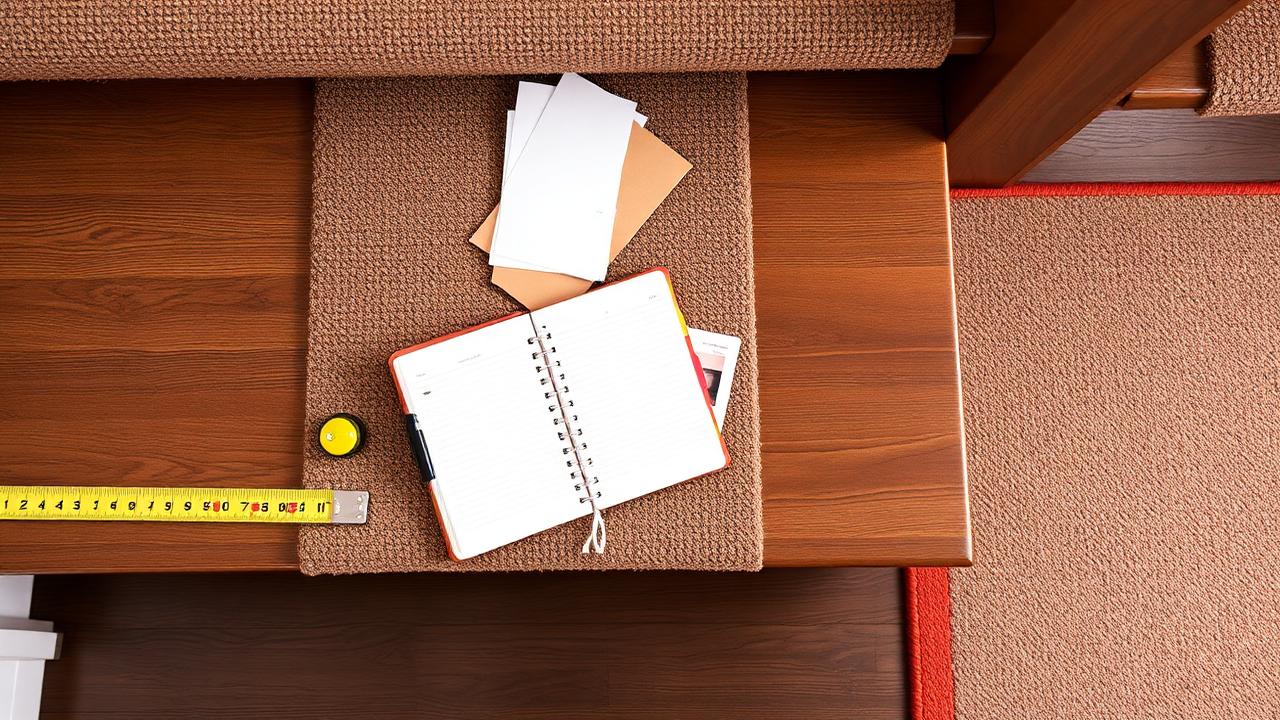
The 3–4 inch reveal rule
The strip of bare stair either side of the runner is called the reveal or the margin. Designers almost universally aim for 3–4in (7.5–10cm) each side. Less than 2in looks like a fitting error; more than 6in makes the runner look mean and stringy on a wide staircase.
Runner width = stair width − (2 × reveal)
A 36in staircase with a 4in reveal each side wants a 28in runner — so you would buy the nearest standard size, 27in.
Standard stair runner widths
| Runner width | Metric | Suits stair width | Reveal each side |
|---|---|---|---|
| 24in | 60cm | 30–32in | 3–4in |
| 27in | 70cm | 33–36in | 3–4.5in |
| 30in | 76cm | 36–38in | 3–4in |
| 32in | 80cm | 38–40in | 3–4in |
| 36in | 90cm | 42in+ | 3in+ |
Know your numbers in 30 seconds
Enter your step count, tread depth and riser height — the stair runner calculator gives you the exact length to order, in metres and feet, with waste included.
Open the stair runner calculatorMeasuring stair width correctly
Measure at the narrowest point of the flight, wall to wall. If one side is open with a balustrade, measure to the inside face of the newel post and spindles — not to the outer edge of the tread, because the runner should not run under the spindles.
When to break the rule
- Narrow staircases under 30in: go as wide as you can and accept a 2–3in reveal — a skinny runner on a narrow stair looks worse than a small margin.
- Grand or period staircases: a wider runner with a generous 4–5in reveal reads as more traditional and lets a decorative stair edge show.
- Very worn or patched stair edges: a wider runner hides more, but check the reveal is even on both sides before committing.
- Patterned runners: centre the pattern, not the physical edge — an off-centre repeat is visible from the bottom of the flight.
Does the reveal have to be equal on both sides?
It should look equal, which is not always the same as being equal. Old staircases are rarely square, and a fitter may split the difference over the length of the flight so the runner appears straight even where the wall is not. Ask your fitter to run a string line before stapling.
Custom widths
Any roll carpet can be cut down and bound or whipped on both edges to make a custom-width runner. Expect to pay for binding by the linear metre on each side, typically a modest addition, and add a week or two of lead time. It is the usual route when your staircase falls awkwardly between standard sizes.
How reveal affects perceived staircase width
A narrower reveal makes a staircase feel wider because more of the visual field is taken up by the (usually lighter) stair timber. A wider reveal draws the eye to the runner as a distinct object and tends to make a hallway feel more furnished and traditional. Neither is right or wrong — it is worth standing at the bottom of your stairs and picturing both before you commit to a width.
Binding and edge finish options
| Edge finish | Look | Typical use |
|---|---|---|
| Serged / overlocked | Neat, thin line | Most cut-down runners |
| Cotton or wool binding tape | Visible contrasting or matching border | Feature runners, period homes |
| Leather binding | Heavy, tailored | High-end wool runners |
| Self-finished (loom edge) | Invisible, no added trim | Pre-made runners only |
Order the binding colour with a sample in hand
Binding tape colour can shift noticeably under stair lighting compared with how it looks on a supplier's screen. Ask for a physical swatch against your actual runner sample before confirming.
Width and safety on open-sided stairs
On an open-sided staircase the runner should never extend under or beyond the balusters — it creates a trip point at the open edge and looks unfinished from below. Measure to the inside face of the spindles, not the outer edge of the tread, and treat that as your absolute maximum width regardless of what the reveal formula suggests.

Matching width across a multi-flight staircase
Where a staircase has more than one flight, use the width of the narrowest flight for the whole run rather than varying the runner width floor to floor. A single consistent width reads as intentional; a runner that steps from 32in to 27in partway up looks like an ordering mistake even when it was a deliberate fit.
Cost impact of width
Wider runners cost more per linear metre because they use proportionally more raw material, typically 10–20% more between a 24in and a 32in width in the same range. Custom cut-down widths add binding cost on top. Use the stair runner cost calculator once you have settled on a width to see the full effect on your budget.
Runner width and stair rods
If you plan to fit stair rods, check the rod length before finalising runner width — rods are sold in fixed lengths (typically 26in, 30in, 34in, 38in) and need to sit just outside the runner's edge, not flush with it. A runner ordered a fraction too wide for the nearest standard rod length will look pinched at the ends, so pick the rod length first if hardware is part of the plan, then work the runner width backward from that.
International width conventions compared
| Region | Narrow | Medium | Wide |
|---|---|---|---|
| US (inches) | 24in | 27–30in | 32–36in |
| UK/Europe (cm) | 60cm | 67–76cm | 80–90cm |
| Typical stair width served | 30–34in | 34–40in | 40in+ |
Convert before comparing prices across regions
A 70cm runner and a 27in runner are close but not identical (70cm is about 27.6in). When comparing a UK and a US supplier, convert to the same unit before assuming either is cheaper for the same coverage.
Width mistakes that are hard to fix after fitting
Two width errors are almost impossible to correct without re-fitting: choosing a runner too wide to clear balusters on an open-sided staircase, and choosing one so narrow that the gripper rod is visible outside its edges. Both come from measuring the tread's outer dimension instead of the true usable width. Double-check your width figure against a straight edge held at the narrowest point of the flight before you order, not just a single tape reading taken quickly at the bottom step.
How width interacts with visual weight
A runner does not just fill a strip of tread — it changes how heavy or light the whole staircase looks from the hallway. On a staircase with slim, painted spindles and a pale handrail, a wide runner with a narrow reveal can visually overpower the delicate joinery. On a staircase with chunky timber newels and a dark stained rail, a narrow runner with a wide reveal can look thin and under-scaled by comparison. Stand back at the bottom of the flight and look at the balustrade and the treads together before settling on a final width, rather than judging width in isolation from a swatch or a single-step sample.
Width and vacuum or cleaning access
A generous reveal is not purely decorative — it also gives you a strip of bare, easily wiped timber either side of the runner, which matters on a staircase that collects dust and pet hair. A reveal under 2.5in is hard to vacuum cleanly with a standard nozzle without repeatedly bumping the runner edge, while a 3.5-4in reveal gives enough room to clean the exposed timber properly without the vacuum head constantly catching on the binding. If low-maintenance cleaning matters more to you than a fully dressed look, lean toward the wider end of the reveal range rather than the narrower end.
Whatever you decide, get the numbers first: the stair runner calculator doubles as a stair runner length calculator, adding nosing wrap, landings, winders, pattern repeat and waste so you order the right length the first time.
Still deciding on material, width or pattern? Our hub on stair runners compares weaves, widths, backings and fitting styles side by side, then hands the numbers straight to the calculator.
Frequently asked questions
What width should a stair runner be?
Most stair runners are 24in, 27in or 32in wide (60cm, 70cm or 80cm). Choose the width that leaves 3–4 inches of bare stair showing on each side of your staircase.
Can a stair runner be too wide?
Yes. If it leaves less than about 2in of stair either side it reads as a full carpet that was cut badly, and it can interfere with the spindles on an open-sided staircase.
What if my staircase is a different width at the top and bottom?
Measure the narrowest step and choose your runner width from that. A good fitter will then align the runner so the reveal appears consistent rather than mathematically identical.
Does runner width affect how much length I need?
No, width and length are calculated independently. Width only changes how much material is used across each step; length depends on the number of steps, tread depth and riser height.
Is a wider runner always more expensive?
Generally yes, because wider runners use more raw material per linear metre. The difference between common widths is usually 10-20% on the per-metre price within the same product range.
Should the reveal be the same on a landing as on the stairs?
Ideally yes, for visual continuity, though landings sometimes allow slightly more flexibility since there is no balustrade constraint. Keep the same runner width through a landing wherever the layout allows it.
Know your numbers in 30 seconds
Enter your step count, tread depth and riser height — the stair runner calculator gives you the exact length to order, in metres and feet, with waste included.
Find my runner widthReady for real prices?
Get quotes from vetted stair runner suppliers and fitters near you. Free, no account, no obligation.
Every guide is written from hands-on measuring and fitting experience, checked against the calculator’s own maths, and re-reviewed whenever prices or methods change. Read our editorial standards.