

What stair width suits a 39in runner
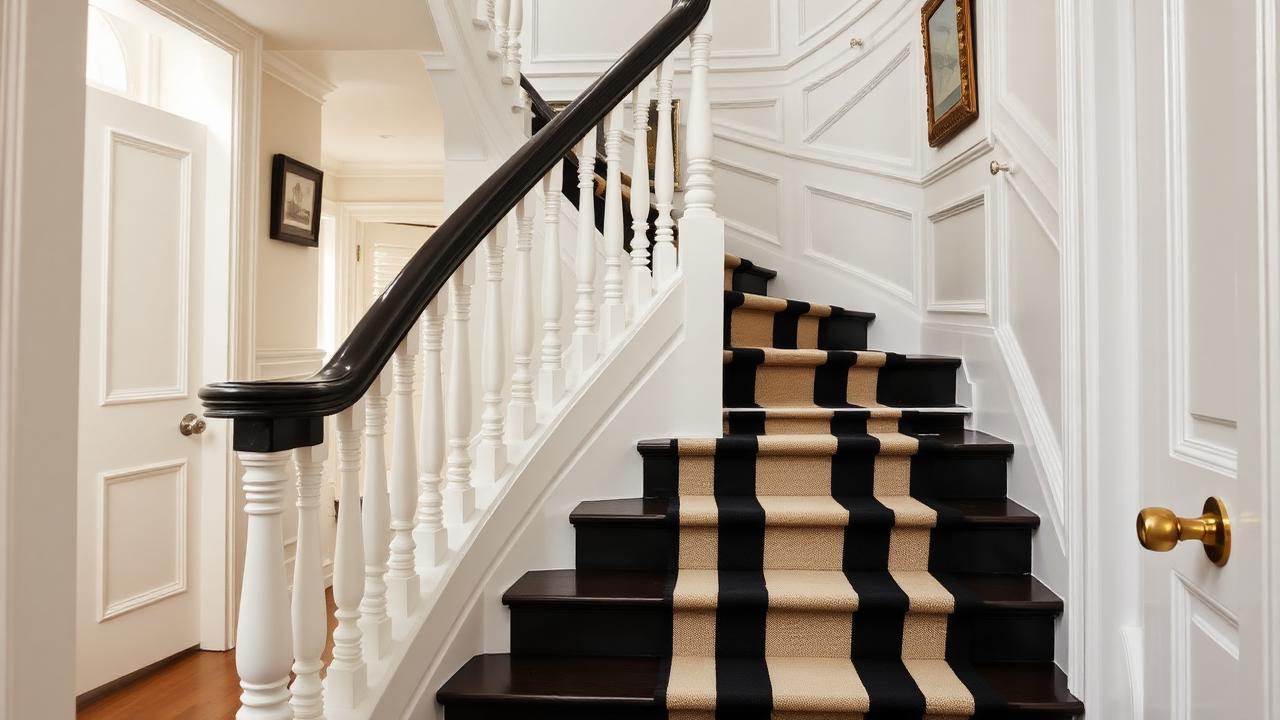
A 39in runner is sized to leave a visible border of bare tread — the 'reveal' — on each side once it is centred and fixed. The comfortable range for that reveal is roughly 2-4.5in (5-11cm) each side; narrower than that and the runner looks jammed against the strings, wider than that and it starts to look lost in the middle of the tread. Working back from that reveal range, a 39in runner suits a staircase that measures 42-47in (107-119cm) stair width between the strings (or between the wall and the baluster on an open side).
| Stair width (strings to strings) | Reveal each side | Verdict |
|---|---|---|
| 38in / 97cm | -0.5in — under 2in | Too tight; runner reads edge-to-edge, no visible frame |
| 42in / 107cm | 1.5in | Minimum comfortable reveal |
| 44in / 113cm | 2.8in | Ideal — balanced reveal |
| 47in / 119cm | 4.0in | Maximum comfortable reveal |
| 51in / 130cm | 6.0in — over 4.5in | Runner looks narrow/lost; step up a size |
Exact reveal maths for your stair
The formula is simple: (stair width − runner width) ÷ 2 = reveal on each side, assuming the runner is centred, which it should be on almost every straight flight. For a 39in runner on a stair measuring, say, 44in between the strings, that's (44 − 39) ÷ 2 = 2.8in of bare tread down each side. Measure the clear width at three points — top, middle and bottom of the flight — because most staircases taper by a few millimetres over their length, and the reveal should be calculated from the narrowest point so the runner never overhangs the tread nosing anywhere.
Measure the narrowest point, not the average
Skirting boards, dado rails and old plaster are rarely perfectly parallel. If your stair width varies between top and bottom, size the runner and its reveal off the tightest measurement — an even reveal that is a little generous at the wide end looks intentional; a reveal that goes negative at the narrow end does not.
Roll widths and metric equivalents
Stair runners are cut from broadloom carpet, so the width you buy is set by the loom width the mill weaves, not by an arbitrary inch measurement. A 39in runner is almost always cut from 100cm (39.4in) — a metric broadloom width common in European mills, sold as 'circa 39in' in English-language catalogues. When comparing products between UK, US and European suppliers, always check the centimetre figure — an 'inch' size is often a rounded label over a genuine metric width, and a difference of a centimetre either way changes your reveal by 5mm each side.
| Roll width (cm) | Inches | Matches 39in runner? |
|---|---|---|
| 56cm | 22.0in | No — narrower |
| 61cm | 24.0in | No |
| 66cm | 26.0in | No |
| 71cm | 28.0in | No |
| 81cm | 31.9in | No |
| 100cm | 39.4in | Yes |
| 120cm | 47.2in | No |
Rod and holder width for this runner
Stair rods and holder bars need to clear the runner by roughly 25-40mm (1-1.6in) in total — about the same overhang on each end, excluding any finials. For a 39in runner that means a rod length (before finials) of roughly 40-40.6in (102-103cm). Confirm this against your actual stair width too — the rod must sit clear of the strings, not just clear of the runner, so on a stair near the top of this runner's range the rod length is set by the string gap rather than by the runner edge. Work out exact holder counts and lengths with the stair runner rods calculator.
Where this width looks wrong
- On a stair narrower than about 39in (99cm): the reveal disappears and the runner reads as wall-to-wall carpet rather than a runner.
- On a stair wider than about 51in (130cm): the runner looks like a narrow strip lost in the middle of a wide tread — step up a size.
- On a staircase with a strong taper: a reveal that is correct at the top and negative at the bottom, so the runner appears to run off the tread.
- Where the newel posts are wide and boxy: a narrow runner beside a chunky post looks under-scaled; measure the reveal against the post, not just the string.
- On winders and curved sections: this straight-flight sizing does not apply — winders need bespoke width planning, usually handled with a template.
Worked yardage example: 16-step flight
Take a flight of 16 steps with a 11in tread depth and a 8in riser height, plus a 5in return onto the landing at the top. The 'going' of carpet needed per step is tread plus riser: 11 + 8 = 19in. Across 16 steps that's 19 × 16 = 304.0in, plus the 5in landing allowance, giving a total run of 309.0in (25.75ft, 7.85m).
| Step | Calculation | Result |
|---|---|---|
| Going per step | 11in tread + 8in riser | 19in |
| Total for 16 steps | 19in × 16 | 304.0in |
| Landing allowance | Fixed extra at the top | 5in |
| Total run | Sum of the above | 309.0in / 25.75ft |
| Waste and pattern-matching allowance | +10% standard allowance | 2.58ft |
| Order length | Total run + waste, rounded up to the yard | 9.4 yards (8.6m) |
Round up, always
Suppliers cut to the yard or metre, not the inch, and re-ordering a short length rarely matches the original dye lot. Round 9.4 yards up to 10 yards and treat the extra as insurance, not waste — it also covers binding take-up and any pattern repeat on a striped or patterned 39in runner.
39in vs the next size up or down
| Width | Best for | Reveal on a typical 32in stair |
|---|---|---|
| 22in / 56cm | Cottage and older narrow staircases | 5.0in — very generous, borderline lost |
| 24in / 61cm | Standard narrow hall staircases | 4.0in — wide but workable |
| 26in / 66cm | Mid-size semi/terrace staircases | 3.0in — comfortable |
| 28in / 71cm | Wider mid-size staircases | 2.0in — comfortable, tighter |
| 32in / 81cm | Wide detached/new-build staircases | 0in — needs a wider stair |
Fitting and stock notes for this width
Because 100cm is a European broadloom standard rather than an imperial stock size, availability varies a lot more by supplier than the more common inch sizes — some ranges only offer it as a special order with a longer lead time and a minimum order length. If your staircase would also work with a 36in (91cm) or 32in (81cm) runner, it's worth comparing lead times and minimum orders across both before settling on the metric size, since the reveal difference is often only a centimetre or two.
Know your numbers in 30 seconds
Enter your step count, tread depth and riser height — the stair runner calculator gives you the exact length to order, in metres and feet, with waste included.
Open the stair runner calculatorBuying checklist for this width
- Measure your stair's clear width at top, middle and bottom; use the narrowest figure.
- Confirm 39in gives a reveal in the 2-4.5in range at that narrowest point.
- Check the supplier's exact cm figure against the 100cm standard for this size, not just the inch label.
- Calculate total run length (tread + riser × steps + landing) and add 10% for waste.
- Round the order up to a full yard or metre and confirm dye-lot consistency for the full length.
- Size rods or holders to roughly 40-40.6in, excluding finials, and clear of the strings.
Whatever you decide, get the numbers first: the stair runner calculator doubles as a stair runner length calculator, adding nosing wrap, landings, winders, pattern repeat and waste so you order the right length the first time.
Frequently asked questions
What stair width suits a 39in runner?
A 39in (100cm) runner suits a staircase measuring roughly 42-47in (107-119cm) stair width between the strings, giving a reveal of about 1.5-4.0in on each side.
How do I calculate the reveal for a 39in runner?
Subtract the runner width from the stair width and divide by two: (stair width − 39) ÷ 2. Measure the stair at its narrowest point so the reveal never goes negative anywhere along the flight.
What roll width is a 39in stair runner cut from?
Almost always 100cm (39.4in) — a metric broadloom width common in European mills, sold as 'circa 39in' in English-language catalogues.
How long a rod do I need for a 39in runner?
Roughly 40-40.6in (102-103cm) excluding finials, provided that length also clears the strings on your actual stair.
Is 100cm the same as 39in?
100cm converts to 39.4in, which is rounded to 39in in most English-language catalogues — close enough that reveal calculations barely change, but confirm the exact figure before ordering if your stair is near the edge of the comfortable range.
When does a 39in runner look wrong?
On a stair narrower than about 39in the reveal disappears and it reads as wall-to-wall carpet; on a stair wider than about 51in it looks like a narrow strip lost on the tread.
How much runner do I need to order for a typical flight?
For a 16-step flight with a 11in tread and 8in riser, expect a total run of about 25.8ft before waste, and around 9.4 yards once the standard 10% allowance is added — always round up to a full yard.
Should I round my order up or down?
Always round up to the next full yard or metre. A short order rarely matches the original dye lot on re-order, and the extra covers binding take-up and any pattern repeat.
Know your numbers in 30 seconds
Enter your step count, tread depth and riser height — the stair runner calculator gives you the exact length to order, in metres and feet, with waste included.
Check my stair widthReady for real prices?
Get quotes from vetted stair runner suppliers and fitters near you. Free, no account, no obligation.
Every guide is written from hands-on measuring and fitting experience, checked against the calculator’s own maths, and re-reviewed whenever prices or methods change. Read our editorial standards.