
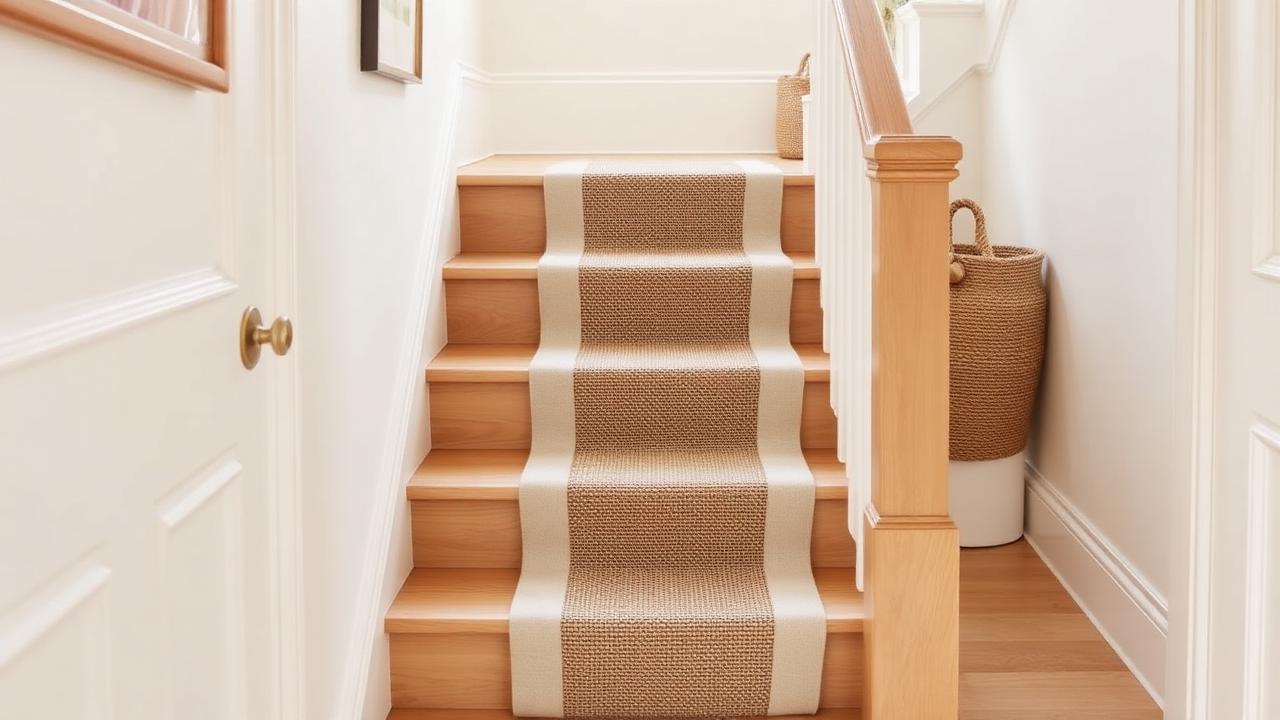
Standard roll widths sold by the foot
| Roll width | Region | Typical use |
|---|---|---|
| 66cm (26in) | UK/Europe | Standard natural fibre width |
| 68cm (27in) | UK/Europe | Most common wool runner width |
| 27in | US | Standard imported runner width |
| 32in | US | Wider standard width |
| 3ft (36in) | US | Wide staircases, less common |
| 4ft (48in) | US | Grand or wide staircases |
Converting linear feet to a stair count
Each step consumes roughly the tread depth plus the riser height, typically 10in tread plus 7.5in riser, or about 1.5 linear feet per step for a closed-riser stair. Add roughly 10 to 15 percent waste for pattern matching, top and bottom finishing, and any turns, plus extra length for a waterfall or hollywood installation style, which uses slightly more or less material respectively per step.
| Number of steps | Linear ft needed (approx, closed riser) | Linear ft with 12% waste |
|---|---|---|
| 10 | 15 ft | 17 ft |
| 13 | 19.5 ft | 22 ft |
| 16 | 24 ft | 27 ft |
| 20 | 30 ft | 34 ft |
Know your numbers in 30 seconds
Enter your step count, tread depth and riser height — the stair runner calculator gives you the exact length to order, in metres and feet, with waste included.
Open the stair runner calculatorOpen riser stairs use far less
On open riser stairs, the runner covers only the tread top and wraps the nosing, with no riser face to cover, so material use drops to roughly tread depth plus 2 to 3 inches per step, often 40 to 50 percent less linear footage than a closed-riser calculation.
- Always order in whole linear feet or metres; most suppliers will not cut to fractional lengths below a minimum.
- Confirm whether the quoted price per foot includes VAT or sales tax and whether cutting and binding are extra.
- Ask for the roll width before ordering rods or measuring your stair width; rods are sized to width, not length.
- Keep any offcut; it is useful for a hallway mat, a small landing patch repair, or a future step repair.
Price per foot varies more with fibre than with length
A budget polypropylene runner might run $10–$20 per linear foot, while a wool or wool-blend runner typically runs $25–$65 per linear foot; length affects total cost linearly, but fibre choice affects the per-foot rate far more.
Buying checklist with price bands
Buying by the linear foot (or metre) means the price you are quoted usually covers carpet only, so always confirm what else is included before comparing two quotes side by side.
| Fibre/tier | Price per linear ft (US) | Price per linear m (UK) |
|---|---|---|
| Budget synthetic | $10-$18 | £14-£25 |
| Mid-range wool blend or sisal | $25-$45 | £35-£65 |
| Premium wool or bespoke weave | $50-$85+ | £70-£120+ |
- Ask whether the per-foot price includes waste allowance, underlay, fitting and rods.
- Confirm the roll width used to calculate the per-foot price, since a wider roll costs more per foot but may need less total length.
- Request the price in both per-foot and total-flight terms so nothing is lost in the conversion.
Common specification mistakes
The most common error buying by the foot is comparing two suppliers' per-foot prices without checking whether they are quoting the same roll width, since a narrower roll can look cheaper per foot but require binding or seaming to reach the same finished runner width.
| Mistake | Consequence |
|---|---|
| Comparing per-foot prices across different roll widths | Apparent savings disappear once binding cost is added |
| Ignoring waste margin when ordering by the foot | Running short mid-installation, needing a rushed reorder |
| Not accounting for pattern repeat when ordering | Extra length needed to match motifs, increasing real cost per foot |
Common buying mistakes when ordering by the foot
- Ordering exact calculated length with no waste margin, then running short mid-fit.
- Forgetting that pattern repeat can force rounding up to the next full repeat, adding length beyond the basic waste allowance.
- Mixing up linear feet (length only) with square feet (length times width) when comparing supplier quotes.
- Not accounting for extra length needed at a top or bottom turn onto a landing.
Trade tip: buy from a single dye lot
When a job needs more linear footage than a single roll section holds, always request matching dye lot numbers across sections. Even small dye variations between lots are highly visible on a stair runner viewed under raking daylight from a landing above, more so than on a flat floor where the eye does not compare adjacent sections directly.

Metric versus imperial ordering
UK and European suppliers typically quote in linear metres and centimetre roll widths, while US suppliers quote in linear feet and inch widths, which can cause confusion when comparing an international supplier's price directly. Always convert to a single consistent unit before comparing quotes, and double check whether a quoted metre price includes VAT, since UK trade and retail pricing conventions differ.
| Conversion | Value |
|---|---|
| 1 linear metre | 3.28 linear feet |
| 1 linear foot | 0.305 linear metres |
| 66cm roll width | 26 inches |
| 27 inch roll width | 68.6cm |
Ordering for a split-level or landing-heavy staircase
Staircases with multiple half-landings or direction changes need more careful linear footage calculation than a simple straight flight, since each landing typically adds a fixed length of flat coverage plus turning allowance that a simple steps-times-average-length formula will underestimate. Always ask a supplier or fitter to measure a split-level stair in person rather than relying on a phone-based estimate for the order quantity.
Ordering extra for future repairs
Buying an additional 3 to 6 linear feet beyond the calculated total, stored flat in a dry place, gives you matching material for a future nosing repair or a small damaged section years down the line, when the original dye lot may no longer be available from the mill. This modest extra cost upfront is cheap insurance against a visibly mismatched patch or a full unnecessary replacement later.
Whatever you decide, get the numbers first: the stair runner calculator doubles as a stair runner length calculator, adding nosing wrap, landings, winders, pattern repeat and waste so you order the right length the first time.
Still deciding on material, width or pattern? Our hub on stair runners compares weaves, widths, backings and fitting styles side by side, then hands the numbers straight to the calculator.
Frequently asked questions
How do I convert linear metres to linear feet for a stair runner quote?
Multiply linear metres by 3.28 to get linear feet, or divide linear feet by 3.28 to get linear metres. Always confirm which unit and roll width a quote is based on before comparing suppliers.
Does a split-level staircase need more runner than a straight flight of the same step count?
Yes, generally. Each half-landing adds flat coverage and turning allowance beyond a simple per-step calculation, so a split-level or dog-leg stair should be measured in person rather than estimated from step count alone.
How many linear feet of stair runner do I need for 13 steps?
Roughly 19 to 20 linear feet of runner for the treads and risers themselves, plus waste, giving about 22 linear feet ordered for a closed-riser 13-step flight.
What is a standard stair runner roll width?
27in and 32in are the most common widths in the US, while 66cm and 68cm are standard in the UK and Europe; wider 3ft and 4ft rolls exist for grand staircases.
How much waste margin should I add when buying by the foot?
Add 10 to 15 percent for pattern matching, finishing and any turns or landings, and more if the runner has a directional or large-repeat pattern.
Does open riser stair construction need less runner?
Yes, significantly. Open riser stairs need only enough runner to cover the tread top and wrap the nosing, often 40 to 50 percent less linear footage than a closed-riser stair.
Does buying by the foot include fitting?
Usually not. Price per linear foot or metre almost always refers to the carpet material alone. Underlay, rods, staples or tackless strip, and professional fitting are typically quoted separately, so ask for an all-in total before comparing suppliers.
Know your numbers in 30 seconds
Enter your step count, tread depth and riser height — the stair runner calculator gives you the exact length to order, in metres and feet, with waste included.
Calculate my linear footageReady for real prices?
Get quotes from vetted stair runner suppliers and fitters near you. Free, no account, no obligation.
Every guide is written from hands-on measuring and fitting experience, checked against the calculator’s own maths, and re-reviewed whenever prices or methods change. Read our editorial standards.