

Why animal print works on stairs
Stairs are a natural showcase for pattern because you see them from multiple angles and distances at once. An animal print stair runner reads as texture from the bottom of the flight and as a bold graphic up close, which is exactly why designers reach for it in hallways that need personality. Leopard, zebra, and cheetah motifs are the most requested, but snakeskin and cowhide-style prints are gaining ground for a more contemporary look.
The trick with any strong print is balancing it against the rest of the hallway. If your walls, banister, and flooring are neutral, an animal print stair runner becomes the hero feature and can carry the whole space. If you already have busy wallpaper or a patterned floor, choose a smaller-scale print or a tonal version so the staircase does not compete with itself.
Choosing the right scale of print
Print scale matters more on stairs than on flat flooring because each tread only shows a narrow band of pattern at a time. A large-scale leopard spot might get chopped awkwardly across the nosing, while a smaller, denser print reads cleanly on every step. Ask your supplier for a full repeat photo, not just a swatch, so you can see how the motif falls across a 10 in (25 cm) tread.
Popular animal print options
- Leopard - warm, versatile, hides dirt well on busy stairs
- Zebra - high contrast, best in modern or monochrome schemes
- Cheetah - smaller spots, softer overall look than leopard
- Snakeskin - subtle texture-led print for understated drama
- Cowhide-style - patchwork look, good in farmhouse interiors
How much stair runner do I need?
Work it out per step first. In US units: a 10 in tread plus a 7.5 in riser plus 0.75 in for the nosing wrap gives 18.25 in per step. Multiply by 13 steps for 237.25 in, then add roughly 24 in for top and bottom finishing, giving 261.25 in, or 21.77 ft. Add an 8-10% waste allowance for pattern matching on a printed runner (patterned runners typically need more waste than plains), and you should order about 24 ft. In metric: 25 cm tread + 19 cm riser + 1.9 cm wrap = 45.9 cm per step, times 13 steps is 596.7 cm, plus 60 cm finishing is 656.7 cm, plus 10% waste brings you to about 7.3 m.
| Item | US (in/ft) | UK (cm/m) |
|---|---|---|
| Per-step total | 18.25 in | 45.9 cm |
| 13 steps | 19.77 ft | 5.97 m |
| With finishing | 21.77 ft | 6.57 m |
| With 10% waste | 24 ft | 7.3 m |
Know your numbers in 30 seconds
Enter your step count, tread depth and riser height — the stair runner calculator gives you the exact length to order, in metres and feet, with waste included.
Open the stair runner calculatorOrder extra for pattern matching
Animal prints are irregular by nature, but many runners still have a directional repeat. Ask your supplier how the print aligns across a seam or a landing before you finalise your order length.
Fibre and durability for busy stairs
Because animal print stair runners are often chosen for high-traffic hallways, prioritise a hard-wearing nylon or wool-blend construction over a purely decorative flatweave. A dense pile will hold the print crisper for longer and resist crushing on the nosing, which is the first place any stair runner shows wear.
Living with a bold print long term
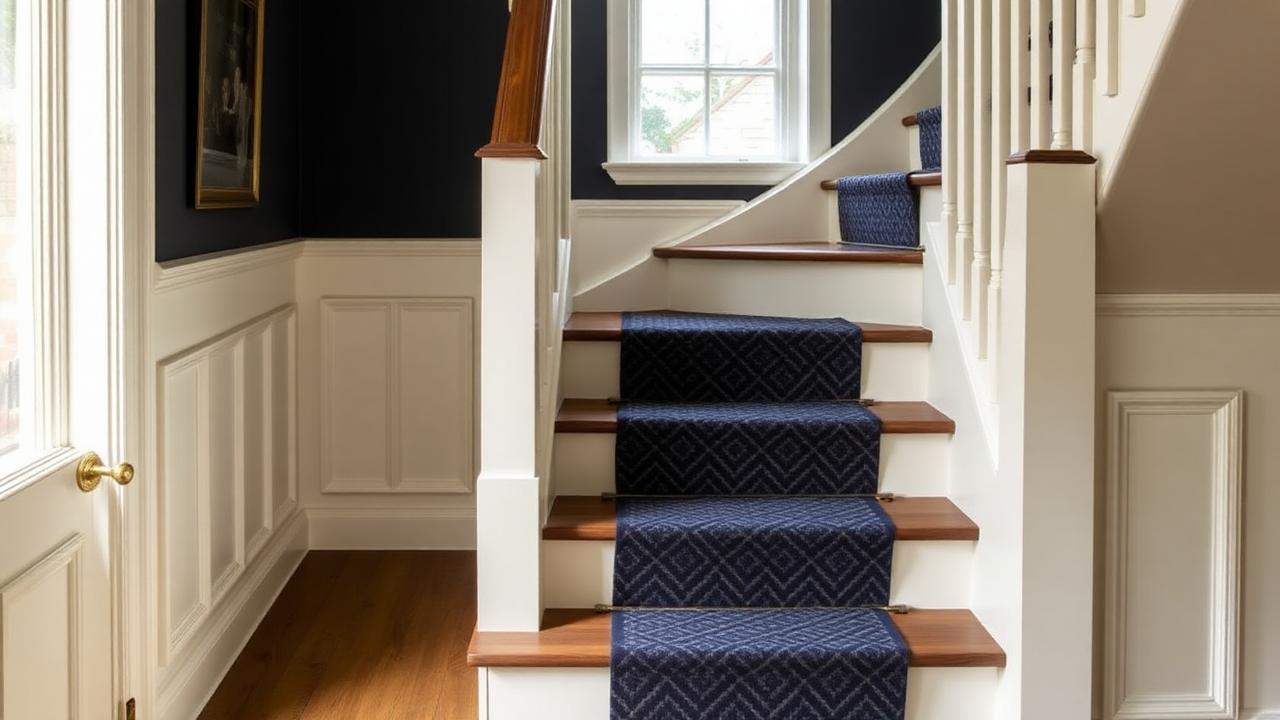
One advantage of animal print is that it disguises everyday marks — muddy paw prints, dropped crumbs, and general scuffing blend into the pattern far better than they would on a plain runner. This makes it a smart practical choice for households with pets or young children, not just a decorative indulgence. Pair it with simple stair rods in brass or matte black rather than an ornate finish, so the hardware does not fight the pattern for attention.
Checking specs before you order
Before you commit to a printed roll, run the supplier spec sheet against your own flight. Confirm the pile height (most animal print stair runners sit between 0.25 in and 0.5 in / 6-13 mm), the backing type, and the fibre content, since a printed face over a loose woven backing will distort faster on the nosing than a print baked into a heat-set nylon pile. Ask specifically whether the print is dye-printed onto the yarn or woven as part of the construction - woven-in patterns hold their definition through years of vacuuming, while surface-printed versions can dull noticeably within 2-3 years on a busy flight.
It is also worth checking the roll width against your stair width before ordering. A typical stair runner ships in 27 in, 31 in, or 36 in (69 cm, 79 cm, 91 cm) widths, and most homes fit a runner that leaves 3-4 in (7.5-10 cm) of exposed tread or stringer on either side. Measure your narrowest stair width first, since older homes often taper slightly toward the top of the flight, and a printed runner that needs trimming down loses its edge binding unless you have it re-bound by the fitter.
Fitting steps for a printed runner
Fitting an animal print runner follows the same broad sequence as any stair runner, but a couple of extra checks matter because the eye follows a pattern more readily than a plain colour. First, dry-lay the full length on the stairs before cutting anything, checking that the print runs the same direction on every step and that any directional motif (a zebra stripe, for example) points the way you want as you climb. Second, fit the gripper rods and underlay exactly as you would for a plain runner, then work from the top of the flight downward, stapling or tacking each step before wrapping the nosing so the pattern stays square to the riser line rather than drifting off-true by the bottom step.
- Dry-lay the full run first to check pattern direction and repeat
- Fit gripper rods at the back of each tread and the base of each riser
- Work top to bottom, keeping the pattern square to each nosing
- Staple or tack before trimming any excess at the skirting
- Bind or re-bind cut edges immediately to stop fraying
Cost bands for animal print runners
Printed synthetic runners in polypropylene or basic nylon typically start around $18-28 per linear foot ($60-90 per metre) supplied only, making a 24 ft (7.3 m) flight roughly $430-670 before fitting. Heat-set nylon or wool-blend animal prints with a woven-in pattern usually run $35-55 per linear foot ($115-180 per metre), putting the same flight at $840-1,320. Professional fitting for a straight 13-step flight typically adds $250-450 in the US or £180-320 in the UK, depending on region and whether gripper rods and underlay are included.
| Fibre type | US per ft | UK per m |
|---|---|---|
| Printed polypropylene | $18-28 | £40-60 |
| Heat-set nylon print | $28-40 | £60-85 |
| Wool-blend woven print | $40-55 | £90-120 |
Maintenance that keeps the print sharp
Vacuum an animal print stair runner at least weekly, using a brush attachment rather than a beater bar on wool-blend versions to avoid pulling the pile. Rotate any loose stair rods every few months if your fitting uses them, since constant pressure in the same spot can flatten the pile line and make the print look uneven under raking light. Treat spills immediately with a cleaner matched to the fibre content, and have the runner professionally deep-cleaned roughly every 12-18 months on a busy staircase to keep both the colour and the pattern definition looking fresh.
Whatever you decide, get the numbers first: the stair runner calculator doubles as a stair runner length calculator, adding nosing wrap, landings, winders, pattern repeat and waste so you order the right length the first time.
Frequently asked questions
Is animal print stair runner out of style?
No, it has remained a classic hallway choice for decades and continues to be reinterpreted in new colourways and materials.
Does animal print hide stains well?
Generally yes, the irregular pattern is very forgiving of everyday marks compared to a plain runner.
What backing is best for a printed stair runner?
A firm woven or latex backing holds the print flat and prevents distortion when the runner is fitted around the nosing.
Can I use animal print on a curved staircase?
Yes, but ask your fitter to check how the print behaves on winders, as tight turns can visually distort a large-scale motif.
Should the print be the same on every step?
Ideally yes for a cohesive look, though natural prints can vary slightly which is part of the appeal.
What colour walls suit an animal print runner?
Neutral or muted tones like warm white, taupe, or charcoal let the runner stand out without visual clutter.
Is animal print suitable for a small hallway?
Yes, provided you choose a smaller-scale print; a large motif can overwhelm a narrow space.
How do I clean an animal print stair runner?
Vacuum weekly and spot clean spills immediately with a mild carpet cleaner suited to the fibre type.
Know your numbers in 30 seconds
Enter your step count, tread depth and riser height — the stair runner calculator gives you the exact length to order, in metres and feet, with waste included.
Work out your length with the stair runner calculatorReady for real prices?
Get quotes from vetted stair runner suppliers and fitters near you. Free, no account, no obligation.
Every guide is written from hands-on measuring and fitting experience, checked against the calculator’s own maths, and re-reviewed whenever prices or methods change. Read our editorial standards.