

The formula
Total length = steps × (tread depth + riser height + nosing allowance) + landings + winder allowance + pattern allowance + waste.
- Tread depth: front edge to the riser behind, measured on the deepest tread.
- Riser height: the vertical face between treads.
- Nosing allowance: 2–5cm per step for a wrapped (Hollywood) fit; zero for a waterfall fit.
- Landings: the full depth of each landing, plus 10–15cm tuck per piece.
- Winders: treat each pie step as a full step and add 15–20% on the turn.
- Pattern allowance: one full repeat per separate piece.
- Waste: 5% straight flights, 10% with turns or bold patterns.
Worked example — 13-step straight flight
| Element | Calculation | Result |
|---|---|---|
| Tread depth | 27cm × 13 | 3.51m |
| Riser height | 19cm × 13 | 2.47m |
| Nosing wrap | 3cm × 13 | 0.39m |
| Subtotal | 6.37m | |
| Waste at 5% | 6.37 × 1.05 | 6.69m |
| Purchase length | Round up | 7.0m |
Always round up to the next half metre
Suppliers cut to order, and returning a custom cut is usually impossible. A spare 30cm costs a few pounds; being 30cm short costs a whole new order from a different batch.
Worked example — 16 steps with a half landing
| Element | Calculation | Result |
|---|---|---|
| Steps (28cm tread + 18cm riser + 3cm nosing) | 49cm × 16 | 7.84m |
| Landing 1.0m deep + 0.15m tuck | 1.15m | |
| Pattern repeat, 2 pieces × 0.4m | 0.80m | |
| Subtotal | 9.79m | |
| Waste at 10% | 9.79 × 1.10 | 10.77m |
| Purchase length | Round up | 11.0m |
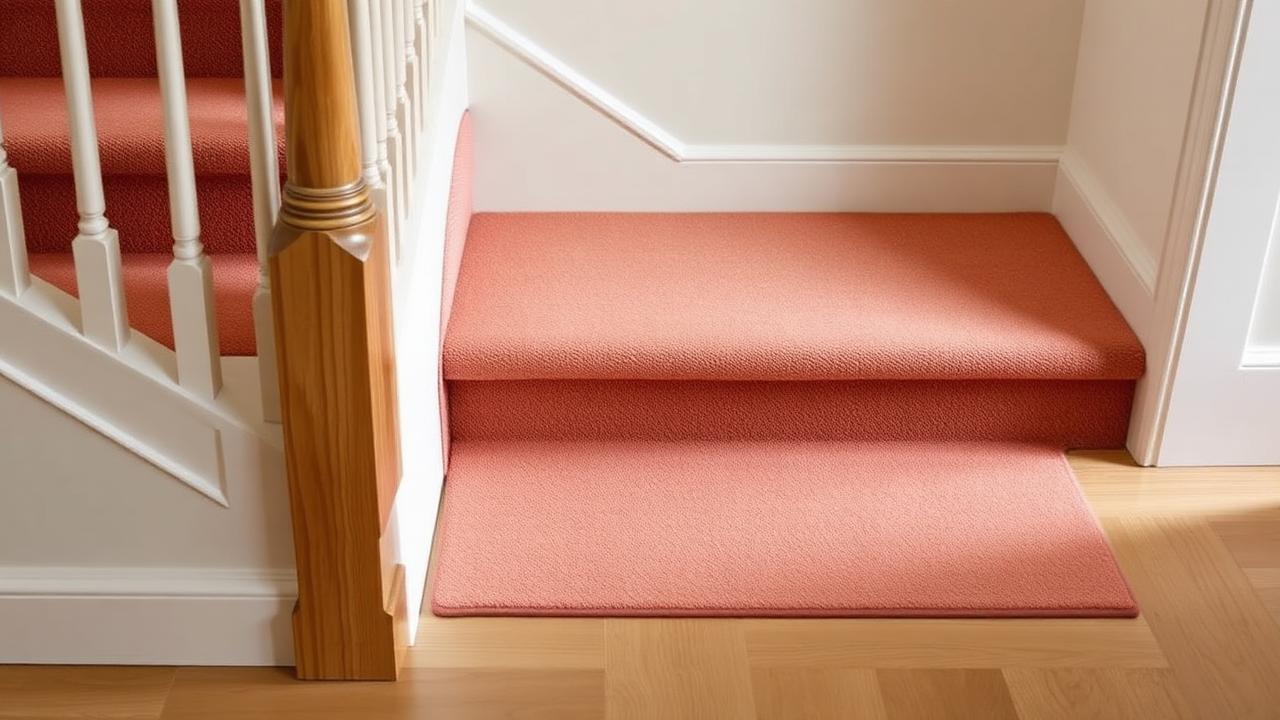
The allowances people forget
- The bottom step is often deeper (a bullnose or curtail step) — measure it separately.
- The top nosing needs runner over it and onto the landing, typically 5–8cm.
- Winders eat material because each piece is cut from the widest point of the wedge.
- Pattern repeats apply per piece, not per staircase.
- Pile direction means offcuts often cannot be reused elsewhere on the same flight.
Quick reference
| Staircase | Typical order length |
|---|---|
| 12 straight steps | 6.0–6.5m / 20–21ft |
| 13 straight steps | 6.5–7.0m / 21–23ft |
| 14 straight steps | 7.0–7.5m / 23–25ft |
| 16 steps with landing | 10.5–11.5m / 34–38ft |
| 13 steps with 3 winders | 8.0–9.0m / 26–30ft |
Treat these as sanity checks only. Tread depths vary by 5cm or more between houses, and that difference alone moves a 13-step flight by nearly a metre — which is why it is worth entering your own measurements rather than trusting a table.
Measuring tools that make this easier
- A steel tape rather than fabric — fabric tapes stretch slightly and compound errors over a long flight.
- A folding carpenter's rule or a stiff card template for tricky winder shapes, where a tape alone cannot capture the taper accurately.
- A notepad sketch of the staircase with each step numbered — write measurements directly onto it rather than trying to remember them.
- A phone camera to photograph each tread and riser junction, useful if you are relaying measurements to a supplier or fitter later.
Worked example — 13 steps with 3 winders
| Element | Calculation | Result |
|---|---|---|
| 10 straight steps (27cm + 19cm + 3cm) | 49cm × 10 | 4.90m |
| 3 winder steps at widest point, plus 20% | 0.55m × 3 × 1.20 | 1.98m |
| Subtotal | 6.88m | |
| Waste at 10% (turn present) | 6.88 × 1.10 | 7.57m |
| Purchase length | Round up | 8.0m |
Winders are the number one source of underestimation
Because a winder tread is wedge-shaped, the runner is always cut from its widest point, not its average width. Skipping this and estimating winders like ordinary steps is the single most common reason people run short mid-installation.
How tread and riser sizes vary by house age
| House type | Typical tread depth | Typical riser height |
|---|---|---|
| Victorian / Edwardian terrace | 22–25cm | 19–20cm |
| 1930s semi | 24–26cm | 18–19cm |
| Modern new-build | 25–28cm | 17–18cm |
| Open-plan / architect-designed | 28–32cm | 15–17cm |
These figures explain why two houses with the same number of steps can need noticeably different lengths of runner — a modern staircase with deep, shallow treads can need 15–20% more material than a steep Victorian stair with the same step count.
What happens if you order the wrong length
- Too short: the fitter either stops the runner early on a step, which looks unfinished, or a second piece is ordered from a different batch and the colour difference shows under any lighting change.
- Too long: usually not wasted — the excess is trimmed and can often be kept as a spare for future repairs or a small hallway mat.
- Custom cuts are rarely returnable, so an underestimate almost always costs a second full order, not just a top-up.
- If a pattern is involved, a mismatched second piece is far more visible than a plain colour mismatch, so patterned runners deserve an even more generous waste allowance.
Checklist before you place an order
- Measured every tread depth individually, not assumed they are identical.
- Measured every riser height individually.
- Added a nosing allowance if fitting a wrapped (Hollywood) style.
- Added full landing depths plus tuck allowance for each landing.
- Treated each winder as its widest point plus 15–20%.
- Added one pattern repeat per separate piece, if patterned.
- Added 5% waste for a straight flight, or 10% where turns or bold pattern exist.
- Rounded the final figure up to the next half metre.
Ordering for a two-flight staircase with a full landing
A staircase that turns 180 degrees with a full landing between two flights is one of the most common layouts in semi-detached and terraced houses, and it is also the layout most likely to catch people out on length, because the landing itself is easy to under-measure. Treat the landing as its own element: measure its full depth in the direction of travel, not just the width of the doorway crossing it, and add the same 10–15cm tuck allowance used for a half landing on both the entry and exit edges, since the runner has to be fixed on both sides of the flat section.
| Element | Calculation | Result |
|---|---|---|
| Lower flight, 7 steps (27+19+3cm) | 49cm × 7 | 3.43m |
| Full landing, 1.2m deep + 0.30m total tuck | 1.50m | |
| Upper flight, 7 steps (27+19+3cm) | 49cm × 7 | 3.43m |
| Subtotal | 8.36m | |
| Waste at 10% | 8.36 × 1.10 | 9.20m |
| Purchase length | Round up | 9.5m |
Buying enough for a future repair patch
Ordering a small additional length beyond the waste margin — typically 30–50cm — and storing it flat and out of light gives you an exact colour and batch match for a future repair, such as patching a burn mark or a section damaged by a dropped appliance. This spare piece is far more valuable than the modest extra cost it adds, because reordering years later from a different production batch rarely matches the original shade precisely, especially on wool.
Whatever you decide, get the numbers first: the stair runner calculator doubles as a stair runner length calculator, adding nosing wrap, landings, winders, pattern repeat and waste so you order the right length the first time.
Still deciding on material, width or pattern? Our hub on stair runners compares weaves, widths, backings and fitting styles side by side, then hands the numbers straight to the calculator.
Frequently asked questions
How much stair runner do I need for 13 stairs?
Around 6.5–7.0m (21–23ft) for typical dimensions of a 27cm tread, 19cm riser and a wrapped nosing, including 5% waste. Measure your own treads, though — depth varies enough to change the answer by nearly a metre.
How do you calculate stair runner length?
Multiply the number of steps by the sum of tread depth, riser height and nosing allowance, then add landing depths, winder allowance, one pattern repeat per piece and 5–10% waste.
How much extra runner should I allow for waste?
5% on a straight flight with a plain runner, and 10% where there are landings, winders or a bold pattern that must be matched.
Does the runner need to go over the top step?
Yes — allow 5–8cm to run over the top nosing and onto the landing so the edge is fixed on a flat surface rather than on the nosing itself.
Why do winder steps need so much extra runner?
A winder tread is wedge-shaped, and the runner has to be cut wide enough to cover its widest point on every piece, so material is used far less efficiently than on a straight step. Budgeting 15–20% extra across the winder section is standard.
Do tread and riser sizes vary much between houses?
Yes, by as much as 5–8cm in tread depth alone between an older terrace and a modern new-build. That difference alone can shift a 13-step order by close to a metre, which is why generic tables are only a sanity check.
What if I get the length wrong after ordering?
A shortfall almost always means a second order, and because custom cuts come from specific production batches, colour can differ slightly even with the same product code. It is far cheaper to over-order by 5–10% up front.
Know your numbers in 30 seconds
Enter your step count, tread depth and riser height — the stair runner calculator gives you the exact length to order, in metres and feet, with waste included.
Run the numbers automaticallyReady for real prices?
Get quotes from vetted stair runner suppliers and fitters near you. Free, no account, no obligation.
Every guide is written from hands-on measuring and fitting experience, checked against the calculator’s own maths, and re-reviewed whenever prices or methods change. Read our editorial standards.