
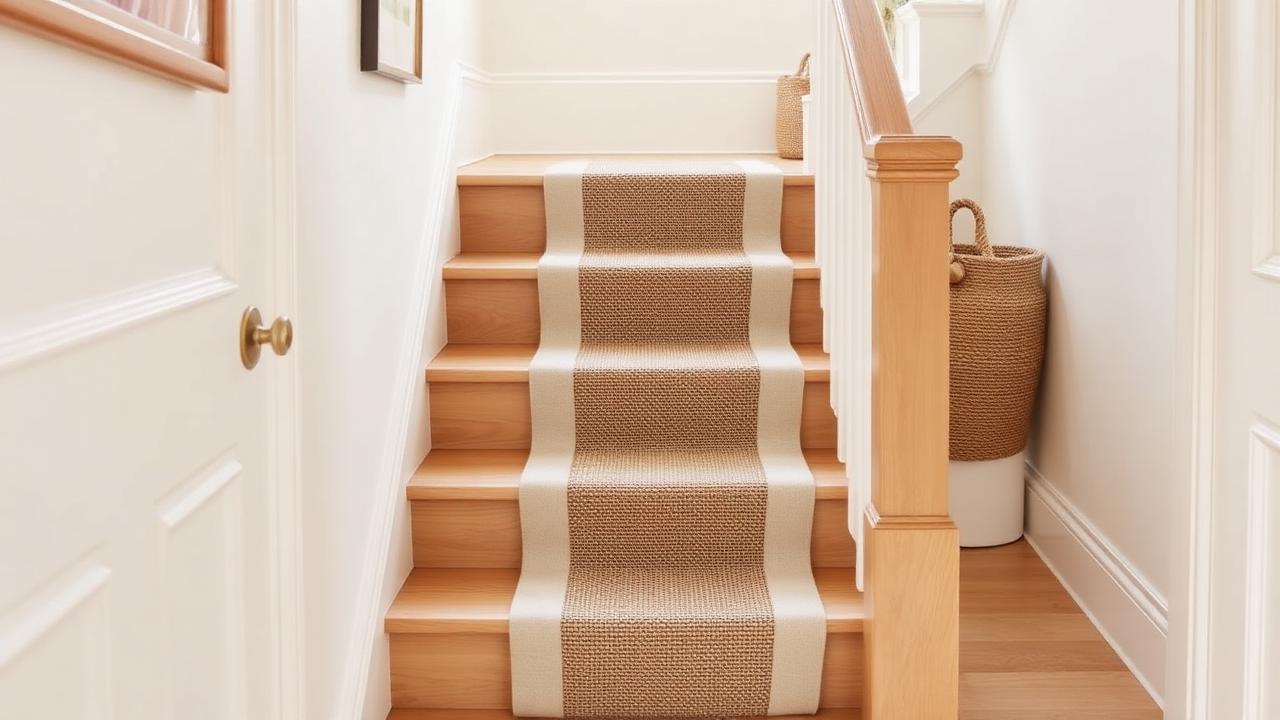
Why antelope print endures
Unlike leopard or zebra print, which read as much more overtly bold, the antelope print (sometimes called a gazelle or fawn print) has a softer, more irregular spotted pattern in muted tones, typically browns, tans, and creams. This gives it a decorative, textured quality without shouting for attention the way a high-contrast print does. Interior designers have used antelope carpet stair runners for decades precisely because it adds visual interest and a sense of movement to a staircase while still working comfortably alongside traditional furniture, patterned wallpaper, or more minimal, modern decor.
The muted, tonal nature of most antelope prints also means it's genuinely practical for a busy household. The irregular pattern is excellent at disguising everyday dirt, pet hair, and minor wear, arguably even better than a plain solid colour in a similar tone, since there's no flat, uninterrupted surface for marks to stand out against.
Choosing the right base colour and scale
Antelope prints typically come in a few base colourways: a classic tan-and-cream, a cooler grey-and-cream, and occasionally darker charcoal-and-black variations for a more dramatic look. The scale of the spots also varies between manufacturers, from delicate, small-scale prints that read almost as a texture from a distance, to larger, more graphic prints that are clearly recognisable as an animal-inspired pattern up close. For a busy hallway with a lot of foot traffic, a mid-scale print in a wool or wool-blend construction tends to offer the best mix of visual interest and durability.
| Colourway | Best paired with | Practicality |
|---|---|---|
| Tan and cream | Traditional, warm-toned interiors | Excellent, hides dirt well |
| Grey and cream | Contemporary, cooler palettes | Excellent, hides dirt well |
| Charcoal and black | Bold, dramatic schemes | Very good, hides dirt very well |
How much runner do I need?
As with any runner, colour and pattern don't change the underlying length calculation. For a 13-step flight: 10 in tread + 7.5 in riser + 0.75 in nosing wrap = 18.25 in per step, totalling 237.25 in over 13 steps. Add roughly 24 in for finishing allowances, giving 261.25 in (21.77 ft), then include an 8-10% waste margin, bringing your total to about 23.5-24 ft. Metric: 25 cm + 19 cm + 1.9 cm = 45.9 cm per step, times 13 is 596.7 cm, plus 60 cm finishing gives 656.7 cm, plus 8-10% waste is approximately 7.1-7.3 m.
Know your numbers in 30 seconds
Enter your step count, tread depth and riser height — the stair runner calculator gives you the exact length to order, in metres and feet, with waste included.
Open the stair runner calculatorCheck the pattern's irregularity before ordering
Because antelope prints are irregular rather than a repeating geometric pattern, pattern matching at seams is generally less critical than with a striped or symmetrical design, which can simplify installation on longer flights.
Styling it with your staircase
Antelope print runners work particularly well with natural wood staircases, brass or wrought iron stair rods, and warm-toned lighting, all of which complement the earthy, organic feel of the print. They also pair nicely with sisal or jute accents elsewhere in the home for a cohesive, textured, and slightly rustic-luxe aesthetic. If your home leans more coastal or Scandinavian in style, the grey-and-cream colourway tends to integrate more smoothly than the classic tan version.

- Choose a mid-scale print for the best balance of style and durability.
- Opt for wool or wool-blend construction on high-traffic stairs.
- Pair with brass or wrought iron stair rods for a classic finish.
- Pattern matching is generally less critical than with geometric designs.
- Confirm your total length with the stair runner calculator before ordering.
Spec checks for animal print runners
Because the antelope pattern is printed or woven onto the base fibre, ask whether the print is a genuine yarn-dyed weave (colour goes through the fibre) or a surface print (colour sits on top of the pile). Yarn-dyed antelope prints hold up far better to wear and cleaning over time, since a surface print can show a lighter, worn patch in high-traffic areas as the top layer of colour wears away, revealing the base fibre underneath. Reputable stair runner suppliers should be able to confirm which method their antelope print uses.
Also check the backing and pile height against your stair nosing profile; antelope prints are most commonly available in a low, dense pile, which handles the repeated bending at each nosing better than a longer, plush pile that can crush unevenly at the fold and disrupt the pattern's visual flow down the stairs.
Cost bands for antelope prints
Genuine yarn-dyed wool antelope runners sit at the premium end, typically $45-75 per ft ($150-245 per m), while wool-blend surface-printed versions run $25-40 per ft ($80-130 per m), and budget synthetic interpretations of the print start around $16-26 per ft ($50-85 per m).
| Construction | Print method | US price per ft |
|---|---|---|
| Premium wool | Yarn-dyed | $45-75 |
| Wool-blend | Surface print | $25-40 |
| Synthetic | Surface print | $16-26 |
Styling rules for a lasting look
Because the print itself provides plenty of visual interest, keep stair rods and other hardware simple; an antique brass or aged bronze finish tends to complement the earthy tones better than a bright, polished chrome, which can feel like a jarring contrast against the warm, organic pattern. Rotate area rugs or runners elsewhere in the home to match the same undertone (warm tan versus cool grey) as your chosen antelope colourway, so the print feels intentional throughout the house rather than an isolated statement on the stairs alone.
- Ask whether the print is yarn-dyed or surface printed before ordering.
- Choose a low, dense pile to handle repeated nosing bends cleanly.
- Match stair rod hardware finish to the print's warm or cool undertone.
- Coordinate other soft furnishings to the same colour temperature.
- Budget for the premium yarn-dyed option if the stair sees heavy daily use.
An antelope carpet stair runner offers a rare combination of decorative texture and everyday practicality, hiding wear and dirt while adding genuine character to a staircase. Whatever colourway you choose, use the stair runner length calculator to lock in your exact quantity before you order.
Whatever you decide, get the numbers first: the stair runner calculator doubles as a stair runner length calculator, adding nosing wrap, landings, winders, pattern repeat and waste so you order the right length the first time.
Frequently asked questions
Is antelope print the same as leopard print?
No, antelope print has a softer, more irregular spotted pattern in muted tones compared to the bolder contrast of leopard print.
Does antelope print hide dirt well?
Yes, the irregular, tonal pattern is very effective at disguising everyday dirt and pet hair.
What colourways are available for antelope stair runners?
Common options include tan-and-cream, grey-and-cream, and charcoal-and-black variations.
Does an animal print change how much runner I need?
No, length is determined by your step dimensions, not the pattern or colour of the runner.
What fibre is best for an antelope print runner?
Wool or wool-blend construction offers the best balance of visual quality and durability for stairs.
Does pattern matching matter for antelope prints?
Less so than with geometric or striped patterns, since the irregular spots don't need precise alignment at seams.
What decor styles suit an antelope stair runner?
It pairs well with natural wood, brass or wrought iron rods, and both traditional and rustic-luxe interiors.
How much waste margin should I add?
An 8-10% waste margin is typical, similar to most other patterned stair runners.
Know your numbers in 30 seconds
Enter your step count, tread depth and riser height — the stair runner calculator gives you the exact length to order, in metres and feet, with waste included.
Calculate your length with the stair runner calculatorReady for real prices?
Get quotes from vetted stair runner suppliers and fitters near you. Free, no account, no obligation.
Every guide is written from hands-on measuring and fitting experience, checked against the calculator’s own maths, and re-reviewed whenever prices or methods change. Read our editorial standards.