
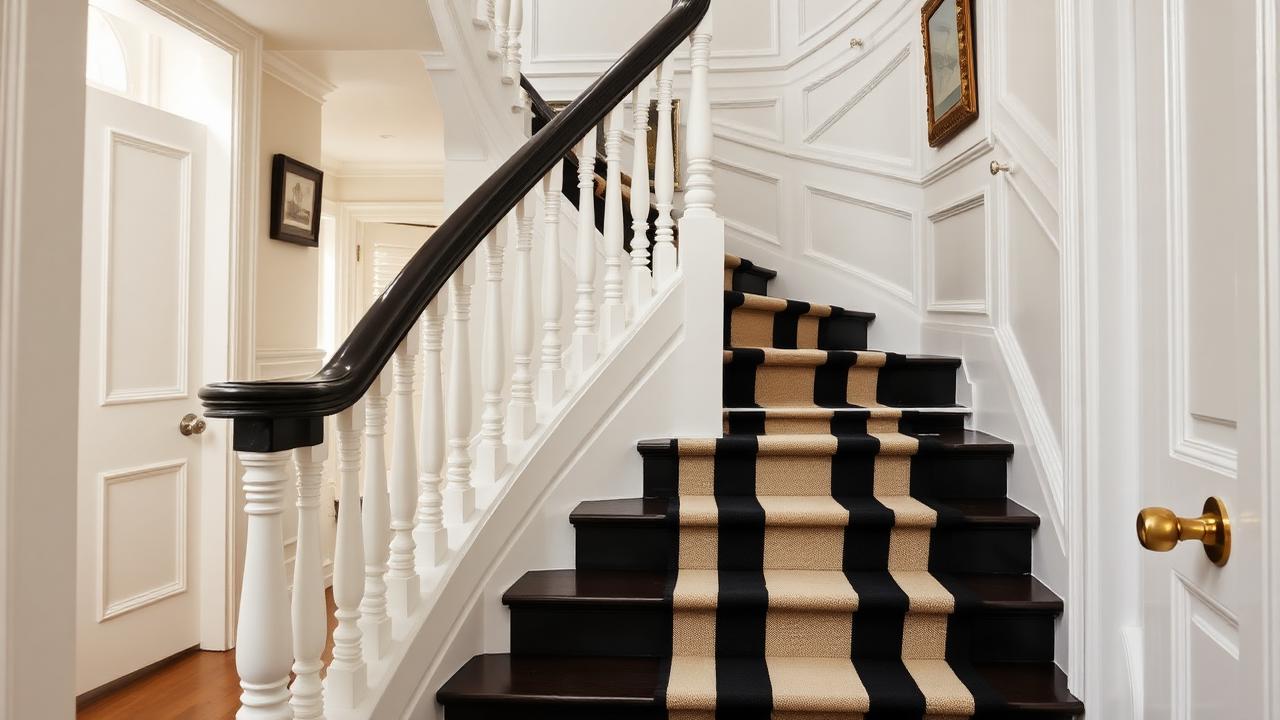
The main ways to combine beige and black
There are three common formats, and they read very differently on the stairs. A beige field with a black border keeps the overall impression warm and traditional, with black doing a supporting, framing job. A black field with a beige or ivory border reverses that balance, reading as bolder and more contemporary. A woven pattern that mixes beige and black together — a herringbone, houndstooth, or geometric repeat — sits between the two and hides wear better than either solid option because the mixed tones break up marks.
| Format | Overall impression | Best suited to | Wear visibility |
|---|---|---|---|
| Beige field, black border | Warm, classic, traditional | Period homes, oak or walnut stairs | Beige field shows soil faster |
| Black field, beige border | Bold, modern, high-contrast | Painted white staircases, contemporary interiors | Black field hides soil, shows light dust and pet hair |
| Beige and black woven pattern | Textured, forgiving, versatile | Busy family staircases | Best at hiding day-to-day marks |
| Beige and black stripe | Graphic, directional | Long straight flights, hallway runners continuing the theme | Depends on stripe width and darkness balance |
Getting the border proportion right
A black border that is too narrow reads as an afterthought; one that is too wide competes with the field colour and stops looking like a border at all. As a working rule, a border between 1.5 and 3 in (4 to 7.5 cm) wide on each side works on most standard runner widths of 26 to 32 in (66 to 81 cm). Wider runners can carry a proportionally wider border without it looking heavy; narrower runners need a tighter border or the beige field disappears almost entirely.
Order border and field as one piece where possible
A pre-made bordered runner, woven or sewn as a single unit, keeps the black perfectly straight and parallel down every step. A border added after the fact by a fitter using contrast binding tape is a cheaper option but is far less forgiving of a slightly uneven cut, and any waviness is more visible in a black-on-beige combination than in a single solid colour.
Where the combination suits the staircase
Beige and black works particularly well where the staircase already has a strong architectural line to echo — a black wrought-iron balustrade, black stair rods, or a black front door visible from the hall. It also suits staircases with warm, honey or mid-toned oak treads, since the beige bridges between the wood and the black accent rather than fighting either. It is a weaker choice on a staircase with very pale, blonde timber and white walls, where the black can look like the only saturated element in an otherwise very light space unless it is deliberately used as a single bold statement.
In the UK, this combination is popular in Georgian and Victorian terraced houses where a black-bordered runner over stripped or stained boards has been a standard look for decades. In the US, the same pairing shows up frequently in Colonial and farmhouse-style homes, often paired with black iron stair rods rather than a bound edge.
Measuring and ordering
- Count total steps including winders, and measure a typical going and rise as for any runner order.
- Decide your total runner width, then decide how that width splits between beige field and black border.
- Check the pattern repeat if choosing a woven beige-and-black design, so it can be squared and centred on the first tread.
- Confirm whether the border is woven in as one piece or applied afterward as binding tape, since this affects lead time and cost.
- Add wrap allowance per step (roughly the going plus the rise) and turning allowance at top and bottom.
- Use the stair runner length calculator to convert your step count and dimensions into a single order length.
What it costs
| Item | Typical US | Typical UK |
|---|---|---|
| Beige field carpet, mid weight | $20-38 per sq yd | GBP 17-32 per sq m |
| Black carpet for border or field | $20-40 per sq yd | GBP 17-34 per sq m |
| Contrast binding tape (border applied after cut) | $5-10 per linear ft | GBP 4-8 per linear m |
| Woven-in bordered runner, ready-made | $28-55 per linear ft | GBP 24-46 per linear m |
| Fitting, straight flight | $25-50 per step | GBP 20-42 per step |
Living with a beige and black runner
The beige field will show soil and staining well before the black border does, so treat spills on the beige area with more urgency than you might on an all-dark runner — blot immediately rather than letting a mark set. Vacuum regularly with the beater bar off or on a gentle setting to avoid pulling loops if the construction is a loop pile, and check the border stitching or binding annually where it turns each nosing, since that is the point of highest flex and the first place binding tape can start to lift.

Balancing beige and black in a narrow hallway
A narrow entrance hall or tight staircase changes how a beige and black combination should be proportioned. In a wide, well-lit hall, a bold black border or a black field can anchor the space without making it feel smaller. In a narrow hall, a large area of black can visually compress the width, so many designers favour the beige-field-with-black-border format specifically for tight spaces, keeping the black as a defining line rather than a dominant mass. If the hallway is genuinely dark or windowless, lean toward a slightly lighter beige than you would in a bright space, since a deep beige and a black border together can read as almost uniformly dark under weak artificial light.
Runner width interacts with this too: in a narrow hallway, keeping 3 to 4 inches (7.5 to 10 cm) of exposed flooring either side, rather than pushing the runner edge-to-edge, helps the beige and black combination feel considered rather than overwhelming for the space.
Choosing between wool, wool-blend and synthetic for this pairing
| Fibre | How beige performs | How black performs | Best for |
|---|---|---|---|
| 100% wool | Rich, deep, hides some soiling via natural lanolin | Deep, matte, ages well | Main staircases, long-term investment |
| Wool-nylon blend | Slightly flatter but more stain resistant | Holds colour well under traffic | Family homes wanting durability and value |
| 100% synthetic (nylon/polypropylene) | Can look slightly flat or shiny in bright light | Can bronze or shift tone under UV over years | Budget-conscious buyers, rental properties |
Because the beige field is the area most likely to show soiling first, it is worth spending slightly more on fibre quality for the beige portion even if the black border is a cheaper synthetic binding tape - most suppliers will not let you mix fibre types within one weave, but if you are having binding applied separately, this is a legitimate way to manage budget without compromising where it matters most.
Know your numbers in 30 seconds
Enter your step count, tread depth and riser height — the stair runner calculator gives you the exact length to order, in metres and feet, with waste included.
Open the stair runner calculatorWhatever you decide, get the numbers first: the stair runner calculator doubles as a stair runner length calculator, adding nosing wrap, landings, winders, pattern repeat and waste so you order the right length the first time.
Still deciding on material, width or pattern? Our hub on stair runners compares weaves, widths, backings and fitting styles side by side, then hands the numbers straight to the calculator.
Frequently asked questions
Should the border or the field be black on a beige and black runner?
A beige field with a black border gives a warmer, more traditional look and suits period homes and honey-toned timber. A black field with a beige border is bolder and more contemporary, and suits painted white staircases or wrought-iron balustrades. Neither is more correct; it depends on the rest of the hallway's palette.
How wide should the black border be?
Between 1.5 and 3 inches (4 to 7.5 cm) on each side works for most standard runner widths of 26 to 32 inches. Go narrower on a tight runner width so the beige field still reads as the dominant colour, or wider on a broad runner where a thin border would look under-scaled.
Is a woven-in border better than one added afterward?
Yes, where budget allows. A woven-in border stays perfectly straight and parallel down every step and needs no ongoing maintenance. A border added with contrast binding tape after the carpet is cut is cheaper but shows any unevenness in the cut more clearly and can lift at the nosing over time.
Does the beige show marks more than a plain gray runner would?
Generally yes, particularly a pale or warm beige, because it lacks the fleck or mid-depth tone that helps gray and darker neutrals hide daily soiling. Choosing a beige with a subtle heather or tweed texture rather than a flat solid narrows this gap considerably.
What stair rod finish suits beige and black best?
Black stair rods, either matte or antique-finish, tie directly into the black element of the runner and are the most common pairing. Brass rods can work if the rest of the hallway has warm metal fixtures, but they introduce a third colour note that needs to be repeated elsewhere to look intentional.
Can I use a beige and black pattern instead of a solid-and-border combination?
Yes, a woven herringbone, houndstooth or geometric pattern combining beige and black is a strong alternative, and it generally hides day-to-day wear better than either a solid field or a border design, because the broken pattern disguises marks that would show clearly on a flat colour.
What does a beige and black bordered runner typically cost for a 13-step staircase?
Material and binding for a mid-weight bordered runner typically falls in the low-to-mid hundreds of dollars or pounds for a straight thirteen-step flight, before fitting. Fitting adds roughly $25-50 (GBP 20-42) per step, so get an itemised quote covering both material and labour before comparing suppliers.
Know your numbers in 30 seconds
Enter your step count, tread depth and riser height — the stair runner calculator gives you the exact length to order, in metres and feet, with waste included.
Measure my staircaseReady for real prices?
Get quotes from vetted stair runner suppliers and fitters near you. Free, no account, no obligation.
Every guide is written from hands-on measuring and fitting experience, checked against the calculator’s own maths, and re-reviewed whenever prices or methods change. Read our editorial standards.