

Contrast vs tonal borders
| Border approach | Effect | Best for |
|---|---|---|
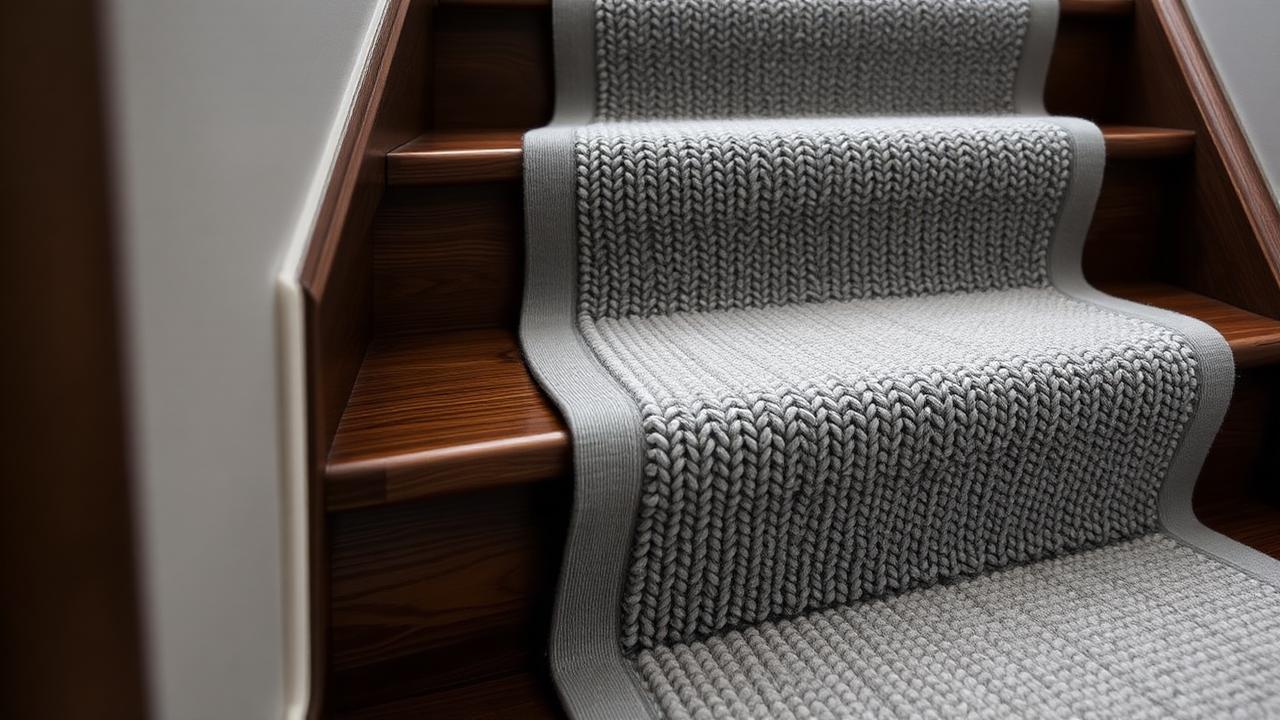
| High contrast (e.g. cream on charcoal) | Draws a strong line up the stairs, emphasises width | Bold, contemporary schemes |
| Tonal (e.g. two shades of grey) | Subtle definition, still looks neat and tailored | Traditional, understated hallways |
| Matching binding colour to a hallway accent | Ties the staircase into the wider decor | Any style, most cohesive result |
| Double or striped border | More detailed, formal look | Period and grand staircases |
Border width and proportion
A border that reads clearly without dominating the runner is typically 5 to 8 percent of the total finished width, roughly half an inch to just over an inch on a standard 27 inch runner. Wider borders start to compete with the field colour rather than framing it.
Know your numbers in 30 seconds
Enter your step count, tread depth and riser height — the stair runner calculator gives you the exact length to order, in metres and feet, with waste included.
Open the stair runner calculatorColour vs dirt visibility vs binding material
| Border colour | Dirt visibility on border | Best binding material |
|---|---|---|
| Cream / ivory | High, shows soil at the edges first | Cotton or leather |
| Charcoal / black | Very low | Cotton, leather or wool whipping |
| Navy | Low | Cotton binding, wool whipping |
| Camel / tan | Medium | Leather for a premium look |
Borders wear first
Because a border sits right at the edge where feet and shoes brush the nosing, a pale or delicate border colour will show wear before the central field does. Choose a slightly deeper border tone on busy stairs.
Pattern and stripe borders
Instead of a plain contrast border, some runners use a fine stripe or key pattern along the edge. This adds detail without the stronger visual line of a solid contrast border, and suits period homes particularly well.
Styling bordered with paint and a stair runner
The wall colour either side of a bordered runner does more work than any other single decision in the hallway. Test a large paint sample directly beside your carpet sample, not on a separate wall, because hallway light is usually dimmer and more directional than a living room and both colours will read differently there than on the swatch.
- Paint the stair spindles and skirting a shade lighter than the wall so the bordered runner remains the focal point rather than competing with woodwork.
- If you plan to run a matching or contrasting runner rug in the hallway at the foot of the stairs, buy both from the same batch or dye lot to avoid a visible colour break.
- A single-colour bordered runner tolerates a busier wallpaper better than a patterned one; if your walls are patterned, keep the runner as plain as possible.
Sourcing and lead times for a bordered runner
Not every stockist carries bordered as a stock colour, and custom dye lots typically add 2 to 6 weeks to the order versus a shelf colour. Ask upfront whether the shade is stocked, made to order, or a dye-lot match, since dye-lot orders usually carry a minimum length and cannot easily be topped up later if you underestimate your stair count.
| Sourcing route | Typical lead time | Notes |
|---|---|---|
| Stock colour, in-store cut | 1-2 weeks | Fastest, widest fibre choice for common shades |
| Stock colour, online order | 1-3 weeks | Confirm dye lot if ordering more than one roll |
| Custom dye or bespoke bordered shade | 4-8 weeks | Needed for exact designer colour matches |
Cost ranges for a bordered stair runner
| Fibre and finish | US price per linear foot, installed | UK price per linear metre, installed |
|---|---|---|
| Synthetic (nylon/polypropylene) | $18-$32 | £28-£50 |
| Wool-blend, stock shade | $28-$48 | £45-£78 |
| Pure wool, stock shade | $38-$65 | £62-£105 |
| Bespoke dye lot or bordered wool runners with contrast binding | $55-$95 | £90-£155 |
Fitting typically adds a further $6-$14 per linear foot in the US or £10-£22 per linear metre in the UK, depending on staircase complexity, number of turns, and whether rods or grippers are used. Get at least two written quotes, since labour rates for stair fitting vary more between local fitters than the carpet itself.
Common mistakes to avoid with a bordered runner
- Choosing a border colour that clashes with the skirting or spindles rather than picking up a tone already in the hallway.
- Ordering a border width that is too narrow to read clearly once fitted, particularly on wider staircases.
- Forgetting that a border needs mitred corners at every turn and half-landing, which adds to both cost and fitting time.
- Assuming any fitter can install a bordered runner to the same standard as a plain one, when mitring borders needs particular skill and experience.
DIY vs hiring a professional fitter
Fitting a bordered runner yourself is possible on a straight staircase with basic tools, a staple gun or rod brackets, and patience, and it can save most of the labour cost. Winders, half-landings, and anything with a bordered or patterned repeat are much harder to get right without experience, since a crooked border or misaligned stripe is far more visible than an uneven plain colour. If in doubt, get a professional quote for the tricky sections and DIY the straight runs.
Caring for a Bordered runner day to day
Vacuum a Bordered runner at least weekly, more often on the bottom three treads and any winder, since these take the heaviest footfall and shed the most grit. Use the crevice tool along the edges where the runner meets the tread nosing, as this is where dust and pet hair collect first and where fibres wear fastest if left ungroomed.
- Blot spills immediately rather than rubbing, working from the outside of the mark inward to avoid spreading it further into the pile.
- Rotate or swap door mats regularly so grit is not tracked straight onto the first few treads of a Bordered runner.
- Have the runner professionally cleaned every 12-18 months in a busy household, or every 2-3 years in a low-traffic home.
- Check stair rods or grippers annually for movement, since a loose fixing accelerates wear at the point of stress.
How Bordered compares with the other popular stair colours
| Comparison colour | How it differs from Bordered | Best for |
|---|---|---|
| Grey | Cooler, more neutral, hides dirt similarly well | Contemporary interiors, easy resale |
| Beige / neutral | Warmer, blends more with wood tones | Traditional hallways, warm-toned decor |
| Charcoal / black | Higher drama, needs more attention to nosing visibility | Bold, modern schemes |
Order a larger sample than the standard swatch
A postage-stamp sample is not enough to judge a Bordered runner accurately. Ask for an A4-sized cutting if possible and view it against your actual walls, skirting and flooring before committing to the full order.
Whatever you decide, get the numbers first: the stair runner calculator doubles as a stair runner length calculator, adding nosing wrap, landings, winders, pattern repeat and waste so you order the right length the first time.
Still deciding on material, width or pattern? Our hub on stair runners compares weaves, widths, backings and fitting styles side by side, then hands the numbers straight to the calculator.
Frequently asked questions
How wide should a stair runner border be?
Roughly 5 to 8 percent of the total finished width, which is about half an inch to just over an inch on a standard 27 inch runner.
Should a stair runner border match the field colour or contrast?
Either works. Contrast borders create a bold, defined line up the stairs; tonal borders give a subtle, tailored finish that suits traditional interiors.
Do borders wear out faster than the rest of a stair runner?
Yes, because they sit at the tread edge where feet and shoes make the most contact. A deeper border colour hides this wear better than a pale one.
What binding material suits a contrast border?
Cotton binding is the standard, cost-effective choice. Leather gives a premium finish, and wool whipping suits a softer, traditional look.
Does a border add much to the cost of a stair runner?
A contrast border or binding typically adds 10 to 20% to the total price due to the extra fabric and sewing labour, but it lifts a plain runner considerably and can hide a slightly imprecise cut edge.
How often should I clean a Bordered stair runner?
Vacuum weekly, treat spills immediately, and have it professionally cleaned every 12-18 months in a busy household or every 2-3 years in a lower-traffic home.
Does a Bordered runner need a thicker underlay?
A denser underlay improves comfort and extends the life of any stair runner, but it does not change how the colour itself performs. Use a stair-rated 8-10mm underlay for the best balance of cushioning and grip.
Can I match a Bordered runner across an open-plan landing?
Yes, order the landing carpet from the same dye lot as the stair runner wherever possible, since even a small colour shift between batches is noticeable on a continuous run.
Know your numbers in 30 seconds
Enter your step count, tread depth and riser height — the stair runner calculator gives you the exact length to order, in metres and feet, with waste included.
Check my runner widthReady for real prices?
Get quotes from vetted stair runner suppliers and fitters near you. Free, no account, no obligation.
Every guide is written from hands-on measuring and fitting experience, checked against the calculator’s own maths, and re-reviewed whenever prices or methods change. Read our editorial standards.