

Why beige is the most fitted colour on the books
Ask any carpet fitter which colour they cut most of in a year and beige comes out top, ahead of grey, ahead of navy stripes, ahead of anything with a pattern repeat. It isn't exciting to talk about but it does the job that most homeowners actually need: it bridges a pale oak stair with a mid-tone wall, it doesn't show every stray hair the way a near-white runner does, and it doesn't read as heavy or dated the way some browns can on a bright hallway. I've fitted beige on Victorian terraces with dark stained treads and on new-build stairs with pale engineered oak, and it worked in both settings because the undertone was chosen to match the room rather than picked off a swatch in isolation.
The trap most people fall into is treating 'beige' as one colour. It isn't. There's a warm, yellow-leaning beige that flatters honey-toned oak and terracotta tile, a cooler, grey-leaning beige (sometimes called greige) that suits painted white or grey stairs, and a sandy, slightly pink beige that works with warm wall paint but clashes badly against blue-grey walls. Before you order anything, hold a sample against your actual tread wood and your wall colour, in the light your hallway actually gets during the day, not under a shop's fluorescent tubes.
Matching beige to your treads and walls
If your treads are a warm wood, oak, pine, or a red-toned hardwood, lean into a warm beige with a slight camel or wheat undertone; a cool greige will look slightly grubby against warm wood in daylight. If your stairs are painted white, off-white or a cool grey, a greige with a hint of blue-grey in the fibre reads as more deliberate and less like an afterthought. And if your walls are painted in a warm neutral, magnolia, warm white, soft terracotta, match the runner's undertone to the wall rather than the tread, since the runner sits against far more wall surface visually (the stringers, the skirting) than it does against bare tread once it's fitted.
Test in daylight and lamp light both
Beige shifts more under artificial light than almost any other stair runner colour. Pin a sample to the wall at the top and bottom of the flight and check it morning, midday and evening before you commit to an order.
How much runner do I need?
Take a 13-step US flight: 10 in tread run, 7.5 in riser height, and a 0.75 in nosing wrap allowance per step for a standard rounded nosing. Per step that's 10 + 7.5 + 0.75 = 18.25 in. Across 13 steps that's 237.25 in, or 19.77 ft. Add a top and bottom finishing allowance of 12 in each (24 in total) for tucking cleanly under the landing carpet and finishing at the base, giving 261.25 in, or 21.77 ft. Apply a 7% waste margin for straight cuts and you land at roughly 23.3 ft, so most people order 23-24 ft to be safe.
In UK metric terms, the same flight is 25 cm tread run, 19 cm riser height and a 1.9 cm nosing wrap, giving 45.9 cm per step. Multiply by 13 steps for 596.7 cm, add 60 cm total finishing allowance for 656.7 cm, then apply a 7% waste margin to reach about 7.03 m. Beige doesn't need any different waste margin to other colours, but if you've chosen a subtly textured or looped beige weave rather than a flat weave, add a touch more, since loop pile shows cutting lines more readily than a smooth cut pile.
| Measurement | US (in/ft) | UK (cm/m) |
|---|---|---|
| Tread run | 10 in | 25 cm |
| Riser height | 7.5 in | 19 cm |
| Nosing wrap per step | 0.75 in | 1.9 cm |
| Per-step total | 18.25 in | 45.9 cm |
| 13 steps subtotal | 19.77 ft | 5.97 m |
| Plus finishing allowance | 21.77 ft | 6.57 m |
| With 7% waste margin | 23.3 ft | 7.03 m |
Know your numbers in 30 seconds
Enter your step count, tread depth and riser height — the stair runner calculator gives you the exact length to order, in metres and feet, with waste included.
Open the stair runner calculatorPicking a runner width that suits a lighter colour
Beige shows off exposed tread either side more flatteringly than a very dark runner does, because the contrast between wood and carpet is softer, so you can afford to leave a slightly wider margin of bare tread if you like the look of the wood grain framing the runner. A common width on a 36 in (91 cm) staircase is a 27-30 in (68-76 cm) runner, leaving 3-4.5 in (7.5-11 cm) exposed per side. If your treads are painted rather than stained, a slightly narrower runner with more exposed painted tread tends to look crisper than one that nearly fills the full width.
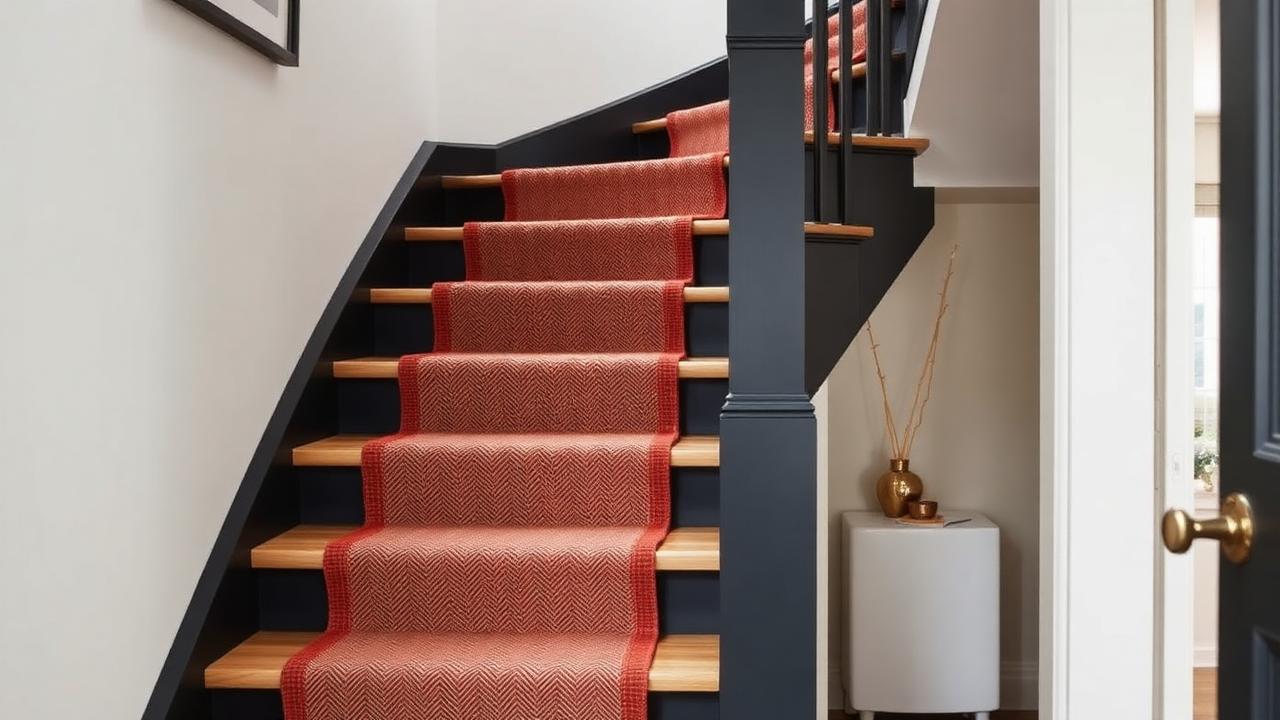
- Warm wood treads: choose a warm, wheat or camel-leaning beige.
- Painted or pale treads: choose a cooler greige to avoid a muddy contrast.
- High-traffic households: pick a mid-tone beige, not the very palest shade, to hide soiling longer between cleans.
- Pet owners: a flecked or lightly textured beige hides shed hair better than a solid flat weave.
- Small hallways: beige reflects more light than a dark runner, which helps a narrow stairwell feel less closed in.
Fibre choice and how it wears
Wool and wool-blend beige runners tend to hide the natural variation in fibre tone that comes from manufacturing, so scuffs and light soiling blend in rather than standing out as a stark mark, which is one of the practical reasons beige remains so popular on busy family stairs. A synthetic nylon or polypropylene beige runner is more stain-resistant and often cheaper, but can show a slightly flatter, more uniform colour that makes any wear patch more visible by contrast. If budget allows, a wool-blend runner in beige on a main household staircase, with a synthetic option for a secondary or basement stair, is a sensible split many households land on.
Keeping a beige runner looking fresh
Beige shows dry soiling, dust and grit more readily than a mid-brown or grey runner, simply because there's less depth of colour to camouflage it, so vacuum the treads at least weekly, more often near an entrance-adjacent staircase. A stain-resistant fibre treatment or a factory-applied stain guard is worth paying for on beige specifically, since spills, wine, coffee, muddy paw prints, show up faster and more starkly than on a darker runner. When ordering, ask your supplier whether the beige you've chosen has any stain treatment already applied, and if not, consider having one applied before fitting rather than after.
Getting the length and width right before you order is where a stair runner calculator earns its keep, because a beige runner cut even slightly short is more visually obvious than a dark one, since the pale colour draws the eye straight to any gap of exposed tread at the top or bottom of the flight. Many suppliers who sell stair runners will ask for your measured length and width up front, so having those numbers calculated correctly the first time avoids a costly reorder.
Whatever you decide, get the numbers first: the stair runner calculator doubles as a stair runner length calculator, adding nosing wrap, landings, winders, pattern repeat and waste so you order the right length the first time.
Frequently asked questions
Does beige show dirt more than other colours?
Beige shows dry dust and grit more readily than mid-brown or patterned runners because there's less depth of colour to disguise it, but it hides everyday scuffs better than pure white. Weekly vacuuming and a stain-guard treatment keep it looking fresh.
What wall colour works best with a beige stair runner?
Warm neutrals, soft whites and muted terracottas pair well with a warm beige runner, while cool greys and blue-tinted whites suit a greige. Matching the runner's undertone to your wall colour usually looks more deliberate than matching it to the tread wood alone.
Is beige a dated colour for a stair runner?
No, beige remains one of the most-ordered colours because it's genuinely versatile across wood tones and wall colours, not because it's a fallback choice. Modern beige weaves with subtle texture or a herringbone pattern read as current rather than dated.
How much beige runner do I need for a 13-step staircase?
For a typical 13-step flight with 10 in (25 cm) treads and 7.5 in (19 cm) risers, expect to order roughly 23-24 ft (7-7.3 m) once nosing wrap, finishing allowance and a waste margin are included.
Should I choose wool or synthetic for a beige runner?
Wool and wool-blends hide natural fibre variation and light wear better on a beige runner, making scuffs less visible, while synthetic fibres are cheaper and more stain-resistant but show a flatter, more uniform tone that makes any wear patch stand out more.
Will a beige runner make a dark staircase look brighter?
Yes, beige reflects considerably more light than a dark brown, navy or charcoal runner, which noticeably lifts a dim or narrow stairwell, especially one lit mainly by a single window or skylight at the top.
Can I use beige on stairs with pets or children?
Beige works fine with pets and children if you choose a mid-tone rather than the very palest shade, add a stain-resistant treatment, and pick a lightly flecked or textured weave, all of which help disguise everyday marks between cleans.
How wide should a beige runner be on a 36 in staircase?
A 27-30 in (68-76 cm) runner on a 36 in (91 cm) staircase leaves 3-4.5 in (7.5-11 cm) of exposed tread per side, which tends to look proportionate and lets warm or painted tread frame the runner nicely.
Know your numbers in 30 seconds
Enter your step count, tread depth and riser height — the stair runner calculator gives you the exact length to order, in metres and feet, with waste included.
Work out your own beige runner length with the stair runner calculatorReady for real prices?
Get quotes from vetted stair runner suppliers and fitters near you. Free, no account, no obligation.
Every guide is written from hands-on measuring and fitting experience, checked against the calculator’s own maths, and re-reviewed whenever prices or methods change. Read our editorial standards.