

The shade range you are choosing from
Blue stair runner carpet is really several distinct products wearing one search term. Pale sky and coastal blues sit at one end, reading as airy and casual but showing soil on treads faster than any other colour family. Mid denim and French blues sit in the middle, forgiving of everyday marks and compatible with almost any wall colour. Navy and ink blues sit at the dark end, behaving much like black in terms of hiding stains but showing dust, and shifting toward near-black under weak light. Deciding roughly where on this spectrum you want to land should come before you look at a single sample, because it determines fibre and construction choices too.
| Shade band | Practicality on stairs | Fades under UV? | Typical household fit |
|---|---|---|---|
| Pale sky / powder blue | Shows soil quickly, needs frequent vacuuming | Can bronze or grey under strong sun | Low-traffic or secondary staircases |
| Denim / mid blue | Good all-rounder, hides everyday marks | Moderate fading risk in surface-dyed fibre | Busy family households |
| Teal-blue | Hides soiling well, dates faster stylistically | Low to moderate | Confident, decorative interiors |
| Navy / ink | Hides stains well, shows dust and lint | Low risk if solution-dyed | Formal hallways, period homes |
Fibre and dye method: the part that actually determines longevity
Two carpets in the identical shade of blue can perform completely differently depending on how the colour was applied. Solution-dyed fibre — most commonly nylon or polypropylene — has the colour mixed into the polymer before it is extruded into yarn, so the colour runs through the entire fibre and resists UV fading and water staining far better than a surface-dyed equivalent. Surface-dyed wool and wool-blends, dyed after the yarn is spun, generally give richer, more nuanced colour but are more vulnerable to fading near windows and to colour loss from harsh cleaning chemicals.
For a stairwell with a landing window, a skylight, or any direct sun exposure on part of the flight, solution-dyed nylon in blue is the more reliable long-term choice, even though wool often wins on look and feel in a shaded stairwell. This single decision affects the finished result more than the exact shade name on the sample card.
Ask for the dye method by name
When ordering, ask directly whether the blue is solution-dyed or surface-dyed, and ask to see the dye lot number on the invoice. This matters twice: once for fade resistance, and again months later if you need to reorder extra length and want it to match without a visible seam line.
Construction and pile weight
| Spec | Recommended range for stairs | Why it matters |
|---|---|---|
| Pile weight | 1,300-1,800 g/m2 (38-53 oz/sq yd) | Below this range wears through at the nosing within two to three years |
| Pile height | 4-10 mm (0.16-0.4 in) | Lower profiles track the nosing edge more precisely and wear more evenly |
| Backing | Woven jute or synthetic action-back | Holds staples and grippers far better than a felt backing on stairs |
| Construction | Woven Axminster/Wilton or dense tufted loop | Woven patterns survive nosing abrasion; printed surface colour does not |
Sizing width and length
For a standard 36 in (91 cm) US staircase or a similar 90-100 cm UK stair, a 27-30 in (68-76 cm) runner width remains the most common proportion, leaving roughly 3-4.5 in (7.5-11 cm) of exposed timber on each side. Pale and mid-blue shades can carry a slightly wider runner without feeling heavy, since they do not read as visually dense the way navy or black does at the same width.
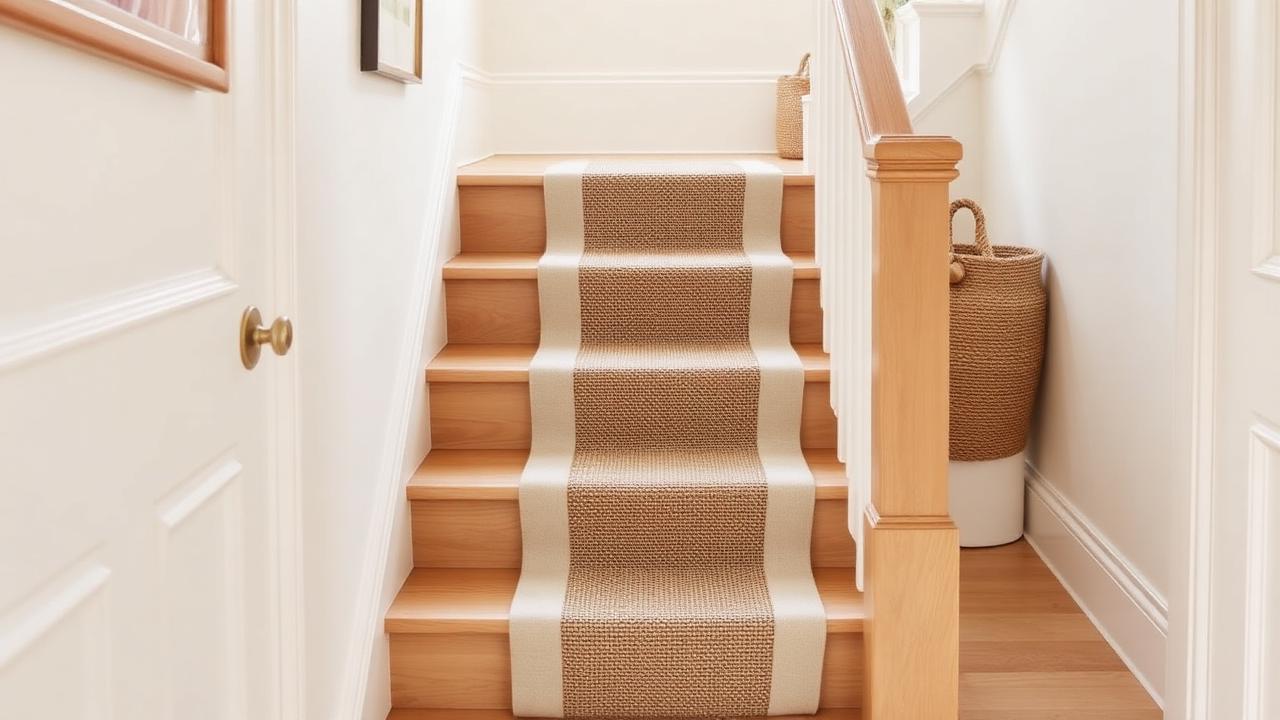
- Measure each tread depth and riser height individually, since older staircases are rarely perfectly uniform.
- Decide the runner width based on your desired exposed-timber margin, typically 3 to 5 in (7.5 to 13 cm) each side.
- Add a run-out allowance of 4-6 in (10-15 cm) at the top and bottom for future re-tensioning.
- Check any winders or curved sections separately, since a width that fits a straight run can bind on a turn.
- Confirm total length against your supplier's roll width to minimise seams, since a seam partway up a flight is far more visible in a solid colour than in a busy pattern.
- Order 5-10% extra length as a buffer for future repairs and to allow for future re-tensioning without running short.
What it costs
| Item | Typical US | Typical UK |
|---|---|---|
| Blue wool-blend runner, broadloom | $28-62 per sq yd | GBP 24-54 per sq m |
| Ready-made bound blue runner, per linear ft | $22-50 | GBP 18-40 per linear metre |
| Solution-dyed nylon runner, broadloom | $26-55 per sq yd | GBP 22-48 per sq m |
| Underlay (stair grade) | $4-9 per sq yd | GBP 5-9 per sq m |
| Fitting, straight flight | $28-56 per step | GBP 22-46 per step |
A thirteen-step straight flight in a solid mid-blue wool-blend, fitted with underlay, typically comes in around the low-to-mid four figures in dollars or a comparable sum in pounds; pale shades that need more frequent replacement due to soiling can end up costing more over a decade than a slightly pricier, more soil-hiding mid-tone. Put your own numbers through a stair carpet cost calculator to compare that lifetime cost, not just the initial invoice.
Code notes
Neither IRC R311.7 in the US nor Approved Document K / Part K in the UK specify carpet colour, but both require a slip-resistant, structurally sound tread surface with a consistent, perceivable nosing. Choosing a moderate pile height and a construction with reasonable underfoot grip, rather than the deepest or plushest option on offer, keeps a blue runner comfortably within the spirit of both frameworks while still looking soft underfoot.
Care and lifespan
Vacuum weekly on a family staircase, more often for pale blue shades, and blot rather than rub any spill to avoid opening the pile and creating a lighter patch. Keep a labelled offcut in dry storage for future repairs, and note the dye lot on your paperwork, since blue shades in particular can shift noticeably between production runs of the same named colour.
Know your numbers in 30 seconds
Enter your step count, tread depth and riser height — the stair runner calculator gives you the exact length to order, in metres and feet, with waste included.
Open the stair runner calculatorWhatever you decide, get the numbers first: the stair runner calculator doubles as a stair runner length calculator, adding nosing wrap, landings, winders, pattern repeat and waste so you order the right length the first time.
Frequently asked questions
What is the most practical blue for a busy family staircase?
A mid denim or French blue is generally the best all-rounder, hiding everyday marks better than pale sky blue while showing dust less obviously than a very dark navy. It also pairs comfortably with most wall colours and timber tones.
Does solution-dyed blue carpet really matter?
Yes, especially near windows or skylights. Solution-dyed fibre has colour mixed in before extrusion, so it resists UV fading and staining far better than surface-dyed carpet, which can visibly fade or bronze on the sun-exposed section of a staircase within a few years.
How wide should blue stair runner carpet be?
27 to 30 inches suits a standard 36 inch staircase, leaving 3 to 4.5 inches of exposed timber each side. Pale and mid-blue shades can comfortably carry a slightly wider runner than navy or black without feeling visually heavy.
Why does my blue sample look different once fitted?
Stairs are lit unevenly and viewed at a steep angle across both tread and riser faces, so a colour that looks accurate on a flat sample board under showroom light can shift noticeably once installed. Always tape a sample to an actual tread and riser and check it under your own lighting.
What pile weight should I ask for?
Aim for 1,300 to 1,800 grams per square metre (roughly 38 to 53 ounces per square yard) for a main staircase. Anything lighter is typically a bedroom-grade product that will show wear at the nosing within two to three years of daily use.
Is pale blue a bad choice for stairs?
Not necessarily, but it needs more maintenance. Pale sky and powder blue shades show soiling and traffic marks faster than mid or dark blues, so they suit lower-traffic or secondary staircases better than a main family flight used many times a day.
Can I match a reorder of blue carpet to my original install?
Only reliably if you kept the dye lot number from the original invoice. Blue shades in particular can shift subtly between production runs of the same named colour, so an unlabelled reorder months or years later carries a real risk of a visible mismatch.
Know your numbers in 30 seconds
Enter your step count, tread depth and riser height — the stair runner calculator gives you the exact length to order, in metres and feet, with waste included.
Measure my staircaseReady for real prices?
Get quotes from vetted stair runner suppliers and fitters near you. Free, no account, no obligation.
Every guide is written from hands-on measuring and fitting experience, checked against the calculator’s own maths, and re-reviewed whenever prices or methods change. Read our editorial standards.