
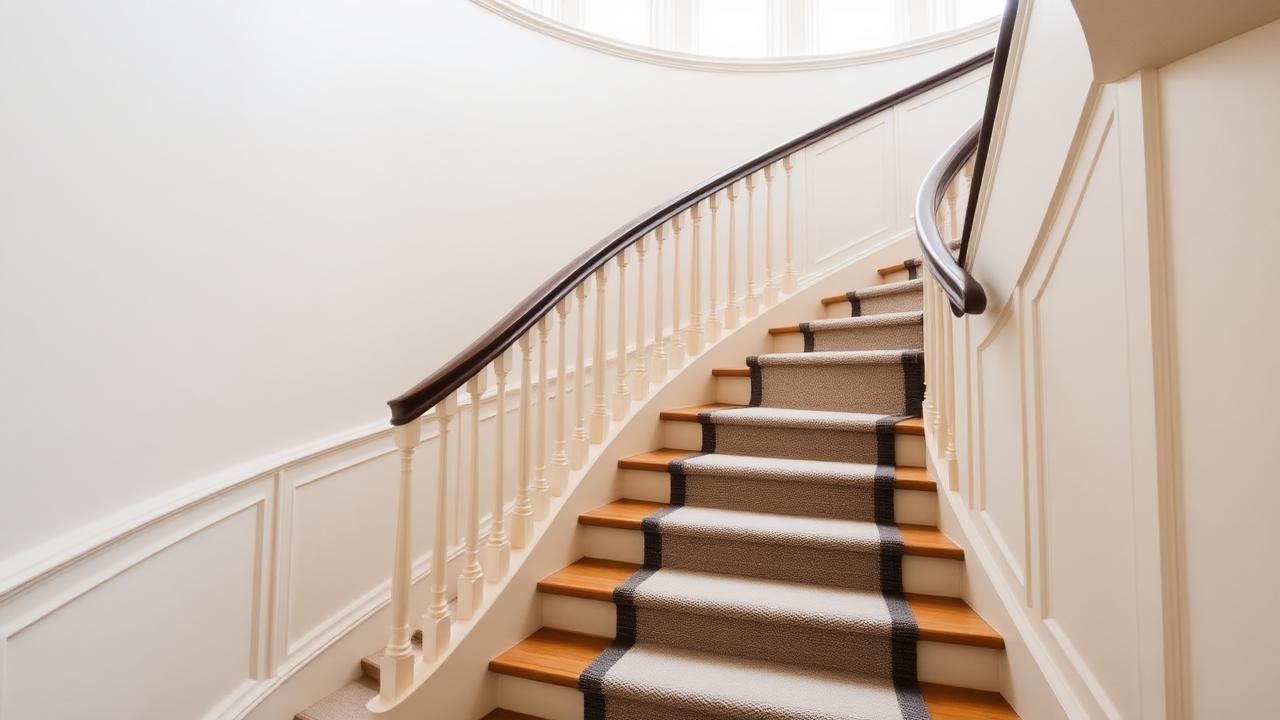
What makes a bullnose step different
A bullnose step has a rounded, projecting nose that extends beyond the stringer, single bullnose on one side or double bullnose curving around both sides. Because the tread's outline is curved rather than square, the runner cannot simply be cut to a rectangle at that step; it needs to be shaped to wrap the curve cleanly.
Wrapped versus waterfall finish on a bullnose
| Finish | How it handles the curve | Look | Extra material |
|---|---|---|---|
| Wrapped (fitted) | Runner is cut and tucked to follow the curved nose exactly | Tailored, formal | 15–25% at that step |
| Waterfall | Runner falls straight over the nose without hugging the curve | Relaxed, casual | 5–10% at that step |
| Capped separately | A separate matching piece caps the bullnose, seamed at the back edge | Very neat but visible seam | 10–15% at that step |
Measuring the bullnose
- Measure the straight run of the flight normally, tread plus riser per step.
- At the bullnose step, measure around the curve with a flexible tape, not straight across, to capture the true wrap distance.
- Add the extra wrap distance as a separate allowance for that single step rather than averaging it into the whole flight.
- If double bullnosed, repeat the curved measurement on both sides and allow for extra width too, since the tread is often wider than the flight above.
Template the bullnose before cutting
Because every bullnose is a slightly different radius, most fitters make a paper template of that one step even when the rest of the flight is measured with a tape.
Know your numbers in 30 seconds
Enter your step count, tread depth and riser height — the stair runner calculator gives you the exact length to order, in metres and feet, with waste included.
Open the stair runner calculatorIs it a DIY job?
| Step type | Extra length allowance | Difficulty | DIY-able |
|---|---|---|---|
| Straight standard step | Standard tread + riser | Easy | Yes |
| Single bullnose | 15–20% extra at that step | Hard | Experienced DIY only |
| Double bullnose | 20–25% extra at that step | Very hard | Fitter recommended |
Safety and building-code notes
Stairs are one of the most common places for a fall in the home, so anything touching fitting a stair runner over a bullnose step should be checked against basic safety practice as well as good looks. Codes vary by jurisdiction but the underlying principles are consistent everywhere carpet meets a staircase.
- Keep nosing build-up modest; a lip much over 3/8 in (10 mm) between the runner and a bare edge becomes a trip hazard.
- Use a slip-resistant backing or pad, particularly on the top and bottom steps where speed is highest.
- Secure every edge fully; a loose corner or lifted seam is the single most common cause of a stair fall on carpeted stairs.
- In rented or multi-occupancy buildings, check local fire and flooring regulations before installing natural fibre runners.
Tools and materials, with typical prices
Before starting anything connected to fitting a stair runner over a bullnose step, it helps to know what the job actually costs in tools and consumables, not just carpet. Most of this list is a one-off purchase that will be reused on future stair or rug projects, so it is worth buying reasonable quality rather than the cheapest option.

- Tape measure and chalk line: $15-30 (£12-24), for marking and checking dimensions.
- Utility knife and spare blades: $10-20 (£8-16), for clean cuts through backing.
- Staple gun or tackless strip and knee kicker: $40-150 (£30-120) depending on method.
- Underlay/pad, per step: $3-6 (£2.50-5), skip only where the fibre specifies no pad.
- Seam tape or adhesive for joins: $8-15 (£6-12) per roll or tube.
DIY vs hiring a fitter
A single bullnose step is achievable for an experienced DIYer who has already fitted straight treads, provided a template is made first and the curve is dry-fitted before any cutting. A double bullnose, or any bullnose needing a fully wrapped finish, is one of the few individual steps genuinely worth paying a fitter for, since the visible curve leaves no room to hide an uneven cut.
Curved gripper rod for a bullnose
Standard straight gripper rod cannot follow a curved bullnose nose, so fitters use a flexible or pre-curved gripper strip specifically made for rounded steps, cut and bent to match the exact radius of that tread. Using straight gripper cut into short segments as a substitute is possible but leaves small gaps between segments that can work loose over time, so a proper curved gripper product is worth the modest extra cost on a step that gets heavy traffic.
Matching the bullnose to the rest of the flight
Because the bullnose step is usually wider than the treads above it, and often a different colour of wood is visible around its edge if the runner does not fully cover it, plan the runner's width and margin at this step before finalising the width for the rest of the flight. A width that looks proportionate on a standard tread can look narrow and lost on a wide bullnose bottom step, so many fitters slightly increase the visual weight of the runner at the bullnose with a wider border or a subtly wider overall width.
Common bullnose fitting mistakes
- Cutting the runner to a straight edge and forcing it around the curve, causing visible puckering.
- Using straight gripper segments instead of curved gripper, leading to lifting after a few months.
- Skipping a template and guessing the wrap distance, which almost always comes up short.
- Choosing a stiff, heavily backed runner that will not conform to a tight bullnose radius without cracking the backing.
Choosing runner width relative to the bullnose
Because a bullnose step is wider than the treads above it, most homeowners keep the runner width consistent with the rest of the flight and let the extra bullnose width show as exposed wood or stone on both sides, rather than widening the runner just for that one step. A wider custom-cut runner for the bullnose alone is possible but adds a bespoke cutting charge, typically $30-60 (£25-50) extra, and can look disproportionate once fitted.
Whatever you decide, get the numbers first: the stair runner calculator doubles as a stair runner length calculator, adding nosing wrap, landings, winders, pattern repeat and waste so you order the right length the first time.
Still deciding on material, width or pattern? Our hub on stair runners compares weaves, widths, backings and fitting styles side by side, then hands the numbers straight to the calculator.
Frequently asked questions
What is a bullnose step?
A bottom step with a rounded, projecting nose extending beyond the stringer on one side (single bullnose) or both sides (double bullnose), requiring the runner to be shaped rather than simply cut square.
How much extra carpet does a bullnose step need?
Around 15 to 25 percent more material at that step alone compared with a standard square step, depending on whether it is single or double bullnosed and whether the finish is wrapped or waterfall.
Can a stair runner be DIY fitted over a bullnose step?
It is possible for an experienced DIYer with a single bullnose, but a double bullnose or a wrapped finish is difficult to get neat and is usually better left to a professional fitter.
Should a bullnose step use waterfall or wrapped carpet?
Wrapped gives the neatest, most tailored look and follows the curve exactly, while waterfall is simpler and uses less material but sits more loosely over the nose.
What is the biggest mistake people make with this?
Rushing the measuring or prep stage. Most poor outcomes with fitting a stair runner over a bullnose step trace back to a single measurement taken at the wrong point, or a substrate check skipped to save a few minutes, both far cheaper to fix before the runner is cut than after.
Can straight gripper rod be used on a bullnose step?
It can be cut into short segments as a workaround, but proper flexible or pre-curved gripper made for rounded steps holds better and avoids the small gaps that let carpet lift over time.
Should the runner be wider at a bullnose bottom step?
Often yes. Bullnose steps are typically wider than the treads above, and a runner width that suits the rest of the flight can look narrow and lost there, so a wider border or width is common at that step.
Does a bullnose step need its own underlay piece?
Yes, cut a separate shaped underlay piece for the curved nose rather than trying to stretch a rectangular offcut around it, since a mismatched pad shape can show through as an uneven bulge.
Know your numbers in 30 seconds
Enter your step count, tread depth and riser height — the stair runner calculator gives you the exact length to order, in metres and feet, with waste included.
Measure my bullnose stepReady for real prices?
Get quotes from vetted stair runner suppliers and fitters near you. Free, no account, no obligation.
Every guide is written from hands-on measuring and fitting experience, checked against the calculator’s own maths, and re-reviewed whenever prices or methods change. Read our editorial standards.