

Why burgundy still holds up as a stair runner colour
Burgundy has been a stock stair runner colour for well over a century, and it hasn't stuck around by accident - it's one of the few dark colours that adds genuine warmth to a hallway rather than just adding depth. On a staircase with dark wood banisters and treads, a lighter grey or navy runner can sometimes feel like it's fighting the wood tone, whereas burgundy sits within the same warm family and ties the whole run together. It's particularly effective in Victorian and Edwardian houses with original woodwork, where a runner in burgundy or a burgundy-and-cream stripe looks period-appropriate rather than like a modern insertion into an old building.
It's also a genuinely practical colour for a busy household. Deep red-brown tones hide the kind of everyday marks - muddy shoe scuffs, a dropped glass of red wine, general grey wear shadowing at the tread edge - that show up far more obviously on lighter stair runners. I've fitted burgundy runners in front hallways with young kids and dogs specifically because clients wanted something that would still look presentable between deep cleans, and it does that job better than most colours in the mid-to-dark range.
Choosing the right shade and finish
Burgundy carpet ranges from a near-maroon that reads almost brown in low light, through to a brighter wine-red that leans closer to true red. The near-maroon end works best against dark wood and traditional interiors, while the brighter wine-red end suits more contemporary spaces and pairs well with black stair rods and pale walls for contrast. Always view your sample against your actual staircase and lighting before ordering, because burgundy is a colour that shifts noticeably between warm incandescent-style bulbs, which deepen it further, and cool white LED bulbs, which can flatten it toward a duller brown-red.
Wool and wool-blend constructions again do the best job of holding burgundy's richness through years of foot traffic, since the fibre takes the dye with more depth than most synthetics. A wool-blend twist is a sensible middle ground for most households, balancing the richer colour of wool against the practicality and lower price of a synthetic backing and blend fibre content.
Check the shade against wood, not just walls
Burgundy interacts with wood tone more than wall colour. Hold your sample against the actual stair treads and banister, not just a paint swatch, since the wood-to-carpet relationship is what determines whether the shade reads as warm or muddy.
How much runner do I need?
Take a US worked example on a 13-step flight: 10 in tread run, 7.5 in riser height, and a 0.75 in nosing wrap allowance per step, giving 18.25 in per step. Across 13 steps that's 237.25 in, or 19.77 ft. Add a 24 in combined finishing allowance top and bottom for 261.25 in, or 21.77 ft, then apply a 7% waste margin to reach roughly 23.3 ft. Round up and order 23-24 ft to allow for a clean cut at both ends without coming up short mid-installation.
In UK measurements the same staircase is 25 cm tread run, 19 cm riser height, and 1.9 cm nosing wrap, giving 45.9 cm per step. Multiplied across 13 steps that's 596.7 cm, plus a 60 cm finishing allowance for 656.7 cm, then a 7% waste margin brings the total to roughly 7.03 m. If your staircase has a turn or half landing, measure that section separately following the actual walked line rather than a straight tape pull, and add it to your straight-run totals before applying the waste margin.
| Measurement | US (in/ft) | UK (cm/m) |
|---|---|---|
| Tread run | 10 in | 25 cm |
| Riser height | 7.5 in | 19 cm |
| Nosing wrap per step | 0.75 in | 1.9 cm |
| Per-step total | 18.25 in | 45.9 cm |
| 13 steps subtotal | 19.77 ft | 5.97 m |
| Plus finishing allowance | 21.77 ft | 6.57 m |
| With 7% waste margin | 23.3 ft | 7.03 m |
Know your numbers in 30 seconds
Enter your step count, tread depth and riser height — the stair runner calculator gives you the exact length to order, in metres and feet, with waste included.
Open the stair runner calculatorPattern and border options
A plain burgundy runner is the classic, safest choice and works in almost any period home, but a burgundy-and-cream or burgundy-and-gold stripe is a close second choice that adds a bit more visual interest without straying from the traditional feel. Herringbone-weave burgundy has become more popular over the last decade, giving the runner a subtle textured look that catches light differently across the flight rather than reading as one flat colour block, which can be especially useful on longer straight staircases where a plain colour can start to look monotonous over a dozen or more steps.
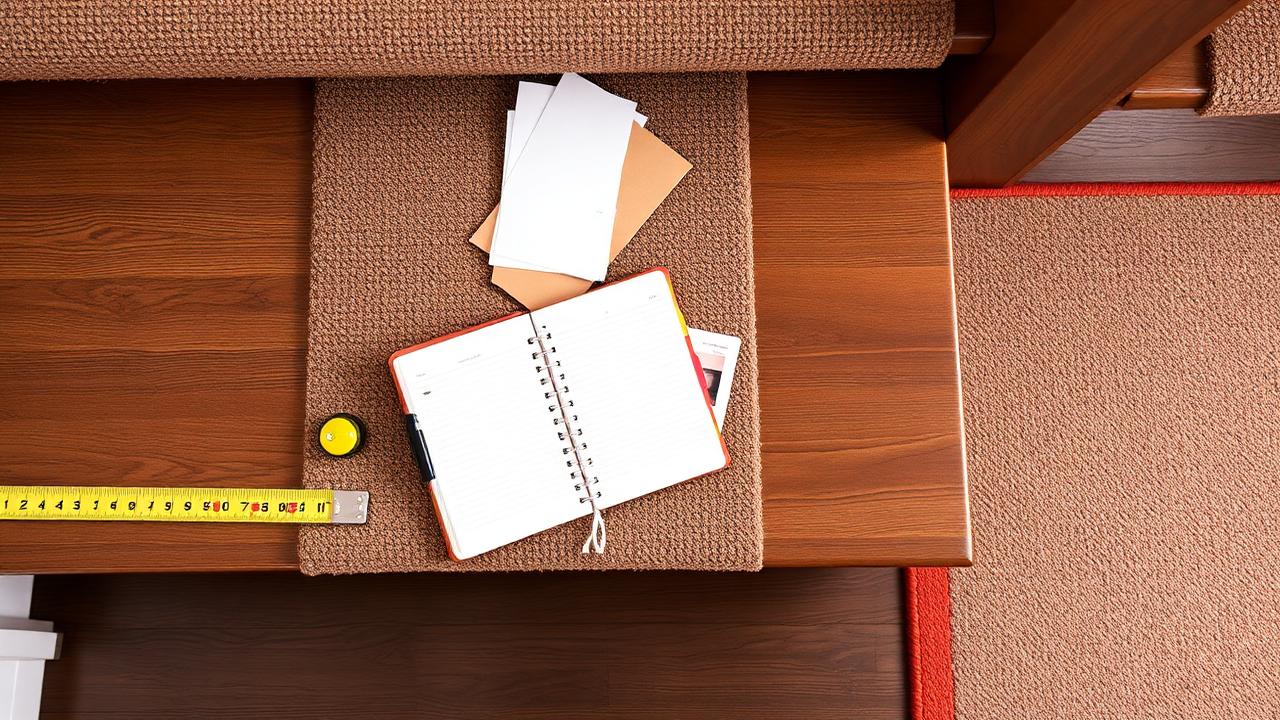
- Plain burgundy - the classic period-home choice, works with almost any wood tone.
- Burgundy and cream stripe - adds contrast and period detail without losing the warm tone.
- Burgundy herringbone - subtle texture, good on longer straight flights.
- Burgundy with a narrow gold or cream border - keeps the runner visually defined against dark treads.
Fitting and maintenance notes
Burgundy carpet fits exactly like any other colour - stair rods, tackless strip, or a fully bonded and glued fit are all options depending on your staircase and how often you expect to want to lift and refit the runner. One practical tip specific to darker reds: vacuum with a brush head rather than a bare suction nozzle where possible, since a bare nozzle can leave faint drag marks that show up more visibly against a rich, saturated colour like burgundy than they would on a lighter or more patterned runner.
Burgundy also fades a little more visibly than some colours if a section of the staircase gets consistent direct sunlight, since the red dye components in a deep wine tone are more prone to UV fade than blue-based dyes used in navy or grey runners. If your staircase has a large window at a landing that floods a section of the flight with direct sun for part of the day, consider a UV-stabilised carpet fibre or a window film to slow the fading, since a sun-faded patch on an otherwise rich burgundy runner is one of the more noticeable colour issues to fix after the fact.
Working out cost and using the calculator
Burgundy stair runner carpet is priced in line with other solid colours of the same fibre and construction, so the material choice itself doesn't usually carry a colour premium the way some custom-dyed or hand-tufted colours can. What does change your total spend is the length you order, which is exactly why getting the sizing right first matters before you start comparing supplier quotes. Running your tread run, riser height and step count through a stair runner calculator gives you a consistent length figure to quote against multiple suppliers, so you're comparing genuinely equivalent lengths of stair runners rather than differing waste assumptions baked into each supplier's own quote.
Whatever you decide, get the numbers first: the stair runner calculator doubles as a stair runner length calculator, adding nosing wrap, landings, winders, pattern repeat and waste so you order the right length the first time.
Frequently asked questions
Does burgundy stair runner carpet suit modern homes?
It can, particularly a brighter wine-red shade paired with black stair rods and pale walls for contrast, but burgundy is most at home in period properties with dark wood staircases where its warm tone complements the existing woodwork.
How much burgundy runner do I need for 13 steps?
For a 13-step flight with 10 in (25 cm) treads and 7.5 in (19 cm) risers, budget roughly 23-24 ft (6.9-7.2 m) including nosing wrap, finishing allowance and a 7% waste margin, adjusted for your own measurements.
Does burgundy carpet fade in sunlight?
Red-based dyes used in burgundy are somewhat more prone to UV fading than blue-based dyes, so a staircase section with consistent direct sun exposure may fade faster than the rest of the runner. UV-stabilised fibre or window film can slow this.
What stair rods suit burgundy carpet?
Brass and antique brass rods are the traditional pairing and suit period homes well, while black or matte bronze rods give a slightly more contemporary contrast against a brighter wine-red shade of burgundy.
Is burgundy good at hiding stains and wear?
Yes, deep red-brown tones hide muddy scuffs, general foot traffic shadowing and light staining noticeably better than pale or mid-grey stair runner carpet, making it a practical choice for busy households.
Should I choose wool or synthetic burgundy carpet?
Wool and wool-blend burgundy hold the colour's richness better over years of wear because the fibre takes dye more deeply. A wool-blend twist gives a good balance of colour depth, durability and price for most households.
Does burgundy work with grey walls?
Yes, burgundy against cool grey walls creates a deliberate warm-cool contrast that reads as considered rather than clashing, provided the wood tones on the staircase itself lean warm to bridge the two colours.
Can I get burgundy in a striped or patterned runner?
Yes, burgundy-and-cream or burgundy-and-gold stripes are widely available and are a popular alternative to plain burgundy in period homes, along with subtle burgundy herringbone weaves for a more textured, contemporary look.
Know your numbers in 30 seconds
Enter your step count, tread depth and riser height — the stair runner calculator gives you the exact length to order, in metres and feet, with waste included.
Get your exact figure from the stair runner length calculatorReady for real prices?
Get quotes from vetted stair runner suppliers and fitters near you. Free, no account, no obligation.
Every guide is written from hands-on measuring and fitting experience, checked against the calculator’s own maths, and re-reviewed whenever prices or methods change. Read our editorial standards.