
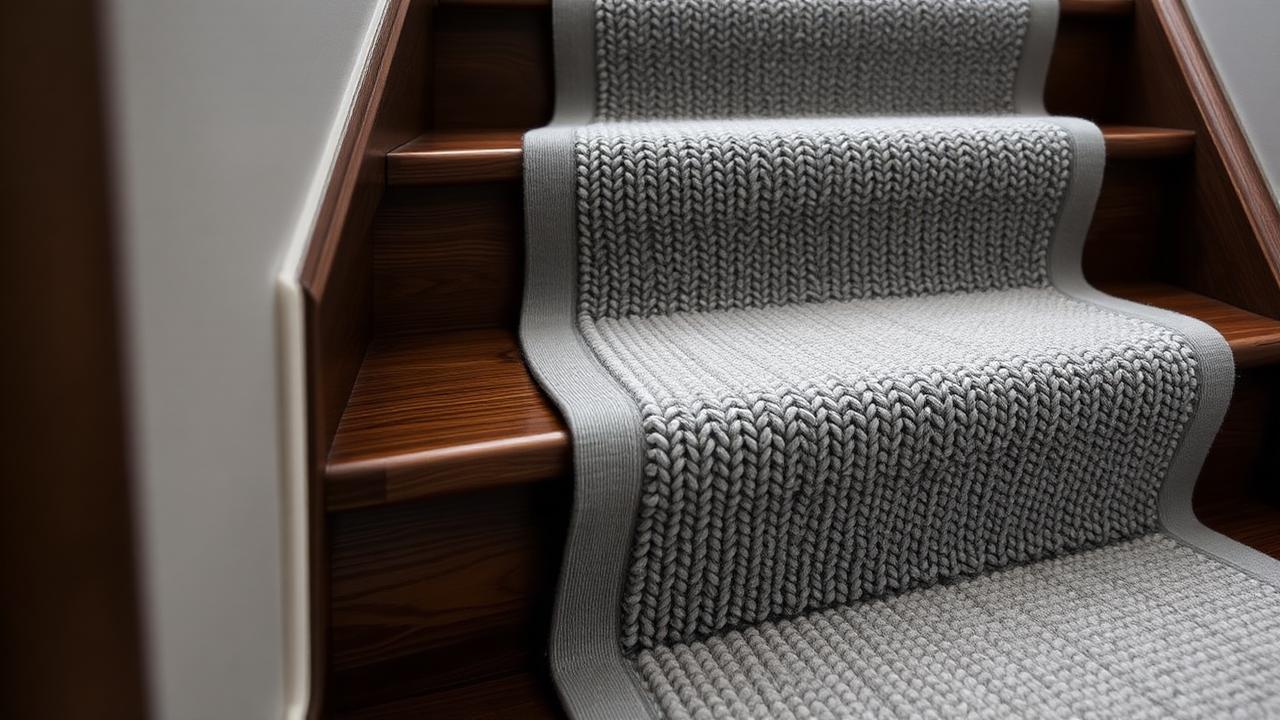
Why full stair carpet is measured differently to a runner
A stair runner is generally a fixed width narrower than the stair, so runner calculations use the runner's own width. Full carpet instead uses your actual stair width, wall to wall (minus a small trim allowance), and needs enough length to wrap every tread and riser edge to edge with no exposed timber margin, which changes both the total yardage and how forgiving the job is of small measuring errors.
The core carpet calculation
- Measure stair width wall-to-wall (or string-to-string, minus trim allowance).
- Measure the wrap depth per step: tread going plus riser height plus a little extra to dress into the angle, commonly totalling roughly 500-600mm (20-24in) per step depending on riser and going.
- Multiply wrap depth per step by the number of steps (treads plus risers together as one continuous wrap, or per-step if fitted in pieces) to get total running length.
- Multiply total running length by stair width to get area, then convert to your supplier's selling units (square metres or square yards).
- Add a waste allowance for pattern matching, cutting and winders.
| Steps | Stair width | Approx. wrap depth/step | Approx. total length needed |
|---|---|---|---|
| 13 | 900mm / 35.4in | ≈550mm / 21.7in | ≈7.2m / 23.6ft |
| 15 | 1,000mm / 39.4in | ≈580mm / 22.8in | ≈8.7m / 28.5ft |
| 16 | 900mm / 35.4in | ≈550mm / 21.7in | ≈8.8m / 28.9ft |
These figures are close estimates for planning purposes. Fitters and suppliers commonly do their own detailed take-off from a site visit, since actual carpet consumption depends heavily on how the fitter chooses to wrap and join pieces, and on whether the roll width allows full-width pieces or requires seaming.
Waste and pattern allowance
| Carpet type | Typical waste allowance |
|---|---|
| Plain, non-patterned | ≈10% |
| Simple repeating pattern | ≈15% |
| Directional or large-repeat pattern | ≈20-25% |
| Winders and turns present | Add a further ≈5-10% on top of the above |
Pattern repeat drives the biggest swings in quantity
A bold or large-repeat pattern can add far more waste than a small measuring error ever would, because every step usually needs to start the pattern at a consistent point. Confirm the pattern repeat size with your supplier before finalising quantity, especially on a long flight.
Winders and landings
Winder treads are wider at one end than the other, so they consume more carpet width per step than a straight tread, and pattern matching around a winder is one of the hardest parts of a stair-fitting job. Landings are typically carpeted separately from the stair flight itself, often from the same roll, and should be added to your quantity as their own area calculation rather than folded into the per-step figure.
Know your numbers in 30 seconds
Enter your step count, tread depth and riser height — the stair runner calculator gives you the exact length to order, in metres and feet, with waste included.
Open the stair runner calculatorUnderlay and gripper for full-width carpet
Full-width carpet needs full-width underlay and gripper, unlike a runner which only needs gripper the width of the runner itself. Order underlay to the same area as the carpet itself, and gripper as a running length equal to roughly the total wrap length calculated above, since gripper is fixed along both the tread and riser edges.
When to get a professional measure
- Any staircase with winders, as pattern and quantity estimates get considerably harder to do accurately from a tape measure alone.
- Bold, large-repeat or directional patterns, where a small quantity error can leave the flight unmatched partway up.
- Very wide staircases where roll width forces seaming, which changes how much waste a fitter needs to allow.
- Any staircase where the treads or risers are not uniform in size.
- Whenever the calculator estimate is close to a full roll or a supplier's minimum order quantity, since a professional measure can avoid over-ordering.
Common carpet stair calculation mistakes
- Using a stair runner's narrower-width calculation method for a full wall-to-wall carpet job.
- Forgetting to add pattern repeat waste on top of standard cutting waste.
- Treating winder treads as standard width when they consume noticeably more carpet.
- Not ordering matching underlay and gripper quantities alongside the carpet itself.
- Skipping a professional measure on a patterned or winder staircase to save a small fee, then discovering a shortfall mid-job.
Comparing full carpet against a stair runner on the same flight
A lot of homeowners weigh up full wall-to-wall carpet against stair runners on the same staircase before ordering, and the deciding factors are usually cost, look and how much of the timber string and tread edge they want left on show. On a 13-step flight roughly 900mm (35.4in) wide, full carpet needs the whole width covered, while a typical runner is ordered somewhere around 600-700mm (24-28in) wide, leaving a timber margin either side. A stair runner calculator works from the same tread going and riser height as the full-carpet method above, but multiplies by the narrower runner width instead of the full stair width, so material quantity - and cost - drops substantially even before you account for the cheaper timber finish either side needing no covering at all.

| Approach | Width used | 13-step approx. area (900mm/35.4in stair) | Exposed timber margin? |
|---|---|---|---|
| Full wall-to-wall carpet | ≈900mm / 35.4in (full stair width) | ≈6.5m² / 70sq ft | No |
| Stair runner (typical width) | ≈650mm / 25.6in | ≈4.7m² / 50sq ft | Yes, both sides |
If you are still deciding, it is worth running both calculations side by side - the full-carpet method on this page, and a separate stair runner calculator pass at your chosen runner width - since the material saving on a runner is often significant enough to justify a higher-quality carpet at a narrower width for a similar total spend.
Roll width and seaming
Broadloom carpet commonly comes in roll widths around 3.66m or 4m (12ft or 13ft), and most domestic staircases at 900mm-1,000mm (35-39in) wide fit within that roll width with the pile running up the flight, avoiding a seam altogether. Wider stairs, or carpet ordered in a narrower roll width (common with some wool and patterned ranges, often 68-80cm/27-32in), may force a seam somewhere along the run, and a seam on a stair is far more visible and more prone to lifting than a seam on a flat floor, so it is worth checking your chosen carpet's roll width against your stair width before ordering.
| Common roll width | Fits full stair width without seaming? |
|---|---|
| ≈3.66m / 12ft (broadloom) | Yes, for almost all domestic stair widths |
| ≈68-80cm / 27-32in (narrow wool rolls) | Rarely - usually needs seaming or is better suited to a runner |
This is another reason narrow-roll wool carpets are so often used as stair runners rather than full-width carpet: a 68-80cm roll comfortably covers a typical runner width with no seam, whereas the same roll would need joining to cover a full 900mm+ stair width.
Fibre choice and how it affects yardage and durability
Fibre choice affects both how much carpet you need and how it performs on a stair, which is one of the highest-wear areas in most homes. Wool and wool-blend carpets are the most common choice for stairs because they hold their pile and resist crushing on the nosing edge better than most synthetics, but they are usually sold in narrower roll widths, which is exactly why wool is so often chosen for stair runners rather than full-width carpet. Synthetic fibres such as nylon or polypropylene are typically cheaper and come in wider broadloom rolls suited to full-width stair carpet, but tend to crush and flatten on the nosing edge faster under heavy daily use.
| Fibre | Typical roll width | Stair-nosing wear resistance | Common use on stairs |
|---|---|---|---|
| Wool / wool-blend | ≈68-80cm / 27-32in | Very good | Runners, feature stairs |
| Nylon | ≈3.66-4m / 12-13ft broadloom | Good | Full-width carpet, family stairs |
| Polypropylene | ≈3.66-4m / 12-13ft broadloom | Fair | Budget full-width carpet |
Whichever fibre you choose, the nosing edge of every tread wears faster than the flat of the tread or the riser, so many fitters recommend moving the carpet or runner slightly (sometimes called 'move up' or periodic repositioning) every few years on a high-traffic flight, which is only practical if the original quantity ordered included a little extra length for that adjustment - another reason to round up rather than order the bare calculated minimum.
Whatever you decide, get the numbers first: the stair runner calculator doubles as a stair runner length calculator, adding nosing wrap, landings, winders, pattern repeat and waste so you order the right length the first time.
Frequently asked questions
How much carpet do I need for stairs?
Multiply the wrap depth per step (tread going plus riser height plus a small dressing allowance, commonly around 500-600mm/20-24in total) by the number of steps, then by stair width, and add a waste allowance of roughly 10-25% depending on pattern.
How is a full stair carpet calculation different from a runner calculation?
Full carpet uses your actual wall-to-wall stair width rather than a narrower runner width, and typically needs a higher waste allowance because there is no exposed timber margin to absorb small cutting errors.
How much extra carpet should I order for a pattern?
A simple repeating pattern often needs around 15% waste, while a large or directional repeat can need 20-25% or more, since most patterns should start at a consistent point on every step.
Do winders need extra carpet?
Yes. Winder treads are wider at one end than the other and consume more carpet per step than a straight tread, and pattern matching around a winder typically needs additional allowance.
Should landing carpet be included in the stair calculation?
It is usually calculated separately as its own area, often cut from the same roll, rather than folded into the per-step stair calculation.
Do I need special underlay for full stair carpet?
Yes, full-width underlay sized to the same area as the carpet, along with gripper along both the tread and riser edges at roughly the total wrap length.
When should I get a professional carpet measure instead of estimating?
For any staircase with winders, a bold or large-repeat pattern, non-uniform treads, or where roll width will force seaming — all of these make a DIY estimate considerably less reliable.
What is 'wrap depth per step' in a carpet stair calculation?
The length of carpet needed to cover one tread going, one riser height, and a small extra allowance to dress the carpet into the angle at the back of the step.
Know your numbers in 30 seconds
Enter your step count, tread depth and riser height — the stair runner calculator gives you the exact length to order, in metres and feet, with waste included.
Calculate my carpet quantityReady for real prices?
Get quotes from vetted stair runner suppliers and fitters near you. Free, no account, no obligation.
Every guide is written from hands-on measuring and fitting experience, checked against the calculator’s own maths, and re-reviewed whenever prices or methods change. Read our editorial standards.