
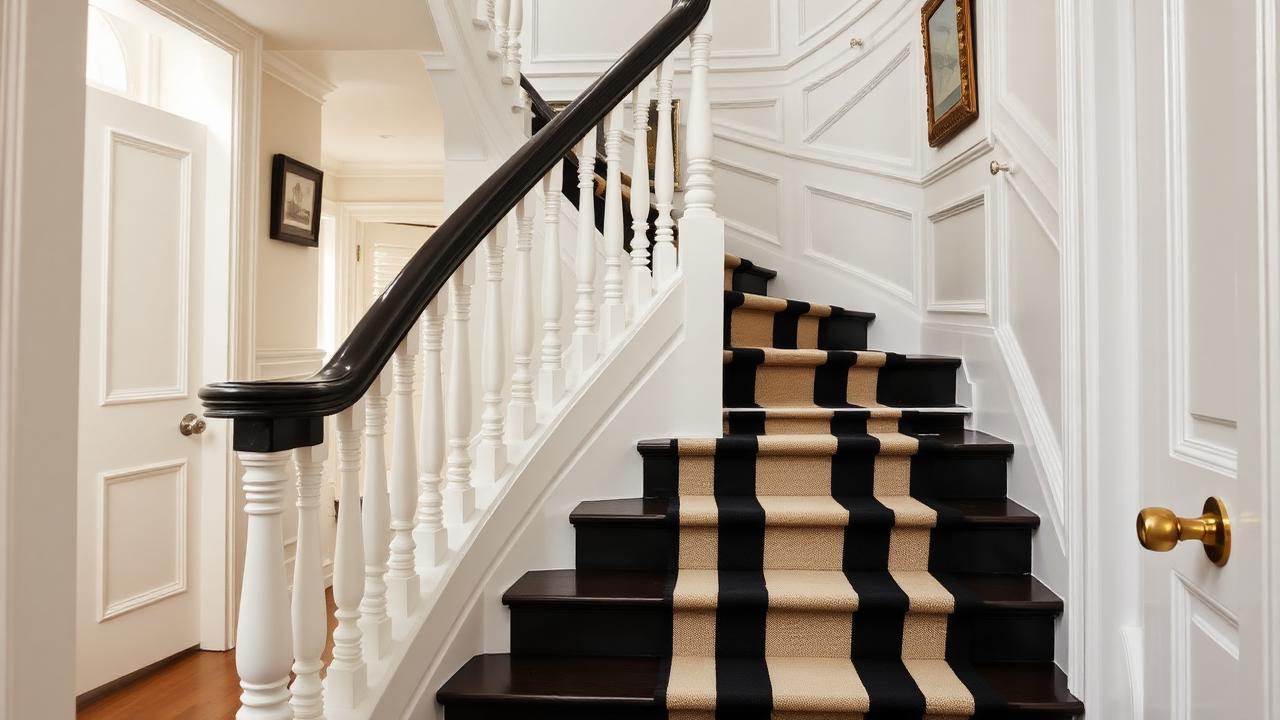
What makes chevron different from a plain weave
Chevron is a directional pattern. Two strips of yarn run at an angle and meet in the middle to form a V, repeated down the length of the runner, so the eye reads a continuous zigzag rather than a random texture. On a flat hallway that's straightforward, but on a staircase the pattern has to fold around the nosing of every step and still look aligned when you stand at the bottom and look up. I've fitted chevron on a dozen or so flights now and the ones that look wrong almost always come down to the fitter not accounting for how much the point shifts when the runner wraps a nosing versus when it lies flat.
Most chevron stair runners are woven with a set repeat length, often somewhere between 4 in and 8 in (10-20 cm), and that repeat has to be considered against your own going and riser measurements before you order. If the repeat doesn't divide neatly into your step dimensions, the point of the chevron will land in a slightly different spot on each tread, which is fine to some people and genuinely irritating to others once they notice it. Ask the supplier for the exact repeat before you buy, not after.
Matching the point across every step
The classic fitting mistake with chevron is cutting each stair pad from the roll without checking where the point falls first. On a straight flight the safest approach is to lay the full length out flat before cutting, mark where the point sits at each step interval, and only then start fixing from the top or bottom. If the point drifts by more than about a quarter of an inch (6 mm) from step to step, it will be visible from the bottom of the stairs looking up, which is the angle most people actually view a staircase from day to day.
Winders and landings are where chevron gets genuinely tricky. A straight flight keeps the zigzag reading cleanly because every tread is the same width, but a winder tapers, which means the point either has to shift off-centre or the pattern has to be deliberately broken at that step. Most fitters I know either centre the pattern on the widest part of the winder and accept a small shift, or they use a plain-colour capping strip at the winder to break the pattern intentionally rather than let it look like a mistake. Either way, decide this before the runner is cut, not on the day of fitting.
Order extra for pattern loss
Because chevron has to be matched across steps, expect to lose more offcut length than with a plain or striped runner. Budget 10% waste rather than the usual 5-7% if your staircase has any winders or a half-landing.
How much runner do I need?
Take a US flight of 13 steps, each with a 10 in tread run and a 7.5 in riser height, plus a 0.75 in nosing wrap. Per step that's 18.25 in, and across 13 steps that's 237.25 in, or 19.77 ft. Add a top and bottom finishing allowance of 12 in each, 24 in total, bringing the running length to 261.25 in, or 21.77 ft. Because chevron needs pattern matching, apply a 10% waste margin instead of the usual 5-7%, which lands you at roughly 23.9 ft, so order 24 ft to leave a small safety margin for re-cuts if the first attempt at matching doesn't land cleanly.
In UK metric terms, the same flight is 25 cm tread run, 19 cm riser height and 1.9 cm nosing wrap, giving 45.9 cm per step and 596.7 cm across 13 steps. Add 60 cm finishing allowance for 656.7 cm, then apply the 10% pattern-matching waste margin to reach about 7.22 m, so round up to 7.3 m when you place the order. It genuinely is worth ordering the extra rather than trying to stretch a tight cut, because a chevron point that's clearly misaligned on one step is far more noticeable than the same error would be on a plain runner.
| Measurement | US (in/ft) | UK (cm/m) |
|---|---|---|
| Tread run | 10 in | 25 cm |
| Riser height | 7.5 in | 19 cm |
| Nosing wrap per step | 0.75 in | 1.9 cm |
| Per-step total | 18.25 in | 45.9 cm |
| 13 steps subtotal | 19.77 ft | 5.97 m |
| Plus finishing allowance | 21.77 ft | 6.57 m |
| With 10% pattern-match waste | 23.9 ft | 7.22 m |
Know your numbers in 30 seconds
Enter your step count, tread depth and riser height — the stair runner calculator gives you the exact length to order, in metres and feet, with waste included.
Open the stair runner calculatorColour, contrast and where chevron works best
Chevron reads most clearly with two contrasting tones, a light and a dark strand, rather than two close shades that blur together from a distance. On a long straight flight with good natural light from a stairwell window, a bold two-tone chevron can be a genuine feature rather than just floor covering. On a dim, narrow staircase with low ceilings, a high-contrast chevron can feel busy, so a tonal chevron, two shades of the same colour family, tends to sit more comfortably and still gives you the texture of the weave without the visual noise.

- Measure your staircase and check the runner's stated repeat length against your going and riser.
- Decide how winders or a half-landing will handle the pattern before ordering.
- Order with a 10% pattern-matching waste margin rather than the usual 5-7%.
- Lay the full length flat and mark point positions before cutting individual stair pads.
- Fit from the top down or bottom up consistently, checking alignment every three or four steps.
Fibre and backing choices for a busy pattern
Chevron weaves are available in wool, wool-blend and synthetic fibres, and the choice affects how crisp the zigzag looks once fitted. Wool holds a sharper point because the fibre takes dye distinctly and doesn't flatten as quickly under foot traffic, while a looped synthetic can slightly soften the edge of the pattern over time, which some people actually prefer on a busy family stair where a slightly less crisp look hides wear better. If you're choosing stair runners for a household with children or pets, a wool-nylon blend gives you most of wool's definition with more resistance to matting on the nosing edge, which is the first place any stair runner shows wear.
Whatever fibre you choose, get the backing checked by whoever fits it. A chevron pattern with any stretch or bias in the backing will visibly skew as it's tensioned down each step, which throws the whole zigzag out of true even if your measuring was perfect. Ask your fitter to dry-lay the full length on the stairs before any pins or grippers go in, so you can catch bias in the weave while it's still easy to send back.
Living with a chevron runner day to day
Once fitted, chevron hides dust and pet hair reasonably well if you've picked a mid-tone base colour, but it does show flattening at the nosing edge sooner than a plain weave because the diagonal yarns catch the light differently once compressed. Vacuum with the grain of the pattern rather than across it where you can, and expect to rotate a stair runner's wear pattern conversation with your fitter if you notice one section flattening faster, since chevron can sometimes be re-laid a step or two further down the flight to spread wear more evenly, the same trick used with plain runners on a heavily used stair.
Whatever you decide, get the numbers first: the stair runner calculator doubles as a stair runner length calculator, adding nosing wrap, landings, winders, pattern repeat and waste so you order the right length the first time.
Frequently asked questions
Does a chevron stair runner need more carpet than a plain one?
Yes, usually about 10% extra rather than the standard 5-7% waste margin. The pattern has to be matched across each step, especially on winders or a half-landing, and that extra matching almost always costs some offcut length you wouldn't lose on a plain weave.
Can chevron patterns go around a curved or winder staircase?
Yes, but the point of the zigzag will usually shift slightly on a winder because the tread narrows on one side. Most fitters either accept a small shift centred on the widest part of the tread or use a plain capping strip to break the pattern deliberately at that step.
What's the ideal width for a chevron stair runner?
The same rule as any runner applies: leave roughly 3-4 in (7.5-10 cm) of exposed tread on each side for most staircases. Chevron doesn't need extra width, but a wider runner does show more of the zigzag repeat per step, which some people prefer visually.
Will the chevron point line up on every single step?
It should if the repeat length divides reasonably evenly into your tread dimensions and the installer dry-lays the full run before cutting. A drift of a quarter inch (6 mm) or so between steps is common and rarely noticeable; anything more becomes visible from the bottom of the stairs.
Is chevron harder to fit than a striped or plain runner?
It takes longer because of the pattern matching, but it isn't a different fitting method. Budget extra time with your fitter, especially if the staircase has winders, and expect the quote for labour to reflect that extra care rather than being identical to a plain runner job.
What fibre holds a chevron pattern best over time?
Wool and wool-nylon blends tend to keep the zigzag looking crisp longest, because the fibre takes dye distinctly and resists flattening at the nosing edge. A pure synthetic loop pile can soften the pattern's definition sooner, though it's often more resistant to fading in bright stairwells.
Can I use chevron on just part of a staircase?
Yes, some homeowners run chevron on the main flight and a plain or striped runner on a secondary or servant staircase to keep costs down. Just make sure the two runners share a similar pile height so any transition at a landing doesn't create a trip edge.
Does a chevron pattern make a narrow staircase look wider or narrower?
A tonal, low-contrast chevron tends to read as texture rather than pattern and doesn't narrow the visual width of a stair. A bold, high-contrast chevron draws the eye more and can make a narrow stairwell feel busier, so on tight staircases a softer two-tone combination usually works better.
Know your numbers in 30 seconds
Enter your step count, tread depth and riser height — the stair runner calculator gives you the exact length to order, in metres and feet, with waste included.
Run your own numbers through the stair runner calculatorReady for real prices?
Get quotes from vetted stair runner suppliers and fitters near you. Free, no account, no obligation.
Every guide is written from hands-on measuring and fitting experience, checked against the calculator’s own maths, and re-reviewed whenever prices or methods change. Read our editorial standards.