
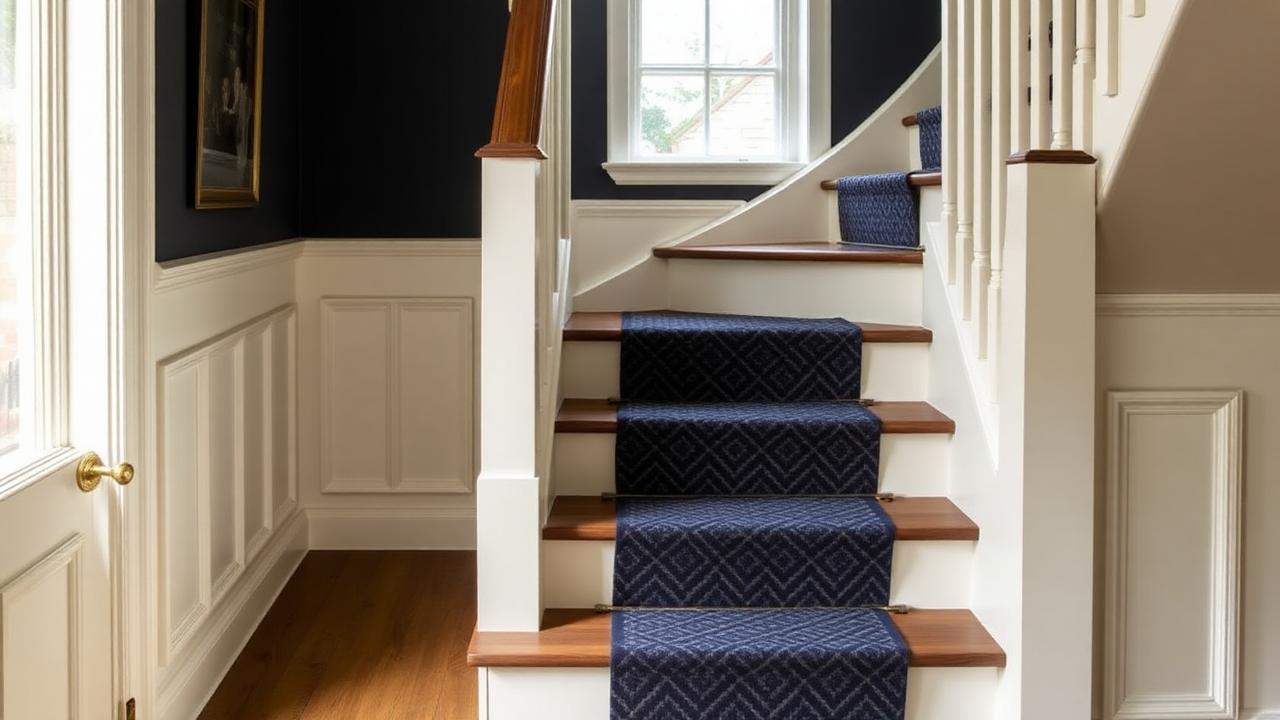
What a trellis pattern actually looks like on a stair
Trellis is a grid or lattice design, usually diamonds or interlocking ogee shapes formed from crossing lines, and it originally comes from garden trellis-work and quilting before it became a popular carpet and runner pattern. On stairs it reads as a repeated geometric motif rather than a directional zigzag like chevron or herringbone, which means it's slightly more forgiving on turns and winders because there's no single point or grain direction that has to track precisely up the flight. That said, the grid lines still need to look level and evenly spaced, so it's not entirely without its own fitting quirks.
Most trellis runners use two colours: a background shade and a contrasting line colour that forms the lattice. The scale of the lattice matters a lot on a staircase specifically, because a large, open trellis with wide diamonds can look sparse on a narrow runner, showing mostly background colour with the odd line crossing a step, while a tight, small-scale trellis reads as a full, busy pattern even on a narrower width. Before ordering, hold a decent-sized sample, not a tiny swatch, against your actual staircase width to judge how much of the lattice will realistically show per step.
Sizing the lattice repeat to your treads
As with any repeating grid pattern, check the manufacturer's stated repeat, which is usually somewhere between 4 in and 10 in (10-25 cm) depending on the design, against your tread going. If a large repeat doesn't divide neatly into your going measurement, you'll end up with a partial diamond on some steps and a full one on others, which isn't a disaster with trellis the way a misaligned chevron point is, but it's still worth knowing about before you order rather than discovering it once the runner's on the stairs.
Order a full sample length, not a swatch
Trellis patterns can look completely different at swatch size versus laid out over several steps. Ask your supplier for at least a 3 ft (90 cm) sample length before ordering, so you can see two or three repeats together rather than judging from one diamond.
How much runner do I need?
Working through a US flight of 13 steps, each with a 10 in tread run and a 7.5 in riser height, plus a 0.75 in nosing wrap, gives 18.25 in per step and 237.25 in (19.77 ft) across the flight. Add a 24 in finishing allowance at the top and bottom, bringing the running length to 261.25 in, or 21.77 ft. Trellis doesn't need the heavier pattern-matching margin that chevron requires, so a standard 7% waste allowance is enough, taking the total to roughly 23.3 ft, meaning most 13-step flights need 23-24 ft ordered.
In UK metric terms, that's a 25 cm tread run and 19 cm riser height with a 1.9 cm nosing wrap, giving 45.9 cm per step and 596.7 cm across 13 steps. Add 60 cm finishing allowance for 656.7 cm, then apply the 7% waste margin to land at about 7.03 m. If your staircase has a half-landing or a winder section, treat that part of the flight separately when using a stair runner length calculator, since winders typically need 10-15% more runner per step than a straight run of the same width.
| Measurement | US (in/ft) | UK (cm/m) |
|---|---|---|
| Tread run | 10 in | 25 cm |
| Riser height | 7.5 in | 19 cm |
| Nosing wrap per step | 0.75 in | 1.9 cm |
| Per-step total | 18.25 in | 45.9 cm |
| 13 steps subtotal | 19.77 ft | 5.97 m |
| Plus finishing allowance | 21.77 ft | 6.57 m |
| With 7% waste margin | 23.3 ft | 7.03 m |
Know your numbers in 30 seconds
Enter your step count, tread depth and riser height — the stair runner calculator gives you the exact length to order, in metres and feet, with waste included.
Open the stair runner calculatorColour combinations that work well with a lattice design
A trellis pattern in a soft neutral background with a slightly darker line colour, cream on taupe, or pale grey on charcoal, tends to age well and doesn't fight with wallpaper or artwork on the stairwell wall. Bolder trellis designs, navy on white, or a bright coral line on cream, work best as a genuine statement piece where the staircase is the main visual feature of an entrance hall, rather than one element among many patterns already in the space.

- Request a full sample length before ordering, not just a small swatch.
- Check the lattice repeat against your tread going to see how the pattern falls per step.
- Choose a smaller-scale lattice for narrow runners, a larger one only on wider flights.
- Add 10-15% extra length for any winder or half-landing section.
- Confirm the background-to-line colour contrast in your own hallway lighting before ordering.
Fibre and where trellis fits best in a home
Trellis stair runner carpet is available in wool, wool-blend and synthetic constructions, and wool tends to give the crispest line definition because the dye sits distinctly in the fibre rather than blending softly the way some synthetic loop piles do. On a high-traffic family staircase, a wool-nylon blend gives a good compromise, holding the lattice lines reasonably sharp while resisting the flattening and pilling that pure wool can show at the nosing edge after a few years of daily use.
Trellis suits entrance halls and staircases that are meant to make an impression, since it has more visual presence than a plain runner or a simple stripe without being as busy as a full floral or animal print. It works particularly well alongside plain painted walls and simple furniture, where the pattern on the stairs can carry the visual interest for the whole space rather than competing with patterned wallpaper or a heavily decorated landing.
Keeping a trellis runner looking sharp
Because the lattice lines are usually a contrasting colour rather than a tonal shift, any wear or flattening at the nosing shows up more obviously than it would on a plain-coloured runner, since the compressed pile catches light differently along the worn line. Vacuum regularly along the direction of the pattern, and if you notice one section of the lattice wearing faster than the rest, ask your fitter whether the runner can be shifted a step or two to spread the wear, the same approach used on plain and striped stair runners when one section takes more daily footfall than the rest of the flight.
Whatever you decide, get the numbers first: the stair runner calculator doubles as a stair runner length calculator, adding nosing wrap, landings, winders, pattern repeat and waste so you order the right length the first time.
Frequently asked questions
What is a trellis stair runner exactly?
It's a runner woven or printed with a repeating lattice or diamond-grid pattern, usually in two contrasting colours: a background shade and a line colour forming the grid. It originates from garden trellis-work and quilting patterns and has become a popular geometric choice for stair runner carpet.
Does a trellis pattern need extra length like chevron?
No, a standard 5-7% waste margin is usually enough, since there's no single point that has to align precisely across every step. Only add extra length, around 10-15%, if your staircase includes winders or a half-landing.
Is trellis pattern suitable for a narrow staircase?
Yes, but choose a smaller-scale lattice. A large, open trellis design can look sparse on a runner narrower than about 27 in (68 cm), showing mostly background colour with only occasional crossing lines per step.
Can trellis go around a turn or winder in the stairs?
Yes, more easily than a directional pattern like chevron, since there's no single point or grain that needs to track continuously. The grid lines should still look reasonably even across the winder, so check a sample laid over the winder shape before fitting.
What colours work best for a trellis stair runner?
Soft neutral combinations, cream on taupe or pale grey on charcoal, tend to age well and suit most hallways. Bolder combinations like navy on white work best when the staircase is meant to be the main visual feature of the entrance.
What fibre gives the sharpest trellis pattern definition?
Wool typically gives the crispest lattice lines because the dye sits distinctly in the fibre. A wool-nylon blend is a practical middle ground for busy households, holding good line definition while resisting flattening at the nosing edge over time.
How do I check the pattern will look right before ordering?
Ask your supplier for a full sample length of at least 3 ft (90 cm) rather than a small swatch, so you can see two or three repeats of the lattice together. This shows you how the pattern will actually look laid across several steps.
Does trellis show wear more than a plain runner?
Slightly, because the contrasting lattice lines make any flattening at the nosing more visible than on a plain-coloured runner. Regular vacuuming along the pattern direction and occasionally shifting the runner's position on the flight helps spread wear more evenly.
Know your numbers in 30 seconds
Enter your step count, tread depth and riser height — the stair runner calculator gives you the exact length to order, in metres and feet, with waste included.
Get an exact figure with the stair runner calculatorReady for real prices?
Get quotes from vetted stair runner suppliers and fitters near you. Free, no account, no obligation.
Every guide is written from hands-on measuring and fitting experience, checked against the calculator’s own maths, and re-reviewed whenever prices or methods change. Read our editorial standards.