

Why cream remains a timeless choice
Cream sits between stark white and warm beige, giving it enough softness to feel inviting without the stark maintenance concerns of pure white. It reflects light beautifully in stairwells and entryways, which are often among the darker corners of a home, and it pairs easily with almost any wall colour, from crisp whites to deep navy or forest green. Because of this versatility, cream has remained a top-selling stair runner colour for decades, moving in and out of specific pattern trends but never really going out of style.
The main hesitation homeowners have with cream is practicality: will it show every mark from shoes, pets, and daily life? The honest answer is that it shows dirt more readily than a dark charcoal or navy runner, but with the right fibre choice and a sensible maintenance routine, cream stair runners perform very well even in busy family homes.
Choosing the right fibre for durability
For a cream runner, prioritise a dense, tightly woven construction over a loose, plush pile. Wool and wool-blend runners tend to resist soiling better than pure synthetic options because the fibre naturally repels some moisture and dirt before it sets into the pile. Look for runners with built-in stain treatments if you have pets or young children, and consider a subtle fleck or tonal pattern within the cream colourway rather than a completely flat, solid shade, since this hides everyday marks far more effectively.
| Fibre | Durability in cream | Best for |
|---|---|---|
| Wool | Very good | Busy households wanting natural fibre |
| Wool-blend (80/20) | Very good | Balance of durability and cost |
| Nylon | Good with stain guard | Budget-conscious, high traffic |
| Sisal/jute blends | Fair, shows soiling faster | Low-traffic, decorative stairs |
How much runner do I need?
For a 13-step flight: 10 in tread + 7.5 in riser + 0.75 in nosing wrap = 18.25 in per step. Over 13 steps that's 237.25 in, plus around 24 in for finishing top and bottom, giving 261.25 in (21.77 ft). Add an 8% waste margin, and you should order about 23.5 ft. Metric: 25 cm + 19 cm + 1.9 cm = 45.9 cm per step, times 13 steps is 596.7 cm, plus 60 cm finishing gives 656.7 cm, plus 8% waste is roughly 7.1 m.
Know your numbers in 30 seconds
Enter your step count, tread depth and riser height — the stair runner calculator gives you the exact length to order, in metres and feet, with waste included.
Open the stair runner calculatorOrder extra for future repairs
With light colours especially, it's worth ordering a small offcut, roughly 3-6 ft (1-2 m), from the same dye lot when you place your order. This gives you matching material if you ever need to patch a stain or replace a worn section years down the line.
Maintenance routine for a cream runner
Vacuum a cream stair runner at least once a week, more often in high-traffic homes, and address spills immediately by blotting rather than rubbing. A professional deep clean every 12-18 months will keep a cream runner looking fresh well beyond what most people expect from a light colour. Consider a doormat and a 'shoes off' policy near the base of the stairs to significantly reduce the dirt that reaches the runner in the first place.
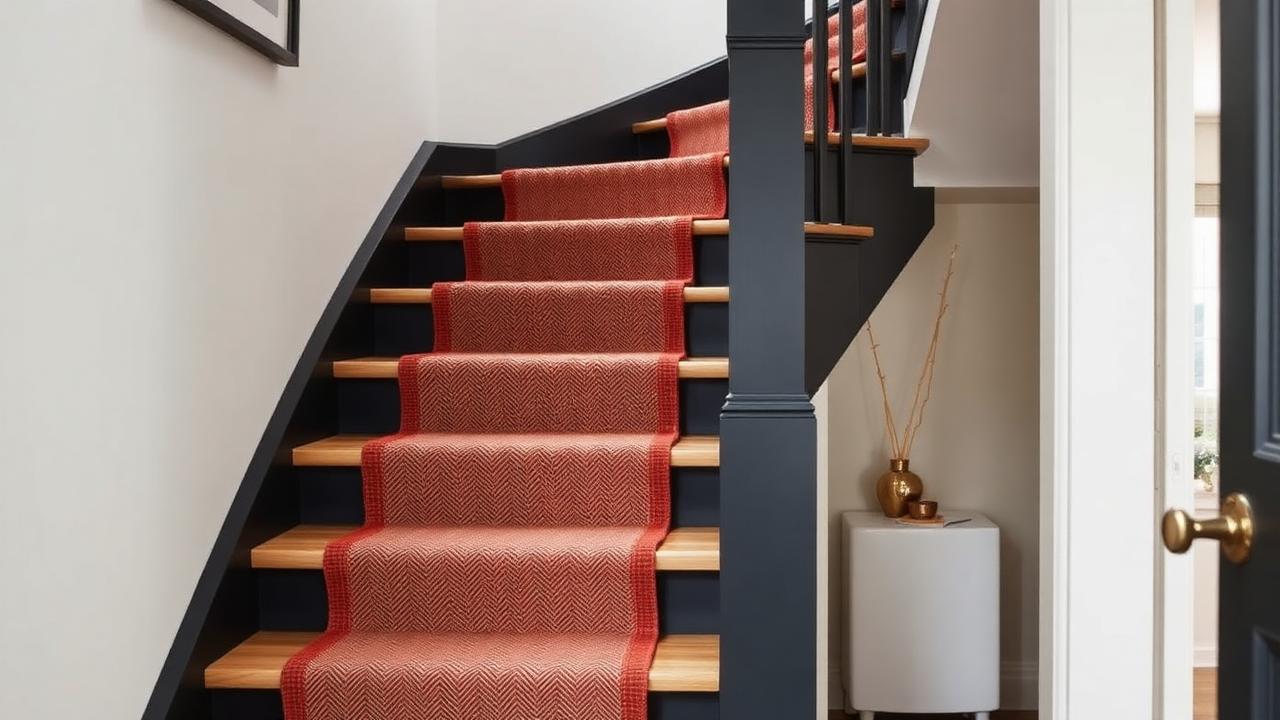
- Choose a dense weave with a subtle fleck to hide everyday marks.
- Look for a built-in stain treatment, especially with pets or kids.
- Vacuum weekly and blot spills immediately.
- Order a small matching offcut for future repairs.
- Schedule a professional clean every 12-18 months.
Spec checks for a light-coloured runner
Ask your supplier for the wear rating (in the US, often given as a Taber abrasion or Class rating; in the UK, look for a BS EN 1307 Class 32 or 33 rating for domestic heavy traffic) before committing to a cream runner for a busy staircase. Also request the pile density in ounces per square yard (US) or grams per square metre (UK); a denser cream runner around 40-50 oz/sq yd (1350-1700 gsm) will resist crushing and soiling noticeably better than a lighter 25-30 oz/sq yd (850-1000 gsm) product often used for lower-traffic areas.
It's also worth checking whether the stain treatment is applied at the fibre level (solution-dyed or built into a synthetic like solution-dyed nylon) versus a topical spray-on treatment, since the former lasts the lifetime of the carpet while the latter can wear off after repeated cleaning and may need reapplying every few years.
Cost bands for cream runners
Cream is available across every price point, but stain-treated and densely woven options carry a premium. Budget synthetic cream runners run $14-24 per ft ($45-80 per m), mid-range wool-blend with stain treatment $28-45 per ft ($90-150 per m), and premium wool with a tonal fleck pattern $50-80 per ft ($165-265 per m).
| Quality band | Pile density | US price per ft |
|---|---|---|
| Budget synthetic | 25-30 oz/sq yd (850-1000 gsm) | $14-24 |
| Mid-range wool-blend | 35-45 oz/sq yd (1200-1500 gsm) | $28-45 |
| Premium wool fleck | 45-55 oz/sq yd (1500-1850 gsm) | $50-80 |
Long-term maintenance rules
Set a maintenance rhythm rather than reacting only when marks appear: weekly vacuuming, immediate blotting of spills with a clean white cloth (never a coloured one, which can transfer dye), and an annual or 18-month professional hot water extraction clean. Avoid steam cleaning wool cream runners too frequently, as excess moisture can affect the backing over many cycles; ask your cleaner about a low-moisture or dry compound method for wool specifically.
- Check the wear rating (Class 32/33 in the UK) before ordering for a busy stair.
- Confirm whether stain treatment is fibre-level or a topical spray.
- Choose a denser pile, 40-50 oz/sq yd (1350-1700 gsm), for durability.
- Blot spills with a clean white cloth to avoid dye transfer.
- Schedule professional cleaning every 12-18 months, using a low-moisture method for wool.
A well-chosen cream stair carpet runner can brighten your whole stairwell while standing up to daily life, provided you pick a durable fibre and stay on top of routine care. Confirm your exact length needs using the stair runner calculator before you order.
Whatever you decide, get the numbers first: the stair runner calculator doubles as a stair runner length calculator, adding nosing wrap, landings, winders, pattern repeat and waste so you order the right length the first time.
Frequently asked questions
Does cream show dirt more than darker colours?
Yes, generally, but a dense weave with a subtle fleck pattern and a stain treatment can significantly reduce visible marking.
What's the best fibre for a cream stair runner?
Wool and wool-blend runners tend to resist soiling better than pure synthetics in light colourways.
How often should I clean a cream runner?
Vacuum weekly and schedule a professional deep clean every 12-18 months.
Should I order extra material?
Yes, a small offcut from the same dye lot is useful for future repairs or patching.
Is cream suitable for a busy household with pets?
Yes, with the right fibre and stain treatment, cream can perform well even with pets and children.
How much runner do I need for 13 steps?
Roughly 23-24 ft (7-7.3 m), including nosing wrap and finishing allowances.
Does cream work with dark wood or dark walls?
Yes, cream contrasts beautifully with darker tones and helps brighten dim stairwells.
What pattern helps disguise marks in cream?
A subtle fleck, tonal weave, or textured loop pile hides everyday soiling better than a flat, solid finish.
Know your numbers in 30 seconds
Enter your step count, tread depth and riser height — the stair runner calculator gives you the exact length to order, in metres and feet, with waste included.
Calculate your length with the stair runner calculatorReady for real prices?
Get quotes from vetted stair runner suppliers and fitters near you. Free, no account, no obligation.
Every guide is written from hands-on measuring and fitting experience, checked against the calculator’s own maths, and re-reviewed whenever prices or methods change. Read our editorial standards.