

What makes a stair runner feel 'cute'
A cute or playful stair runner usually relies on soft colour palettes, small-scale motifs, or a gentle pattern like polka dots, tiny florals, or a cheerful stripe. Pastel pinks, soft blues, buttery yellows, and mint greens are popular choices for family homes, particularly where children's bedrooms sit at the top of the stairs. The goal is a warm, welcoming feel rather than anything too formal or heavy.
Balancing fun with durability
Playful designs still need to withstand daily foot traffic, school bags, and pets. Choose a nylon or wool-blend fibre with good stain resistance rather than a delicate natural fibre, since spills are inevitable in a busy family home. A patterned or lightly flecked design also hides everyday marks better than a plain pastel solid.
How much runner do I need?
For a 13-step flight: 10 in tread + 7.5 in riser + 0.75 in nosing wrap = 18.25 in per step, totalling 237.25 in over 13 steps. Add roughly 24 in for finishing at top and bottom, giving 261.25 in (21.77 ft). For a patterned design, add a 10% waste allowance to keep any motifs aligned, bringing the total to about 24 ft. Metric: 25 cm + 19 cm + 1.9 cm = 45.9 cm per step, 596.7 cm over 13 steps, plus 60 cm finishing = 656.7 cm, plus 10% waste, roughly 7.3 m.
| Measurement | US (in/ft) | UK (cm/m) |
|---|---|---|
| Per-step total | 18.25 in | 45.9 cm |
| 13 steps | 19.77 ft | 5.97 m |
| With finishing | 21.77 ft | 6.57 m |
| With 10% pattern waste | 24 ft | 7.3 m |
Know your numbers in 30 seconds
Enter your step count, tread depth and riser height — the stair runner calculator gives you the exact length to order, in metres and feet, with waste included.
Open the stair runner calculatorDesign ideas to consider
A soft striped runner in two gentle pastel tones is one of the simplest ways to add character without committing to a bold theme the family might outgrow. For a more whimsical look, small-scale motifs like stars, clouds, or scallops can be paired with a plain neutral border to keep the overall effect from feeling too busy. If you would rather keep the base neutral and add character elsewhere, choose a soft solid runner and bring in colour through stair rods, wall art, or a stair runner in a complementary shade further up the landing.
Think beyond the toddler years
Children's tastes change quickly. Choose a pattern that feels timeless enough to still suit the hallway in ten years, or opt for a neutral base with playful accessories that are easy to swap out.
- Choose stain-resistant fibres for busy family homes.
- Pastel stripes are an easy, timeless starting point.
- Small motifs paired with a neutral border avoid visual overload.
- Add a 10% waste allowance for any patterned design.
Practical maintenance tips
Vacuum at least weekly and treat spills immediately, since lighter pastel tones show staining faster than darker colours. A stain-resistant treatment applied during installation adds valuable protection against the inevitable spills of family life.
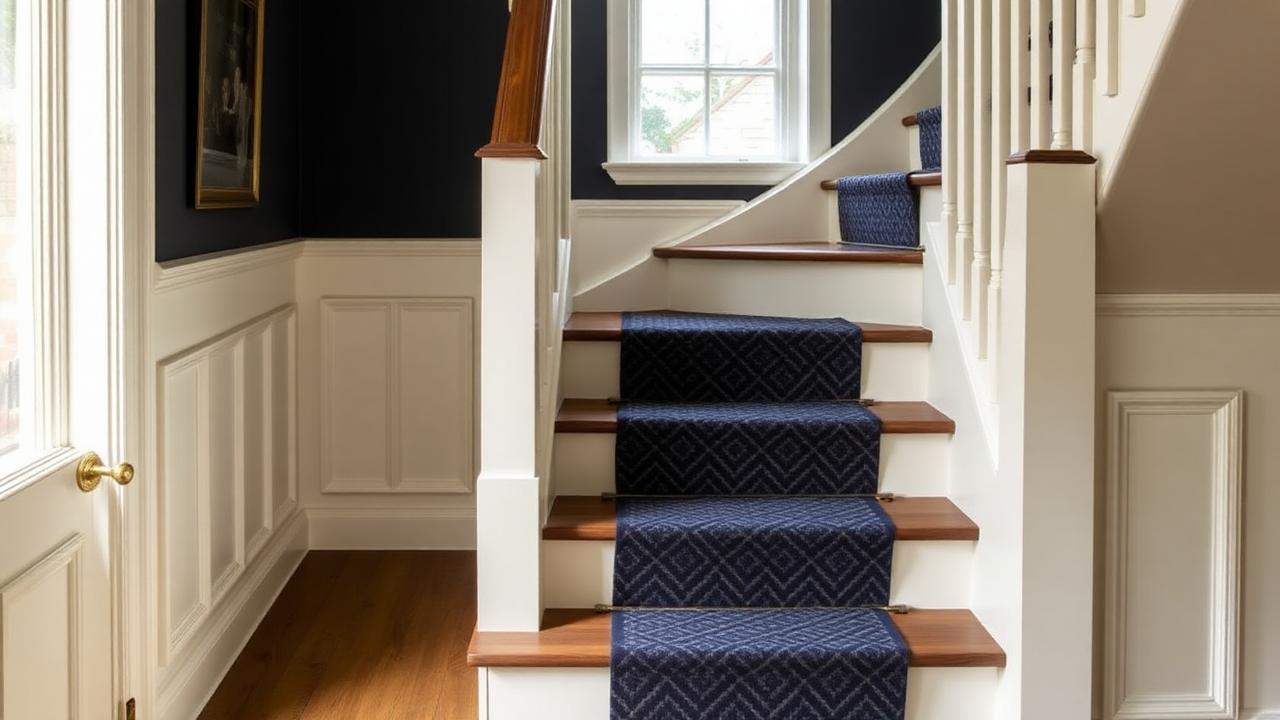
Spec checks for family-friendly runners
Ask specifically about the fibre's stain-resistance rating, since solution-dyed nylon and certain treated wool blends resist common spills like juice or crayon far better than untreated natural fibres. Confirm whether a stain-resistant treatment is factory-applied or needs to be added separately at fitting, as this affects both cost and the treatment's longevity over repeated cleanings. Check the pile height too; a lower, denser pile (around 0.25-0.4 in / 6-10 mm) tends to resist crushing from children running up and down stairs better than a longer, looser pile.
Cost bands for playful family runners
Solution-dyed nylon runners in pastel or playful patterns typically cost $20-35 per linear ft ($66-115 per linear m), offering good stain resistance at a family-friendly price. Wool-blend options with a treated finish run $35-60 per linear ft ($115-197 per linear m). Bespoke or small-motif designer patterns aimed at children's spaces can reach $70-100 per linear ft ($230-328 per linear m).
| Fibre type | US price (per linear ft) | UK price (per linear m) |
|---|---|---|
| Solution-dyed nylon | $20-35 | £52-92 |
| Treated wool-blend | $35-60 | £92-157 |
| Bespoke small-motif pattern | $70-100 | £184-262 |
| Aftermarket stain treatment | $3-6 | £8-16 |
- Ask whether stain resistance is factory-applied or added at fitting.
- Choose a lower, denser pile to resist crushing from active households.
- Solution-dyed nylon is a durable, budget-friendly starting point.
- Reapply stain protection periodically after professional cleaning.
Coordinating with kids' bedroom decor
If children's bedrooms sit at the top of the staircase, it often makes sense to loosely coordinate the runner with the colours used in those rooms, without matching so precisely that the whole scheme feels themed rather than decorated. Picking up a single accent colour, such as the soft yellow trim in a child's bedroom echoed in a yellow stripe on the stair runner, creates a sense of connection between the spaces without committing the whole hallway to a single child's colour scheme, which is useful since bedroom decor tends to change far more often than a stair runner. Neutral base tones with playful accent colours give you the most flexibility to update bedrooms independently over time.
Landings and hallway walls are a good place to introduce more overtly playful elements, such as artwork, growth charts, or coloured picture frames, while keeping the stair runner itself a little more restrained. This way, the runner acts as a long-term backdrop that can outlast several rounds of bedroom redecoration, rather than something that needs replacing every time a child's taste in colour changes.
Safety features to prioritize in family homes
Beyond colour and pattern, a family-friendly stair runner should prioritise slip resistance and secure fitting above all else. A denser, low pile with a firm backing grips shoes and socked feet more reliably than a loose, high pile, and a professionally fitted runner with properly tensioned hold downs is far safer than a loose or poorly secured one, regardless of how attractive the pattern is. If your household includes very young children learning to navigate stairs, ask your fitter about rounded or bullnose-friendly stair rod brackets, which present less of a snag or trip risk than sharp-edged fittings.
Finally, consider a contrast strip or subtly different colour at the very edge of the top and bottom steps, a detail sometimes recommended for households with visually impaired family members or elderly grandparents who visit regularly, since it gives an extra visual cue to where the flight begins and ends without disrupting the overall playful design.
Whatever you decide, get the numbers first: the stair runner calculator doubles as a stair runner length calculator, adding nosing wrap, landings, winders, pattern repeat and waste so you order the right length the first time.
Still deciding on material, width or pattern? Our hub on stair runners compares weaves, widths, backings and fitting styles side by side, then hands the numbers straight to the calculator.
Frequently asked questions
What colours work for a cute, family-friendly stair runner?
Soft pastels like blush pink, mint green, and buttery yellow are popular family-friendly choices.
Are playful patterns durable enough for daily use?
Yes, as long as you choose a stain-resistant nylon or wool-blend fibre suited to heavy foot traffic.
How much extra waste should I allow for a patterned runner?
Around 10% extra helps keep small motifs or stripes aligned across each step.
Will a cute pattern feel outdated as children grow up?
Choose subtle, timeless motifs or a neutral base with playful accessories to avoid outgrowing the look too quickly.
How much runner do I need for a 13-step staircase?
Roughly 23-24 ft (7-7.3 m), including nosing wrap, finishing allowance, and waste margin.
Do light pastel runners show stains easily?
Yes, lighter tones show soiling faster, so treat spills quickly and consider a stain-resistant treatment.
Can I use a stair runner calculator for a playful design?
Yes, the calculation process is identical regardless of colour or pattern choice.
What fibre is best for a cute stair runner in a busy home?
A durable nylon or wool-blend fibre with good stain resistance is ideal for daily family use.
Know your numbers in 30 seconds
Enter your step count, tread depth and riser height — the stair runner calculator gives you the exact length to order, in metres and feet, with waste included.
Measure your stairs with the stair runner calculatorReady for real prices?
Get quotes from vetted stair runner suppliers and fitters near you. Free, no account, no obligation.
Every guide is written from hands-on measuring and fitting experience, checked against the calculator’s own maths, and re-reviewed whenever prices or methods change. Read our editorial standards.