

How custom-cut runner brands work
Brands like Ernesta typically sell runners cut to your specified length rather than requiring you to buy a fixed roll size. This can simplify ordering since you pay for close to the exact length you need, plus a modest waste allowance recommended by the retailer. However, it also means the accuracy of your own measurements matters even more, since a custom cut length cannot easily be extended if you underestimate.
Measuring accurately before you order
Before entering any numbers on a retailer's site, measure your own staircase using a tape measure or a stair runner calculator. Count your total number of steps, and measure a representative tread depth and riser height, since not every staircase has perfectly uniform steps. If your treads vary even slightly, measure several and use the largest figure to avoid running short.
How much runner do I need?
For a 13-step flight: 10 in tread + 7.5 in riser + 0.75 in nosing wrap = 18.25 in per step, giving 237.25 in over 13 steps. Add about 24 in for finishing at the top and bottom, for 261.25 in (21.77 ft). Add a waste allowance of 8-10% to cover fitting adjustments, bringing your order to roughly 23.5-24 ft. Metric: 25 cm + 19 cm + 1.9 cm = 45.9 cm per step, 596.7 cm over 13 steps, plus 60 cm finishing = 656.7 cm, plus waste, roughly 7.1-7.3 m.
| Measurement | US (in/ft) | UK (cm/m) |
|---|---|---|
| Per-step total | 18.25 in | 45.9 cm |
| 13 steps | 19.77 ft | 5.97 m |
| With finishing | 21.77 ft | 6.57 m |
| With waste | 23.5-24 ft | 7.1-7.3 m |
Know your numbers in 30 seconds
Enter your step count, tread depth and riser height — the stair runner calculator gives you the exact length to order, in metres and feet, with waste included.
Open the stair runner calculatorChecking what's included
When ordering a custom-cut runner online, confirm whether the price includes edge binding, since a raw-cut runner will fray without it. Also check the standard widths on offer, and whether the retailer offers samples before you commit to a full-length order, as returning a custom-cut runner is often more restricted than a standard stocked roll.
Always request a sample first
Because custom-cut runners are usually final sale, order a physical sample of the colour and fibre before placing your full order, no matter which brand you buy from.
- Measure every tread and riser rather than assuming uniformity.
- Confirm whether binding is included in the price.
- Check the return policy for custom-cut goods before ordering.
- Request a sample swatch to verify colour and texture in your home.
Installation considerations
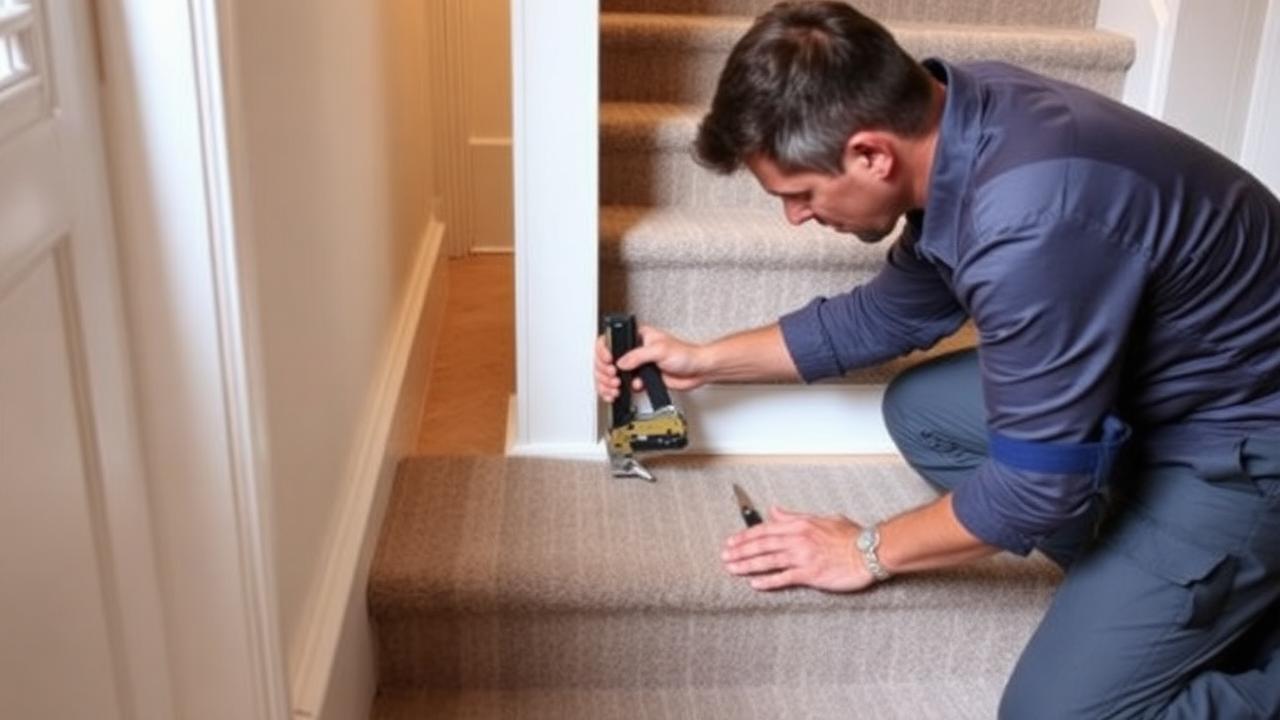
Custom-cut runners still need a professional fitter for a tidy result, particularly around winders or landings. Share your exact measurements with the fitter ahead of time so they can flag any discrepancies before the runner arrives.
Spec checks specific to direct-to-consumer brands
Direct-to-consumer runner brands like Ernesta typically publish a fixed set of standard widths rather than offering full bespoke sizing, so confirm the closest available width to your staircase before ordering. Check whether the listed price is per linear ft/m or a flat price for a pre-set length range, since some brands sell in banded lengths (for example, up to 20 ft) rather than the exact figure you calculate. If your total comes out at 24 ft, you may need to select the next band up and trim any excess during fitting, so ask the retailer how they handle over-ordering.
It's also worth checking the edge finish options offered, since serged or bound edges affect the finished width slightly. A runner bound at 30 in (76 cm) nominal width may finish at 29.5-29.75 in (75-75.5 cm) once the binding is applied, a small but relevant detail if you are matching an existing hold-down bracket spacing.
Cost bands for direct-to-consumer runners
Custom-cut synthetic runners from direct brands typically start around $20-35 per linear ft ($65-115 per linear m), with wool or wool-blend options in the $45-75 per linear ft ($148-246 per linear m) range. Binding, if not included, generally adds $2-4 per linear ft ($6.50-13 per linear m) to the total.
| Item | US price (per linear ft) | UK price (per linear m) |
|---|---|---|
| Synthetic custom-cut | $20-35 | £52-92 |
| Wool/wool-blend custom-cut | $45-75 | £118-197 |
| Binding add-on | $2-4 | £5-11 |
| Sample swatch | Free-$10 | Free-£8 |
- Check whether pricing is per linear ft/m or banded by length.
- Confirm the finished width after binding, not just the nominal width.
- Ask how the retailer handles over-ordering if your length falls between bands.
- Always request a physical sample swatch before a final-sale purchase.
Comparing custom-cut brands to traditional retailers
Direct-to-consumer, custom-cut brands differ from a traditional carpet showroom in a few practical ways worth weighing before you order. You typically deal with the brand entirely online, often without seeing a large sample in person before ordering unless you specifically request one, so photography and colour accuracy on screen matter more than with an in-store purchase. On the other hand, custom-cut pricing is usually transparent and calculated per linear ft or m, without the negotiation or showroom mark-up sometimes found with traditional retailers, and turnaround from order to delivery is often faster since the runner is cut to length rather than woven to a bespoke pattern.
A traditional carpet retailer, by comparison, usually offers in-person fitting as part of the package and may carry a wider range of pile heights, weaves, and border options than a direct-to-consumer catalogue. If you have an unusual staircase, such as a curved flight, a winder, or multiple half-landings, a traditional retailer with an in-house fitting team may be better placed to handle the complexity than a purely online, custom-cut model designed primarily around straight flights.
Delivery, lead times and installation scheduling
Custom-cut runners are made to order rather than pulled from stock, so build in a realistic lead time before booking a fitter. Many direct-to-consumer brands quote 2-4 weeks from order to delivery, though this can extend during peak seasons such as the run-up to the holidays when many households are refreshing their hallways at once. Order your runner first and only confirm a fitting date once you have a firm delivery window, rather than booking a fitter speculatively and hoping the runner arrives in time.
When the runner arrives, unroll it in a large room to check the length, width, colour, and edge finish against your order confirmation before your fitting appointment. Catching a discrepancy a few days before fitting gives you time to contact the retailer, whereas discovering an issue with the fitter already on site can mean a wasted call-out charge and a delayed installation.
Whatever you decide, get the numbers first: the stair runner calculator doubles as a stair runner length calculator, adding nosing wrap, landings, winders, pattern repeat and waste so you order the right length the first time.
Still deciding on material, width or pattern? Our hub on stair runners compares weaves, widths, backings and fitting styles side by side, then hands the numbers straight to the calculator.
Frequently asked questions
Do custom-cut stair runners include binding?
This varies by retailer, so always confirm whether binding is included in the listed price before ordering.
Can I return a custom-cut stair runner?
Custom-cut goods are often final sale or have limited return windows, so check the policy carefully first.
How do I measure for a custom-cut runner?
Measure tread depth, riser height, and total step count, then add nosing wrap and a waste allowance, or use a stair runner calculator.
What waste allowance should I add for a custom order?
Most retailers recommend 8-10% extra to cover fitting adjustments and any measuring imprecision.
Should I order a sample before buying online?
Yes, always order a sample swatch to check colour and texture before committing to a full custom order.
Do I still need a professional installer for a custom-cut runner?
Yes, professional fitting ensures a tidy, secure result, especially around winders and landings.
What if my treads are not uniform in depth?
Measure several treads and use the largest figure so your order doesn't run short.
Is a stair runner calculator useful for custom orders?
Yes, it helps confirm your total length before you enter measurements into any retailer's ordering system.
Know your numbers in 30 seconds
Enter your step count, tread depth and riser height — the stair runner calculator gives you the exact length to order, in metres and feet, with waste included.
Confirm your measurements with the stair runner calculatorReady for real prices?
Get quotes from vetted stair runner suppliers and fitters near you. Free, no account, no obligation.
Every guide is written from hands-on measuring and fitting experience, checked against the calculator’s own maths, and re-reviewed whenever prices or methods change. Read our editorial standards.