

Natural fibres for a farmhouse feel
Sisal, jute, and wool-sisal blends are staples of farmhouse decor because of their textured, organic look. Sisal has a slightly coarse, rustic feel underfoot and pairs beautifully with reclaimed wood and painted shiplap. If you want a softer feel for a family home with children, a wool-sisal blend gives you that texture with more comfort and stain resistance.
Ticking stripes and simple patterns
A classic black and cream, or navy and cream, ticking stripe is one of the most enduring farmhouse choices. It reads as timeless rather than trendy and works on both narrow cottage staircases and wider farmhouse hallways. Herringbone weaves in a single warm neutral tone are another popular option, adding subtle texture without introducing colour or pattern.
How much runner do I need?
For a 13-step flight: 10 in tread + 7.5 in riser + 0.75 in nosing wrap = 18.25 in per step, totalling 237.25 in over 13 steps. Add roughly 24 in for finishing, giving 261.25 in (21.77 ft). For a striped design, add a 10% waste allowance to keep the stripes level across each step, bringing the total to about 24 ft. Metric: 25 cm + 19 cm + 1.9 cm = 45.9 cm per step, 596.7 cm over 13 steps, plus 60 cm finishing = 656.7 cm, plus 10% waste, roughly 7.3 m.
| Measurement | US (in/ft) | UK (cm/m) |
|---|---|---|
| Per-step total | 18.25 in | 45.9 cm |
| 13 steps | 19.77 ft | 5.97 m |
| With finishing | 21.77 ft | 6.57 m |
| With 10% pattern waste | 24 ft | 7.3 m |
Know your numbers in 30 seconds
Enter your step count, tread depth and riser height — the stair runner calculator gives you the exact length to order, in metres and feet, with waste included.
Open the stair runner calculatorColour palettes that suit a farmhouse look
Stick to warm neutrals such as oatmeal, wheat, and soft grey, accented with black or navy stripes for contrast. Avoid overly cool, blue-grey tones, which can feel more contemporary than rustic. Wood tones matter too: warm pine and reclaimed oak pair naturally with these neutral palettes.
Durability matters in a working home
Farmhouses often see heavy foot traffic from family, pets, and muddy boots. Choose a wool or wool-blend fibre with good stain resistance rather than pure jute, which can be less forgiving of moisture.
- Choose sisal or wool-sisal blends for authentic texture.
- Ticking stripes suit both cottage and farmhouse hallways.
- Stick to warm neutral palettes with black or navy accents.
- Add a 10% waste allowance for striped patterns.
Finishing touches
Black iron stair rods complete the farmhouse look nicely, echoing wrought iron hardware elsewhere in the home. A simple whipped or bound edge, rather than an elaborate trim, keeps the overall look understated and true to the style.
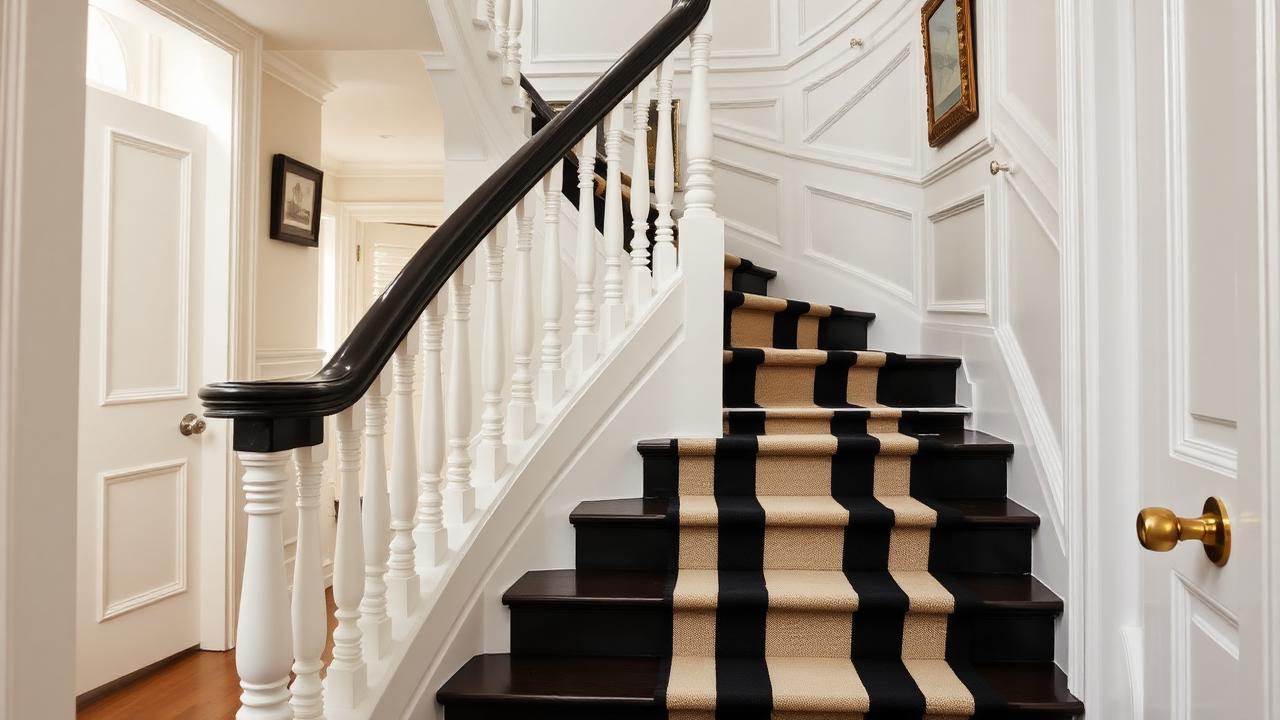
Spec checks before ordering a farmhouse runner
Confirm the fibre blend percentage before ordering; a runner labelled 'wool-sisal' can range anywhere from 15% to 50% wool, and the higher the wool content, the softer and more stain-resistant the finished runner will feel. Ask for the backing type too, since a natural jute backing on a sisal-heavy runner can be sensitive to moisture from wet boots, while a latex-backed version holds up better in an entryway staircase common in farmhouse layouts.
If you're using a ticking stripe, check the stripe width in writing (commonly 0.5-1.5 in / 1.3-3.8 cm) and confirm how it will land on your specific tread depth, since an odd stripe width can leave a noticeably thin or thick stripe at the very edge of each tread once cut and bound.
Cost bands for farmhouse-style runners
Sisal and jute options typically cost $18-30 per linear ft ($59-98 per linear m). Wool-sisal blends with better durability run $32-55 per linear ft ($105-180 per linear m). Classic ticking stripe wool runners sit in a similar range, $30-50 per linear ft ($98-164 per linear m), depending on the mill and finish quality.
| Style | US price (per linear ft) | UK price (per linear m) |
|---|---|---|
| Sisal/jute | $18-30 | £47-79 |
| Wool-sisal blend | $32-55 | £84-144 |
| Ticking stripe wool | $30-50 | £79-131 |
| Black iron rods (per unit) | $8-15 | £21-39 |
- Confirm the exact wool percentage in any wool-sisal blend.
- Check backing type if the entryway sees wet boots regularly.
- Get the ticking stripe width in writing before ordering.
- Pair with black iron rods and a simple bound edge for an authentic look.
Layering rugs and runners in a farmhouse entry
Farmhouse entryways often extend the stair runner's material or colour palette into an adjoining hallway rug, creating a sense of continuity from the front door through to the base of the stairs. A jute or sisal-look runner on the stairs pairs naturally with a similar-toned flatweave or vintage-style rug on the entry floor, though it is worth choosing slightly different pile heights or weave textures between the two so the transition doesn't look like an accidental repeat of the exact same product. A simple way to link them without matching exactly is to repeat a single accent colour, such as a black binding on the stair runner echoed in a black-bordered entry rug.
Be mindful of transition points between a runner and a loose rug, particularly if the entry floor is hardwood or tile, since a loose rug near the base of the stairs can become a trip hazard if it isn't secured with a non-slip pad. Where possible, have any hallway rug near the stair base secured or fitted with the same care given to the stair runner itself.
Seasonal swaps and washable options
Some farmhouse households like to swap accessories seasonally, and while a fitted stair runner is a longer-term commitment than a loose rug, you can still introduce seasonal touches around it, such as a runner-matched stair rod ribbon at the holidays or seasonal doormats that echo the runner's palette. If muddy boots and pets are a daily reality, ask your supplier specifically about machine-washable or spot-cleanable wool-blend options, since some modern wool-blends are treated to tolerate a stronger clean than traditional wool without losing shape or colour.
Whatever fibre you choose, keep a small offcut of the runner from installation in a drawer. It is invaluable for testing cleaning products or stain removers on an inconspicuous sample before applying anything to the actual staircase, particularly important for natural fibres like sisal and jute that can react unpredictably to certain cleaning chemicals.
Whatever you decide, get the numbers first: the stair runner calculator doubles as a stair runner length calculator, adding nosing wrap, landings, winders, pattern repeat and waste so you order the right length the first time.
Still deciding on material, width or pattern? Our hub on stair runners compares weaves, widths, backings and fitting styles side by side, then hands the numbers straight to the calculator.
Frequently asked questions
What fibre is best for a farmhouse stair runner?
Sisal or wool-sisal blends give the most authentic farmhouse texture while offering reasonable durability.
Are ticking stripes a good farmhouse choice?
Yes, black and cream or navy and cream ticking stripes are a timeless farmhouse staple.
How much extra waste should I allow for stripes?
Around 10% to keep the stripes level and aligned as they wrap around each tread and riser.
What colours suit a farmhouse staircase?
Warm neutrals like oatmeal and wheat, accented with black or navy, work best.
Is jute durable enough for a busy farmhouse?
Pure jute is less moisture-resistant; a wool-sisal blend is often more practical for family homes.
How much runner do I need for a 13-step farmhouse staircase?
Roughly 23-24 ft (7-7.3 m), including nosing wrap, finishing, and waste allowance.
Do black iron stair rods suit farmhouse style?
Yes, they echo wrought iron hardware often found elsewhere in farmhouse interiors.
Should I use a stair runner calculator for a farmhouse project?
Yes, it works the same way regardless of style, giving you an accurate length before ordering.
Know your numbers in 30 seconds
Enter your step count, tread depth and riser height — the stair runner calculator gives you the exact length to order, in metres and feet, with waste included.
Measure your farmhouse staircase with the stair runner calculatorReady for real prices?
Get quotes from vetted stair runner suppliers and fitters near you. Free, no account, no obligation.
Every guide is written from hands-on measuring and fitting experience, checked against the calculator’s own maths, and re-reviewed whenever prices or methods change. Read our editorial standards.