

The appeal of a geometric brown pattern
Geometric patterns — diamonds, trellis shapes, chevrons, or angular repeats — bring structure and movement to a staircase without relying on colour alone to do the work. In a warm brown colourway, the pattern reads as grounded and traditional rather than bold or trend-led, which is why geo brown runners suit period homes with dark wood banisters, parquet flooring, or warm-toned wallpaper just as well as they suit contemporary spaces with tan leather furniture and brass fittings.
Brown tones also carry a practical benefit shared with other mid-to-dark neutrals: they're forgiving of everyday wear, muddy footprints, and pet hair. Combined with a geometric print that already has visual complexity, a geo brown runner is one of the most low-maintenance-looking choices you can put on a busy staircase.
Choosing the right scale of pattern
Geometric prints come in a huge range of scales, from small tessellating diamonds to large-scale trellis designs. On a narrower staircase, a smaller-scale geometric repeat avoids the pattern being awkwardly cut at each nosing. On a wider flight, a bolder, larger-scale geo pattern has room to breathe and makes more of a design statement. As a rule of thumb, if your runner width is under 27 in (68 cm), lean toward a finer pattern scale.
| Runner width | Recommended pattern scale |
|---|---|
| Under 27 in (68 cm) | Fine to medium geometric repeat |
| 27-30 in (68-76 cm) | Medium repeat |
| 30 in+ (76 cm+) | Medium to large repeat |
How much runner do I need?
Base per-step total for a 13-step flight: 10 in tread + 7.5 in riser + 0.75 in nosing wrap = 18.25 in, giving 237.25 in across 13 steps. Add 24 in finishing for 261.25 in (21.77 ft). As with other patterned runners, increase the standard 8% waste margin to 12-15% to allow the fitter to align the geometric repeat cleanly at each step, bringing your order to roughly 24.5-25 ft. Metric: 45.9 cm per step, 596.7 cm across 13 steps, plus 60 cm finishing is 656.7 cm; with 12-15% pattern waste, aim for around 7.4-7.6 m.
| Item | US (in/ft) | UK (cm/m) |
|---|---|---|
| Per-step total | 18.25 in | 45.9 cm |
| 13 steps + finishing | 21.77 ft | 6.57 m |
| With pattern waste | 24.5-25 ft | 7.4-7.6 m |
Know your numbers in 30 seconds
Enter your step count, tread depth and riser height — the stair runner calculator gives you the exact length to order, in metres and feet, with waste included.
Open the stair runner calculatorAsk for a full repeat sample
Small swatches often only show a fragment of a geometric pattern. Ask the supplier for a photo or larger sample showing the complete repeat before you commit to sizing.
Fibre and construction
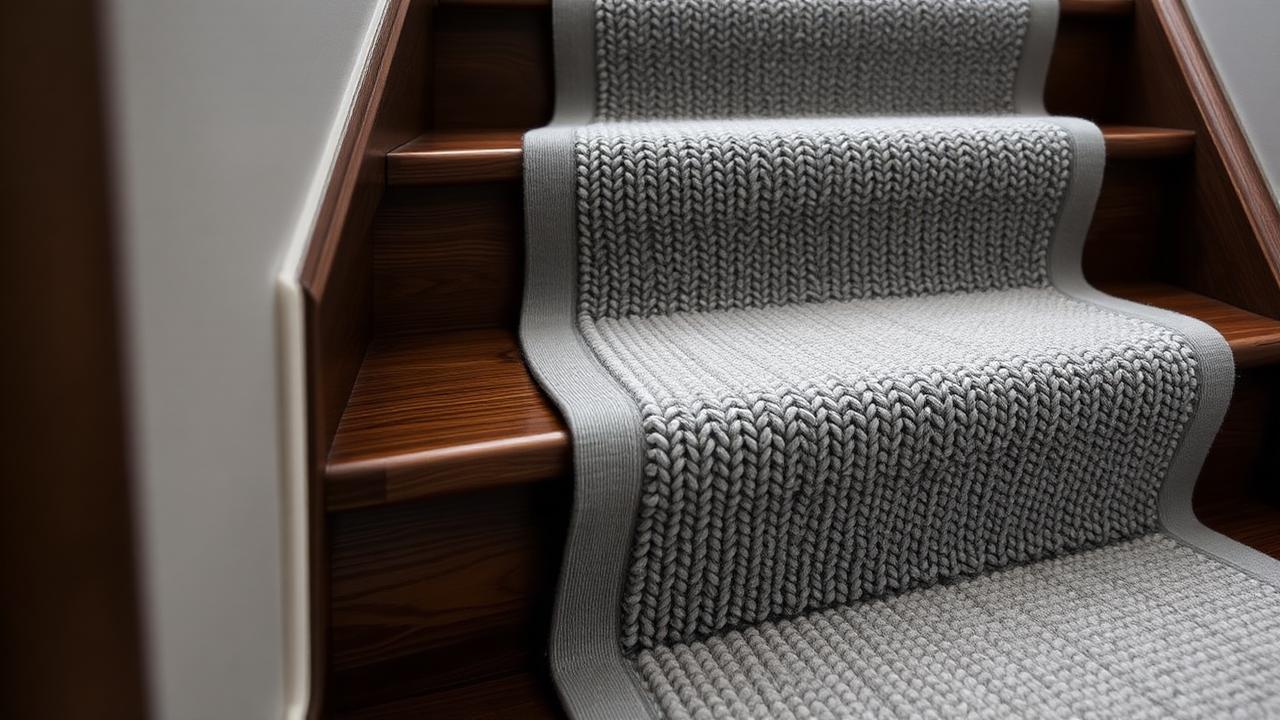
Geometric patterns are most commonly produced as printed or woven nylon and wool-blend runners, since the sharp lines of a geo print need a fine, even weave to stay crisp. A looped or low-pile construction shows off the geometric detail more clearly than a deep plush pile, which can soften and blur sharper angular shapes. If durability is your top priority, a solution-dyed nylon geo print resists fading and holds its pattern definition well under heavy traffic.
- Choose a finer pile construction to keep geometric lines crisp.
- Match pattern scale to your runner width.
- Order 12-15% extra material for pattern alignment.
- Consider solution-dyed nylon for fade resistance in sunlit hallways.
A geo brown stair runner gives you the best of both worlds: the visual interest of a bold pattern with the practical, low-maintenance benefit of a warm, forgiving colour palette.
Fitting steps for a geometric pattern
As with any patterned runner, fitting a geo brown design starts with a full dry-lay to check where the repeat falls on each of your 13 steps. Because geometric repeats are often more regular and predictable than an irregular check, most fitters can complete alignment planning slightly faster than with an organic or hand-drawn pattern, typically adding 20-30 minutes to a standard install.
Matching the repeat at winders
If your staircase includes a turn, ask your fitter to plan the geometric repeat so it reads as a deliberate continuation rather than an abrupt jump at the winder. This sometimes means accepting a slightly different starting point on the return flight, which a good fitter will flag before cutting rather than after.
Cost bands for geometric patterns
Printed geometric patterns on nylon or wool-blend are the most affordable route to a strong pattern statement, while a woven wool geometric — where the pattern is built into the weave rather than printed on top — costs more but holds its definition longer under heavy traffic.
| Spec | Printed (budget/mid) | Woven (premium) |
|---|---|---|
| Base fibre | Nylon or wool-blend | 100% wool |
| Pattern definition over time | Fades gradually with wear | Holds shape well |
| Typical cost band | Budget to mid-range | Premium |
| Best pile type | Low-pile loop | Low-pile loop or flatweave |
- Ask for a full repeat photo, not a small swatch, before ordering.
- Confirm pile construction is low-pile or looped to keep lines crisp.
- Check UV/fade resistance if your stairwell has a skylight or large window.
- Plan the repeat continuation in writing if your flight includes a winder or turn.
Maintenance for geometric brown runners
Vacuum weekly and pay particular attention to the crevice where tread meets riser, since grit collects there and can dull the sharp lines of a geometric print over time. Brown tones are forgiving of general soiling, but a build-up of unremoved grit still accelerates fibre wear even when it isn't visually obvious.
Whatever you decide, get the numbers first: the stair runner calculator doubles as a stair runner length calculator, adding nosing wrap, landings, winders, pattern repeat and waste so you order the right length the first time.
Still deciding on material, width or pattern? Our hub on stair runners compares weaves, widths, backings and fitting styles side by side, then hands the numbers straight to the calculator.
Frequently asked questions
Why choose a geometric pattern in brown?
Brown tones are forgiving of everyday dirt while the geometric pattern adds visual structure and interest.
How much extra material does a geo pattern need?
Increase your waste allowance from the standard 8% to 12-15% to allow clean alignment at each step.
How much runner do I need for 13 steps?
Around 24.5-25 ft (7.4-7.6 m) including the pattern-matching allowance.
What pattern scale suits a narrow staircase?
A finer geometric repeat works best on runners under 27 in (68 cm) wide.
What pile type shows off a geo pattern best?
A looped or low-pile construction keeps the sharp lines of a geometric print crisp.
Does brown hide dirt well?
Yes, mid-to-dark brown tones are among the most forgiving colours for muddy footprints and pet hair.
Should I see a full pattern repeat before ordering?
Yes, ask your supplier for a photo or sample showing the complete repeat, not just a small swatch.
Is nylon or wool better for a geo pattern?
Both work well; solution-dyed nylon offers the best fade resistance for sunlit staircases.
Know your numbers in 30 seconds
Enter your step count, tread depth and riser height — the stair runner calculator gives you the exact length to order, in metres and feet, with waste included.
Size your geometric runner with the stair runner calculatorReady for real prices?
Get quotes from vetted stair runner suppliers and fitters near you. Free, no account, no obligation.
Every guide is written from hands-on measuring and fitting experience, checked against the calculator’s own maths, and re-reviewed whenever prices or methods change. Read our editorial standards.