
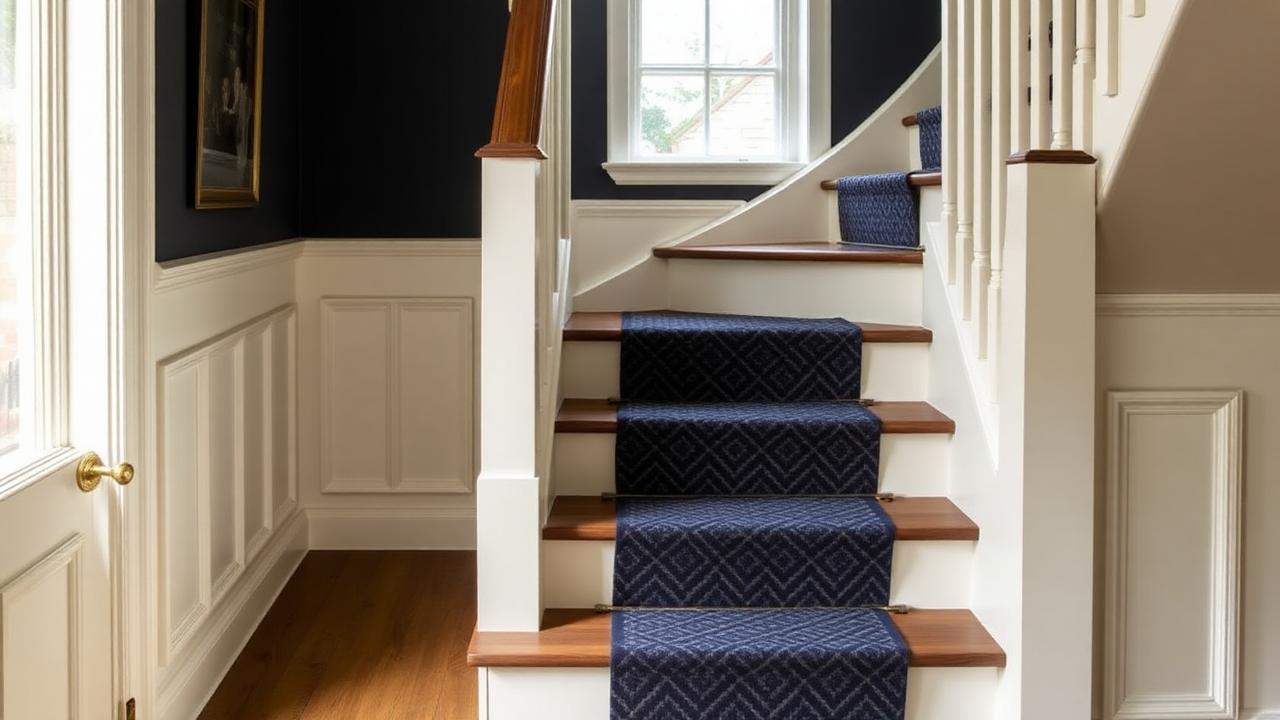
Why plaid suits stairs so well
Tartan and plaid patterns have been used on stairs for well over a century, and there's a practical reason beyond tradition: the interlocking lines and multiple colours are exceptionally good at hiding dirt, pet hair, and light wear. Unlike a solid colour, a busy plaid doesn't show every footprint, which makes it a smart choice for a hallway staircase that gets used dozens of times a day.
Plaid also tends to work well in both period and contemporary homes. In a traditional hallway with panelled walls and a wood handrail, a classic red or green tartan feels right at home. In a more modern space, a muted grey-and-navy plaid or a scaled-down check reads as tailored rather than fussy. The key is choosing a scale of check that suits the width of your treads — an oversized tartan can look chopped up on a narrow runner.
Pattern matching on every step
The single biggest technical challenge with a plaid stair runner is keeping the horizontal lines of the check running straight and level across each tread and riser. Because the pattern repeats at a fixed interval (often every 4-8 in / 10-20 cm), your fitter needs to plan where each repeat falls so it doesn't get awkwardly cut at the nosing. This sometimes means ordering slightly more material than a plain runner would need, because a few extra inches per step are needed to shift the repeat into a clean position.
Order 10-15% extra for pattern runners
Where a plain stair runner might only need an 8% waste allowance, a patterned plaid runner is safer with 10-15% extra to give your fitter room to align the repeat cleanly on every step.
How much runner do I need?
Base calculation for a 13-step flight: tread 10 in + riser 7.5 in + nosing wrap 0.75 in = 18.25 in per step. Over 13 steps that's 237.25 in, plus 24 in finishing allowance gives 261.25 in (21.77 ft). For a plain runner an 8% waste margin is typical, but for plaid, bump that to 12-15% to allow pattern alignment, landing you around 24.5-25 ft. In metric: 25 cm + 19 cm + 1.9 cm = 45.9 cm per step, times 13 steps is 596.7 cm, plus 60 cm finishing is 656.7 cm; with 12-15% waste for pattern matching, aim for roughly 7.4-7.6 m.
| Item | US (in/ft) | UK (cm/m) |
|---|---|---|
| Per-step total | 18.25 in | 45.9 cm |
| 13 steps + finishing | 21.77 ft | 6.57 m |
| Plain waste (8%) | 23.5 ft | 7.1 m |
| Plaid waste (12-15%) | 24.5-25 ft | 7.4-7.6 m |
Know your numbers in 30 seconds
Enter your step count, tread depth and riser height — the stair runner calculator gives you the exact length to order, in metres and feet, with waste included.
Open the stair runner calculatorWorking with your fitter
Before your fitter starts, lay the runner out and mark where each repeat falls against your actual tread and riser dimensions. A good fitter will dry-fit the pattern before cutting, adjusting the starting point at the top or bottom of the flight so the most visible steps get the cleanest repeat. This is one area where DIY installation can go wrong quickly, so if your plaid has a large-scale check, it's worth budgeting for professional fitting.
- Confirm the pattern repeat size before ordering.
- Order 12-15% extra material to allow for alignment.
- Ask your fitter to dry-fit before cutting.
- Start the pattern at the most visible step, usually the bottom.
Colour and fibre choices
Wool plaid runners hold colour beautifully and are the traditional choice for tartan patterns, giving a slightly muted, heathered finish that looks authentic. Wool-blend and synthetic plaids are more affordable and often colourfast enough for busy households, though the pattern can look slightly flatter. Whichever you choose, order samples and check the repeat length is printed accurately — cheaper synthetic plaids sometimes have inconsistent print spacing that makes pattern matching harder.

A well-fitted plaid stair runner is one of the most striking things you can do to a staircase, and getting the yardage and pattern repeat right the first time saves a costly re-cut later.
Fitting steps for a plaid runner
Fitting begins the same way as any runner — underlay cut and fixed, gripper rod placed at each tread-riser junction — but before any cutting starts, a good fitter unrolls the full length on the floor and marks where each pattern repeat will land against your actual step count. On a 13-step flight, this dry-fit stage typically adds 30-45 minutes to the job compared with a plain runner, but it's the step that prevents a check line running crooked or landing awkwardly right at a nosing edge.
Handling turns and winders
If your staircase has a turn or winder steps, plaid becomes noticeably harder to keep aligned, since the pattern has to twist around the narrower inside edge of each winder. Ask your fitter in advance whether they have experience with patterned runners on turns, and expect a slightly higher labour charge for the extra time needed to keep the check consistent through the bend.
Cost bands for plaid runners
Patterned wool tartan sits at the premium end of stair runner pricing because of the yarn-dyed weaving process, while printed plaid on a nylon or wool-blend base is considerably more affordable and still gives a convincing look from a normal viewing distance. Fitting labour for plaid typically costs more than for a plain runner, reflecting the extra time needed for pattern alignment.
| Spec | Printed plaid | Yarn-dyed tartan |
|---|---|---|
| Base fibre | Nylon or wool-blend | 100% wool |
| Pattern method | Printed | Woven into the yarn |
| Typical cost band | Budget to mid-range | Premium |
| Fitting time (13 steps) | 3.5-4.5 hrs | 4-5.5 hrs |
- Ask to see the pattern repeat measurement in writing before ordering.
- Request a dry-fit diagram from your fitter showing repeat placement per step.
- Budget extra fitting time for any winders or turns in the flight.
- Keep an offcut labelled with the dye lot for future repairs or extensions.
Maintenance for a plaid runner
Because plaid already disguises dirt well, it's tempting to vacuum less often, but grit trapped in the pile still wears down fibres even if it isn't visible. Vacuum weekly, check the stair rods or gripper periodically for any loosening, and treat spills quickly since a spreading stain can distort the visual line of the check pattern even after it's been cleaned.
Whatever you decide, get the numbers first: the stair runner calculator doubles as a stair runner length calculator, adding nosing wrap, landings, winders, pattern repeat and waste so you order the right length the first time.
Still deciding on material, width or pattern? Our hub on stair runners compares weaves, widths, backings and fitting styles side by side, then hands the numbers straight to the calculator.
Frequently asked questions
Why does plaid need extra material?
The check pattern needs to align cleanly at each nosing, so 12-15% extra waste allowance is safer than the 8% used for plain runners.
Can I fit a plaid stair runner myself?
It's possible, but pattern alignment is fiddly. Large-scale checks are best left to a professional fitter.
How much runner do I need for 13 steps?
Around 24.5-25 ft (7.4-7.6 m) once the extra pattern-matching allowance is included.
Does plaid hide dirt well?
Yes, the multiple colours and interlocking lines are very effective at disguising everyday wear and pet hair.
What scale of plaid suits narrow stairs?
A smaller check scale works better on narrower treads so the pattern doesn't get chopped up awkwardly.
Is wool or synthetic better for plaid?
Wool gives the most authentic tartan colour depth; synthetic is cheaper but can look flatter.
Where should the pattern start on the flight?
Most fitters start the repeat at the most visible step, typically the bottom, and adjust upward.
Can I match a plaid runner to a landing carpet?
Yes, provided you order enough of the same dye lot and plan the pattern continuation carefully across the landing.
Know your numbers in 30 seconds
Enter your step count, tread depth and riser height — the stair runner calculator gives you the exact length to order, in metres and feet, with waste included.
Plan your pattern repeat with the stair runner calculatorReady for real prices?
Get quotes from vetted stair runner suppliers and fitters near you. Free, no account, no obligation.
Every guide is written from hands-on measuring and fitting experience, checked against the calculator’s own maths, and re-reviewed whenever prices or methods change. Read our editorial standards.