
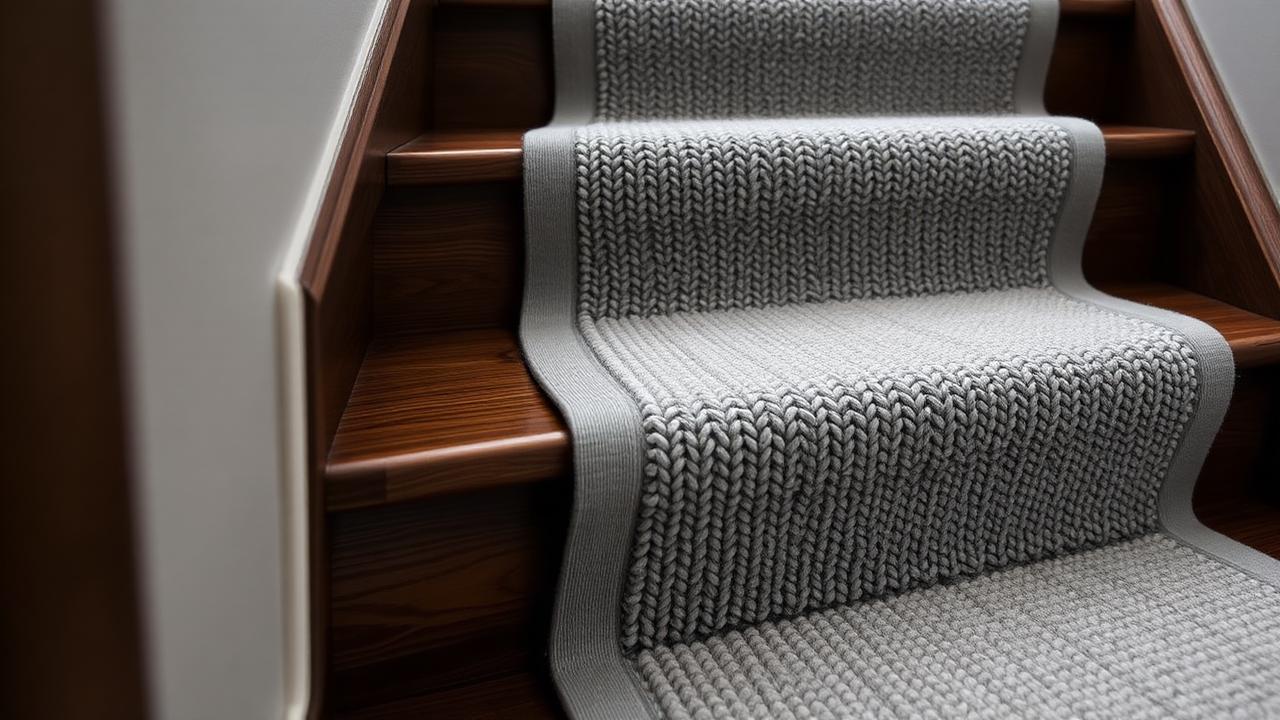
What makes a carpet herringbone
Herringbone is a weave, not a fibre. The yarn runs in short diagonal segments that alternate direction row by row, producing the same broken zig-zag you see in herringbone tweed or parquet flooring. On a stair carpet, that pattern can be woven all the way through the pile (so it survives wear) or printed onto the surface of a plain tufted base (so it wears off within a season or two on the nosing). Knowing which you are buying matters more than the colour, because a stair nosing takes more abrasion per square inch than almost any other domestic surface.
Fibre-wise, herringbone carpet stair runners are most commonly wool or an 80/20 wool-nylon blend, though polypropylene and wool-look synthetics have become common at the budget end. Wool gives the best hand-feel and natural stain resistance from its lanolin content; the nylon addition adds abrasion resistance exactly where the tread edge needs it. Fully synthetic options are cheaper and more stain-resistant against spills but can flatten and shine under heavy daily traffic.
Why herringbone specifically suits a staircase
A plain, solid-colour runner shows every mark: footprints, vacuum stripes, pet hair, even the slight colour shift where the pile has been walked flat. Herringbone breaks the surface into small diagonal fragments too fine for the eye to resolve as a track, so day-to-day wear reads as texture rather than damage. That is the main reason installers recommend it for busy households, rental properties between tenants, and any hallway lit from a side window where raking light shows every flaw in a plain pile.
Woven versus printed - the test that matters
Fold a sample sharply over your finger. A woven herringbone keeps its zig-zag crisp in the fold because the pattern runs through the yarn. A printed herringbone shows the plain base colour peeking through, because only the surface is dyed. On a stair nosing, printed pattern typically wears through within one to three years of daily use; woven pattern does not, because there is nothing to wear off.
Typical specification to ask a supplier for
| Spec | Typical range | Why it matters on stairs |
|---|---|---|
| Fibre | Wool, 80/20 wool-nylon, polypropylene | Wool-nylon blends resist nosing wear better than 100% wool |
| Construction | Woven Axminster, Wilton, or loop-woven Berber | Avoid printed tufted for anything but a low-traffic stair |
| Pile weight | 1,300-2,000 g/m2 | Below 1,300 g/m2 is a room-grade quality, not stair-grade |
| Pile height | 5-8 mm | Low pile hugs the nosing; over 9 mm bridges and looks soft underfoot |
| Pattern repeat | 3-9 cm (1.2-3.5 in) | Smaller repeats waste less material when the pattern is squared |
| Roll width | 4 m or 5 m broadloom | Governs how many runner strips one drop yields with least waste |
| Runner width | 25-33 in (64-84 cm) | 26-27 in suits most 36 in (91 cm) staircases |
| Wear rating | Heavy domestic or contract | Anything below this shows a track within two years on stairs |
Choosing a width and centring the pattern
Most homes leave an equal strip of exposed tread either side of the runner: on a standard 36 in (91 cm) staircase, a 27 in runner leaves about 4.5 in of visible timber each side, which is the proportion most people picture as a classic runner. Herringbone adds one extra constraint on top of width - the pattern needs to be centred left to right, and on a wide repeat an off-centre cut is glaringly obvious looking straight down the flight from the top landing.
If your preferred quality only comes in a stock width that does not fit your staircase, do not compromise the margin to make it fit. Order broadloom and have it cut and bound to the exact figure your staircase needs; a stair runner width calculator (or the width tool on a good runner calculator) will convert your staircase width into the correct order width with the margins already worked out.
Squaring the herringbone as you fit it
Because a stair runner wraps over every nosing and drops down every riser rather than lying flat, any small error in squaring the pattern to the first tread compounds visibly by the time it reaches the top. Fitters solve this from the bottom up, not by eyeballing it at the top afterward.

- Chalk a centre line up the middle of every tread and riser before laying anything.
- Mark the runner's own centre point on the back at its starting end and align the two lines.
- Check the pattern against a spirit level laid across the first tread, not against the tread's own edge, since old treads are rarely perfectly square.
- Fix the bottom step first, then work upward, re-checking the centre line every third or fourth step.
- Stretch the runner into each nosing with a knee kicker or mini stretcher as you go so loops or tufts sit tight.
- Check the pattern squareness again at the top landing before cutting; a 10 mm drift there is easily corrected, a 40 mm drift is not.
What it costs
Prices move with wool and yarn markets, but the ratio between material and fitting stays fairly constant. On a short flight, fitting labour is often the larger line item because it is priced per step rather than per yard.
| Item | Typical US | Typical UK |
|---|---|---|
| Herringbone carpet, broadloom | $26-58 per sq yd | GBP 24-52 per sq m |
| Ready-made bound runner | $20-46 per linear ft | GBP 17-38 per linear m |
| Edge binding or whipping | $4-9 per linear ft | GBP 4-8 per linear m |
| Stair-grade underlay | $4-8 per sq yd | GBP 5-9 per sq m |
| Fitting, straight flight | $26-52 per step | GBP 20-42 per step |
| Fitting, winders or curved flight | $50-105 per step | GBP 42-88 per step |
For a typical thirteen-step straight flight, budget somewhere in the low-to-mid four figures in dollars or pounds for a mid-market wool-blend, more for a designer mill range, and less for a synthetic house brand. Feed your own step count, chosen width and price per unit into a stair runner calculator rather than trusting a flat per-step average, since the pattern allowance alone can shift the material total by a tenth or more.
Underlay, fixings and codes
A herringbone carpet without underlay feels hard and wears through at the nosing far faster. Use a dense stair-grade crumb rubber or firm polyurethane pad, cut narrower than the tread and wrapped over the nosing rather than running full width, so it never shows past the runner's edge. Fixing is usually by staples into the tread-riser angle for a permanent job, or gripper strips plus stair rods where the runner needs to come up again for cleaning or moving house.
Neither the US IRC R311.7 stair provisions nor the UK's Approved Document K (Part K in some jurisdictions) regulate carpet choice directly, but both set tread depth, riser height and nosing projection limits that affect how a runner sits on the stair - checking your existing geometry against those figures before ordering avoids ordering a runner for a nosing profile the fitter then has to fight.
Living with a herringbone runner
- Vacuum with the beater bar off or on its gentlest setting on loop constructions to avoid plucking loops.
- Blot spills rather than rubbing them, since rubbing can distort the weave and leave a visible bright patch.
- Keep a metre or yard of offcut in storage; stair repairs are simple with matching material and near-impossible without.
- Expect a settling shed of loose fibre for the first month or two on a new wool or wool-blend quality.
- Rotate nothing - a stair runner cannot be turned end to end once fitted, so buy the wear rating you need up front.
Know your numbers in 30 seconds
Enter your step count, tread depth and riser height — the stair runner calculator gives you the exact length to order, in metres and feet, with waste included.
Open the stair runner calculatorWhatever you decide, get the numbers first: the stair runner calculator doubles as a stair runner length calculator, adding nosing wrap, landings, winders, pattern repeat and waste so you order the right length the first time.
Frequently asked questions
Is herringbone carpet durable enough for a busy family staircase?
Yes, provided it is a woven (not printed) construction rated heavy domestic or above, with a pile weight of roughly 1,500 g/m2 or more. An 80/20 wool-nylon blend at that weight will outlast a pure wool equivalent of similar price, because the nylon content carries the abrasion at the tread nosing.
How much extra material does the herringbone pattern use?
Allow one full pattern repeat on top of your measured stair run so the herringbone can be centred and squared, plus the usual 4-6 in (10-15 cm) of tuck allowance at each end. On a small repeat this is negligible; on a large repeat it can add roughly a step's worth of extra material.
Can I lay a herringbone stair runner over existing carpet?
No. Lift the old carpet, remove tacks and gripper, and check every tread for movement before laying anything new. A runner fitted over existing carpet creeps underfoot, telegraphs every lump beneath it, and cannot be tensioned properly around the nosing.
What width herringbone runner suits a 36 inch staircase?
A 26-27 in (66-69 cm) runner is the standard choice, leaving about 4.5 in of exposed timber on each side. Go wider, to 30 in, for more nosing protection and a fuller look, or narrower, to 25 in, for a more formal and elongated appearance.
Does a herringbone weave hide dirt better than a plain carpet?
Generally yes. The broken diagonal pattern fragments light and shadow across the surface, so footprints, vacuum lines and light soiling blend into the weave rather than standing out as they would on a flat, solid colour.
Should I buy broadloom and have it bound, or a ready-made runner?
Ready-made runners are cheaper and faster when a stock width matches your staircase. Choose broadloom cut and bound to order when you need a non-standard width, precise pattern centring, or a single unseamed length longer than ready-made rolls typically offer.
How do I know if a herringbone carpet is woven or printed before buying?
Bend a sample sharply and check whether the zig-zag stays crisp through the fold (woven) or fades to reveal a plain base colour (printed). You can also ask the supplier directly for the construction type - woven Axminster, Wilton or loop-woven Berber are safe for stairs; printed tufted is not.
What underlay works best under a herringbone stair carpet?
A dense stair-grade crumb rubber or firm PU foam pad, cut slightly narrower than the tread width and wrapped over the nosing, gives the best combination of cushioning and nosing protection without showing past the runner's edge.
Know your numbers in 30 seconds
Enter your step count, tread depth and riser height — the stair runner calculator gives you the exact length to order, in metres and feet, with waste included.
Measure my staircaseReady for real prices?
Get quotes from vetted stair runner suppliers and fitters near you. Free, no account, no obligation.
Every guide is written from hands-on measuring and fitting experience, checked against the calculator’s own maths, and re-reviewed whenever prices or methods change. Read our editorial standards.