

What country herringbone Berber actually means
Three words are doing three different jobs here, and suppliers rarely explain them. Berber describes the construction: a looped pile, where the yarn is punched through the backing and left as an uncut loop rather than sheared flat. Herringbone describes the pattern: short diagonal runs of loops that alternate direction to form a broken zig-zag, the same geometry as a herringbone tweed. Country is a trade style label used by British and Irish mills for their heathered, undyed or lightly dyed wool ranges — the oatmeal, pebble, moorland and stone tones that read as neutral in daylight.
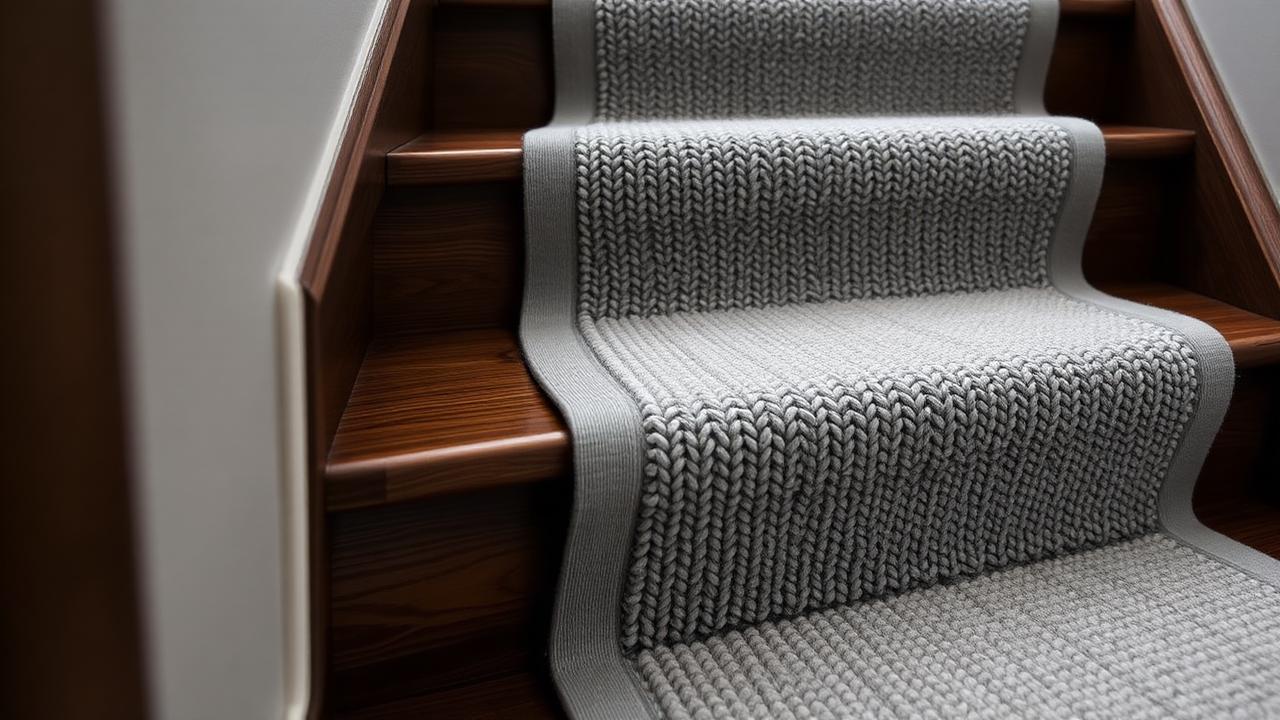
Put together, a country herringbone Berber is a loop-pile wool carpet with a small woven-look zig-zag in a muted natural colour, sold either by the metre on a broadloom roll and cut down, or ready-made in fixed runner widths with the edges already bound. Both routes end up on your stairs, but they behave differently when it comes to seams, widths and waste, which is why the buying decision matters more than the colour swatch.
Why the weave suits staircases
Stairs are the harshest floor in a house. Every step lands on the same two inches of tread nosing, and that edge takes the abrasion that would be spread across a whole room. A loop pile helps because the yarn is anchored at both ends of each loop, so there are no cut tips to splay, fuzz or flatten into a shiny track. Wool helps again because the fibre is naturally springy and recovers its shape overnight, and because the lanolin in the fibre resists water-based spills long enough for you to blot them.
The herringbone geometry then does the visual work. A plain runner shows every vacuum stripe and every footprint; a small repeating diagonal breaks the surface into fragments too small for your eye to read as a mark. That is the single most common reason fitters recommend it to clients with dogs, children or a north-facing hallway where raking light shows everything.
The trade-off nobody mentions
Loop pile can snag. A dog claw, a cat, or a dragged suitcase can pull a single loop into a long run. It is repairable — clip the loop level with the pile, never pull it — but if you own a large dog that takes stairs at speed, a tightly twisted cut pile or a low flat weave is the safer buy.
Typical specification you should ask for
| Spec | Typical range | What it means for stairs |
|---|---|---|
| Fibre | 80/20 or 100% wool | 80/20 wool-nylon wears longer on nosings; 100% wool feels better |
| Pile weight | 1,300-2,000 g/m2 | Under 1,300 g/m2 is a room-only quality, not a stair quality |
| Pile height | 4-7 mm | Low loops hug the nosing; anything over 9 mm bridges and looks soft |
| Backing | Jute, woven or felt | Woven backings hold staples best and resist tread creep |
| Roll width | 4 m or 5 m broadloom | Determines how many runner strips you can cut from one drop |
| Runner widths | 25 / 27 / 30 / 33 in | Ready-made widths; 26-27 in suits most 36 in staircases |
| Pattern repeat | 3-9 cm | Small repeats waste less than large ones when squaring the pattern |
| Rating | Heavy domestic or above | Anything below this will show a track within two years |
Choosing a width for a country herringbone runner
The convention is to leave an equal margin of exposed timber each side of the runner. On a standard 36 in (91 cm) staircase, a 27 in runner leaves roughly 4.5 in either side, which is the proportion most people picture when they picture a runner. Narrow it to 25 in and the stairs look taller and more formal; widen it to 30 in and you get a softer, more upholstered look that also protects more of the tread.
Herringbone adds one constraint: the pattern should be centred, and on a small repeat that is easy, but on a wide repeat an off-centre cut is obvious at the top of the flight where you look straight down at it. If your chosen quality only comes in a 33 in ready-made width and your staircase is 34 in wide, do not squeeze it — order the broadloom and have it cut and bound to the width you actually need. The stair runner width calculator will give you the margin figures for your exact staircase before you commit.
Squaring the herringbone so it does not drift
A runner that climbs a staircase is not a flat rectangle: it wraps over eleven or thirteen nosings and drops down as many risers. If the pattern is not square to the first tread, the error compounds, and by the seventh step the zig-zag is visibly leaning. Professionals fix this at the bottom, not the top.
- Chalk a centre line up the middle of every tread and riser before anything is laid.
- Mark the runner's own centre on the back at the bottom end and align the two lines.
- Check the pattern against a spirit level across the first tread, not against the tread edge — old treads are rarely square.
- Fix the bottom riser first, then work upward, re-checking the centre line every third step.
- Stretch as you go with a knee kicker or mini stretcher so the loops sit tight into each nosing.
- Re-check the pattern at the top landing before you cut; a 10 mm drift is fixable there, a 40 mm drift is not.
What it costs
Prices move with wool markets, but the ratios stay stable. Expect the material to be the smaller half of the job on a short flight and the larger half on a long one, because fitting is priced per step rather than per metre.
| Item | Typical US | Typical UK |
|---|---|---|
| Country herringbone Berber, broadloom | $28-60 per sq yd | GBP 25-55 per sq m |
| Ready-made bound runner, per linear foot | $22-48 | GBP 18-40 per linear metre |
| Edge binding or whipping | $4-9 per linear ft | GBP 4-8 per linear m |
| Underlay (stair grade) | $4-8 per sq yd | GBP 5-9 per sq m |
| Fitting, straight flight | $28-55 per step | GBP 22-45 per step |
| Fitting, winders or curved | $55-110 per step | GBP 45-90 per step |
For a typical thirteen-step straight flight with a small landing, most homeowners land somewhere between a modest four-figure sum and roughly double that, depending on whether the wool is a mill house brand or a designer range. Put your own step count and price per unit into the cost calculator rather than trusting a per-step average — the pattern allowance alone can move the material figure by a tenth.
Underlay, grippers and fixings
A loop pile without underlay feels hard and wears through at the nosing in a fraction of the time. Use a dense stair-grade crumb rubber or a firm PU, cut to the tread width less an inch each side and wrapped over the nosing, never running the full width of the stair. Underlay that reaches the exposed timber shows as a pale shadow line and collects grit.
For fixings, staples into the crotch of each step are the standard for a permanent installation. If the staircase is a restored original and you want the runner removable, use gripper strips in the angle plus stair rods, and accept that the runner will need re-tensioning once a year. Rods on a herringbone look particularly good because the horizontal metal line contrasts with the diagonal weave.
Living with it
- Vacuum with the beater bar off or on its highest setting — a rotating brush can pluck loops.
- Blot spills, never rub; rubbing opens the loop and leaves a bright patch.
- Clip, never pull, any loop that runs; a snagged loop cut flush is invisible in a herringbone.
- Expect a settling shed of loose fibre for the first six to eight weeks on a 100% wool quality.
- Rotate nothing — a stair runner cannot be turned, so buy the wear rating up front rather than hoping.
- Keep one metre of offcut in the loft; a stair repair is trivial with matching material and impossible without.
Where it works and where it does not
Country herringbone Berber suits painted timber staircases, oak treads, period hallways and anywhere the rest of the scheme is already doing the talking. Its muted colouring means it sits under bold wallpaper without fighting it. It is less convincing in a high-gloss contemporary interior, where a flat weave or a tight cut pile in a single deep tone reads cleaner, and it is the wrong choice for an outdoor or unheated stair, where wool holds damp.
Know your numbers in 30 seconds
Enter your step count, tread depth and riser height — the stair runner calculator gives you the exact length to order, in metres and feet, with waste included.
Open the stair runner calculatorWhatever you decide, get the numbers first: the stair runner calculator doubles as a stair runner length calculator, adding nosing wrap, landings, winders, pattern repeat and waste so you order the right length the first time.
Still deciding on material, width or pattern? Our hub on stair runners compares weaves, widths, backings and fitting styles side by side, then hands the numbers straight to the calculator.
Frequently asked questions
Is a country herringbone Berber runner hard-wearing enough for a main staircase?
Yes, provided it is specified at heavy domestic rating or above with a pile weight around 1,500 g/m2 or more. An 80/20 wool-nylon blend in that weight will outlast a 100% wool of the same price on a busy family staircase, because the nylon carries the abrasion at the nosing.
How much extra material does the herringbone pattern need?
Allow the length of one full pattern repeat on top of your measured run so the pattern can be squared and centred, plus the usual 10 to 15 cm of tuck at each end. On a small 4 to 6 cm repeat that is negligible; on a large repeat it can add a whole step's worth of material.
Can it be fitted over an existing carpet?
No. Lift the old carpet, remove the tacks and grippers, punch down any proud nails and check every tread for movement first. A runner laid over carpet creeps, shows every lump underneath and cannot be tensioned properly at the nosing.
What width should I order for a 36 inch staircase?
A 26 to 27 inch runner is the standard answer, leaving roughly 4.5 inches of visible timber each side. Go to 30 inches if you want more protection and a fuller look, or down to 25 inches for a more formal, narrower proportion.
Do loops snag badly with pets?
Cats and large dogs can pull a loop. It is a cosmetic repair — clip the pulled loop level with the surrounding pile with sharp scissors — but if pets take the stairs at speed daily, a tightly twisted cut pile or a flat weave is the lower-maintenance choice.
Should I buy broadloom and have it bound, or a ready-made runner?
Ready-made is cheaper and quicker when a stock width fits your staircase. Buy broadloom and have it cut and bound when you need a non-standard width, a specific pattern centring, or a single unseamed length longer than the ready-made rolls allow.
Know your numbers in 30 seconds
Enter your step count, tread depth and riser height — the stair runner calculator gives you the exact length to order, in metres and feet, with waste included.
Measure my staircaseReady for real prices?
Get quotes from vetted stair runner suppliers and fitters near you. Free, no account, no obligation.
Every guide is written from hands-on measuring and fitting experience, checked against the calculator’s own maths, and re-reviewed whenever prices or methods change. Read our editorial standards.