
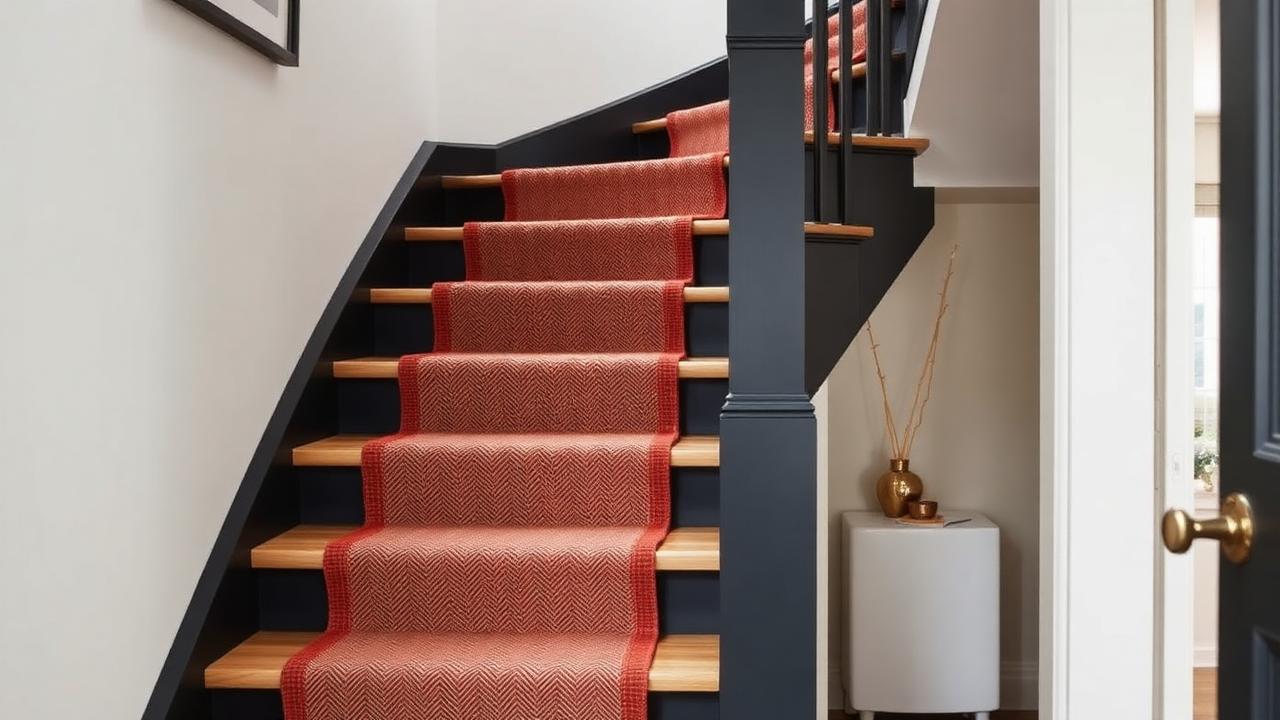
Horizontal versus vertical stripes on stairs
On a staircase, a horizontal stripe runs across the width of the runner, appearing as a series of bands as you look up or down the flight, similar to the stripes of a ticking fabric turned sideways. This differs from a vertical stripe, which runs along the length of the runner and appears as parallel lines flowing down each step. Horizontal stripes tend to draw the eye across the staircase and can visually widen a narrow runner, while also creating a rhythmic, structured look that pairs well with traditional and coastal interiors alike.
Why stripe width matters on stairs
Because a stair runner is applied over a series of individual treads and risers rather than a flat floor, the placement of each stripe matters enormously to the finished look. If a stripe repeat does not align neatly with your tread depth and riser height, you can end up with a partial stripe awkwardly straddling the nosing of every step, which looks unintentional and cheap. Before ordering, always check the stripe repeat measurement supplied by the manufacturer and compare it against your own tread and riser depth using a stair runner length calculator.
How much runner do I need?
For a 13-step flight: 10 in tread + 7.5 in riser + 0.75 in nosing wrap = 18.25 in per step, totalling 237.25 in across 13 steps. Add 24 in for finishing top and bottom, giving 261.25 in or 21.77 ft. Because horizontal stripes require careful repeat alignment, add a slightly higher waste allowance of around 12%, bringing the order to roughly 24.5 ft. Metric: 25 cm + 19 cm + 1.9 cm = 45.9 cm per step, times 13 is 596.7 cm, plus 60 cm is 656.7 cm, and with a 12% allowance for pattern matching, order approximately 7.4 m.

| Measurement | US (in/ft) | UK (cm/m) |
|---|---|---|
| Per-step total | 18.25 in | 45.9 cm |
| 13 steps | 19.77 ft | 5.97 m |
| With finishing allowance | 21.77 ft | 6.57 m |
| With 12% waste for stripe matching | 24.5 ft | 7.4 m |
Know your numbers in 30 seconds
Enter your step count, tread depth and riser height — the stair runner calculator gives you the exact length to order, in metres and feet, with waste included.
Open the stair runner calculatorChoosing a stripe scale for your staircase
Narrow stripes, typically half an inch to one inch wide, create a subtle texture that reads almost as a solid colour from a distance, and they are more forgiving if your treads are not perfectly uniform. Wide stripes, from two to four inches, make a bolder statement and work well on a generously proportioned staircase, but they demand very precise measuring, since even a small discrepancy in tread depth will be obvious across a wide colour band.
Ask your supplier about repeat customisation
Some manufacturers can adjust the stripe repeat slightly to better fit your specific tread and riser measurements. It is always worth asking before you assume you must accept a standard repeat.
Design pairing ideas
- Navy and white stripes for a crisp coastal or nautical hallway.
- Multicolour narrow stripes for a playful, family-friendly staircase.
- Tonal stripes in two shades of the same colour for a subtle, sophisticated look.
- Black and cream wide stripes for a bold, contemporary statement staircase.
Fitting considerations
Because alignment is critical with horizontal stripes, always have your runner fitted by a professional experienced with patterned carpet. A skilled fitter will dry-lay the runner first to check the stripe placement on every step before making any permanent fixings, and will adjust the starting point at the top or bottom of the flight if needed to achieve the most balanced overall look.
In summary, a horizontal striped stair runner is a striking choice that rewards careful planning. Check the stripe repeat against your tread and riser measurements, order a slightly higher waste allowance than usual, and use a stair runner calculator to confirm your total length before committing to an order.
Still deciding on material, width or pattern? Our hub on stair runners compares weaves, widths, backings and fitting styles side by side, then hands the numbers straight to the calculator.
Frequently asked questions
What is the difference between horizontal and vertical stripes on stairs?
Horizontal stripes run across the tread width, while vertical stripes run along the length of the flight down each step.
Do horizontal stripes need more waste allowance?
Yes, typically around 12% versus 8-10% for a plain runner, because the pattern needs to align cleanly with each tread and riser.
Can I customise the stripe width for my stairs?
Some manufacturers can adjust the stripe repeat to suit your measurements, so it's worth asking before ordering a standard pattern.
Do horizontal stripes make a staircase look wider?
Yes, the horizontal bands can create a visual widening effect similar to how stripes work on clothing or flooring.
How much runner do I need for 13 steps?
Approximately 24 to 24.5 feet or around 7.4 meters, accounting for stripe alignment.
Are horizontal striped runners harder to install?
Yes, they require more precise fitting to ensure stripes align neatly with the nosing on every step.
What colours work best for horizontal stripes?
Navy and white for coastal looks, tonal shades for subtlety, or bold contrasting colours for a statement staircase.
Should I dry-lay the runner before fixing it?
Yes, always dry-lay a striped runner first so your fitter can adjust the starting point for the best overall stripe alignment.
Know your numbers in 30 seconds
Enter your step count, tread depth and riser height — the stair runner calculator gives you the exact length to order, in metres and feet, with waste included.
Calculate your yardage with the stair runner calculatorReady for real prices?
Get quotes from vetted stair runner suppliers and fitters near you. Free, no account, no obligation.
Every guide is written from hands-on measuring and fitting experience, checked against the calculator’s own maths, and re-reviewed whenever prices or methods change. Read our editorial standards.