
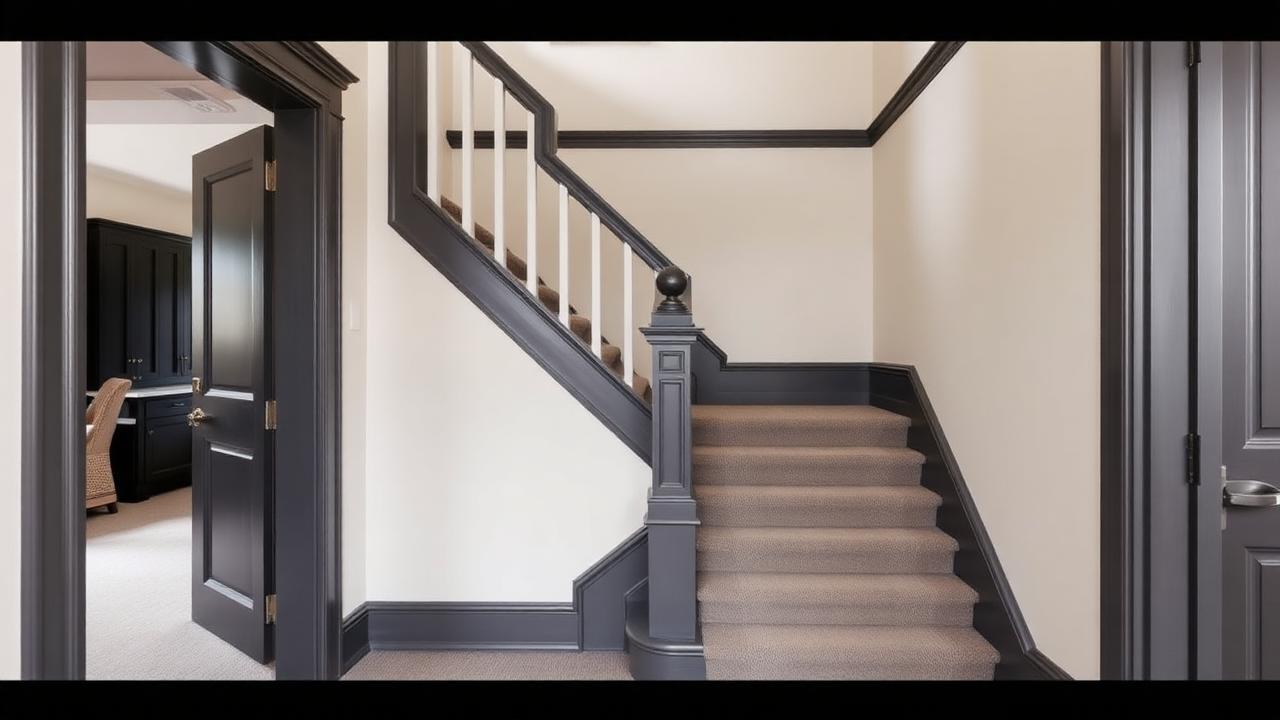
Break the staircase into flights
Treat every straight run as its own flight and every landing as a separate piece. An L-shaped staircase is two flights plus one landing. A U-shaped staircase is usually three flights plus two landings, or two flights plus one long half-landing.
Measure each flight separately
Flights on the same staircase often have different step counts and sometimes different tread depths. Averaging them is how orders come up short.
Measuring the landing
- Stand at the top of the lower flight and follow the path a person walks to the bottom of the upper flight.
- Measure that path in a straight line, or as two legs if it turns.
- Add the depth of the landing nosing if the runner drops over the edge onto the flight below.
- Add 4–6in per landing so the fitter can trim and square the joint.
Know your numbers in 30 seconds
Enter your step count, tread depth and riser height — the stair runner calculator gives you the exact length to order, in metres and feet, with waste included.
Open the stair runner calculator90 degree turns
There are two ways to handle a quarter-turn landing. The seamless approach runs one continuous piece around the corner, which needs careful mitring and looks best with a plain runner. The pieced approach uses a separate landing piece butted to each flight, which is easier to fit, easier to replace, and essential if the runner has a directional pattern that would otherwise run sideways around the corner.
Winder and pie steps
Winders replace a landing with two, three or four tapered treads. Each one is cut individually and measured at its widest point. Budget a full extra pattern repeat and a wider waste margin — 15–20% — because winders generate a lot of off-cut.
| Staircase type | Flights | Typical extra allowance |
|---|---|---|
| Straight | 1 | 10% waste |
| L-shaped, one landing | 2 | Landing length + 10–15% |
| U-shaped, two landings | 3 | Both landings + 15% |
| Winder turn | 2 | Widest tread per winder + 15–20% |
Where the runner meets landing carpet
If the landing is carpeted wall to wall and the stairs take a runner, the transition happens at the landing nosing. Most fitters bring the runner over the nosing and finish it just under the landing carpet edge, so the two never meet on a visible surface. Measure the runner to include that nosing wrap, and tell your fitter which of the two goes on top.
Worked example: L-shaped staircase
A common L-shaped layout runs 7 steps up to a landing, turns 90 degrees, then 6 steps to the upper floor. Tread 10in, riser 7.5in, landing walking path 48in.
| Element | Maths | Length |
|---|---|---|
| Lower flight | 7 × 17.5in | 122.5in |
| Landing | 1 × 48in | 48in |
| Upper flight | 6 × 17.5in | 105in |
| Subtotal | — | 275.5in (7.0m) |
| Waste at 15% | 275.5 × 0.15 | 41.3in |
| Total to order | — | 316.8in ≈ 8.05m / 26ft 5in |
Deciding seamless vs pieced at the turn
| Seamless (one piece) | Pieced (landing panel) | |
|---|---|---|
| Best runner type | Plain or non-directional | Any, including strong directional pattern |
| Fitting skill needed | High — precise mitring | Moderate |
| Future repair | Whole piece affected | Landing panel replaceable alone |
| Visual result | Continuous flow | Deliberate, tailored break |
Decide the turn treatment before you measure
A seamless mitred turn and a pieced landing need slightly different measurements and different waste allowances, so settle on the approach first rather than reworking your figures afterwards.
U-shaped staircases with a half landing
A U-shaped stair typically has two flights facing opposite directions joined by one wide half landing. Measure the landing's walking path as a straight line from the top of the lower flight to the bottom of the upper flight — usually roughly the landing's depth plus half its width, depending on where the flights meet it. This is the step people most often measure wrong, because it is tempting to just use the landing's overall width.
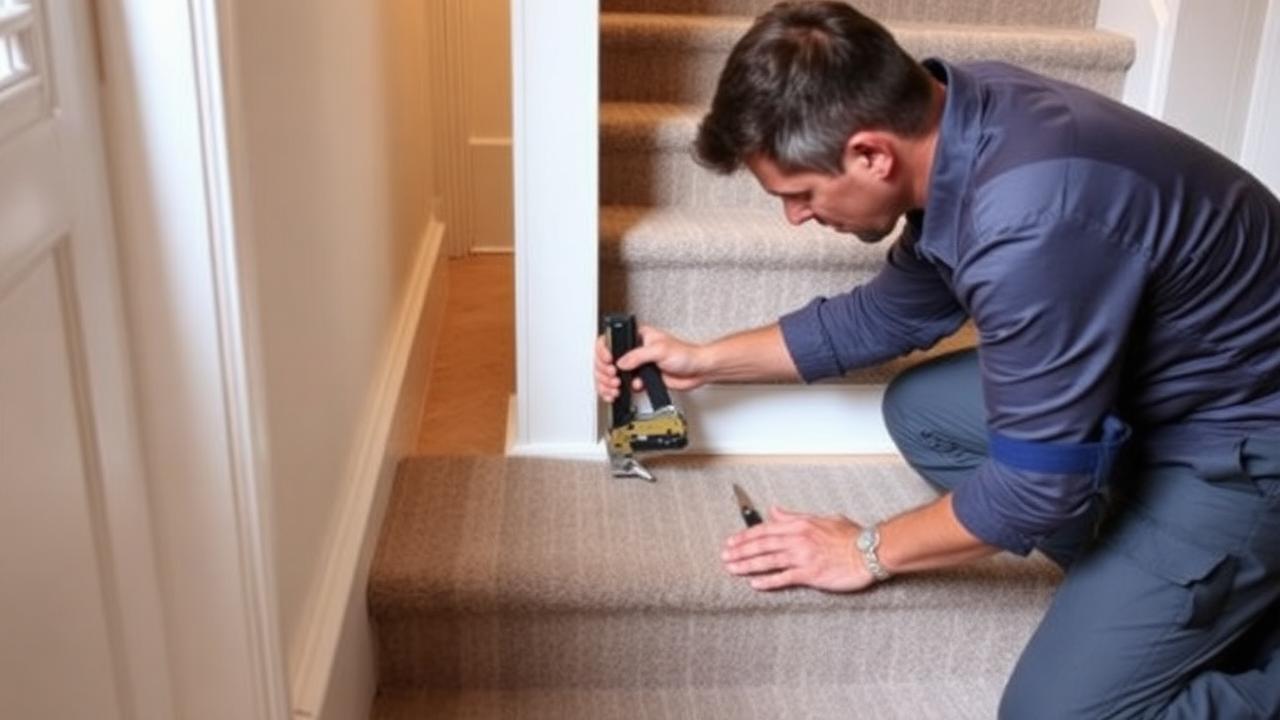
Checklist for turns and landings
- Identify how many flights and landings the staircase actually has.
- Measure every flight's step count and tread/riser separately.
- Walk and measure the actual path across each landing, not its overall dimensions.
- Decide seamless or pieced at each turn before finalising quantity.
- Add 15-20% waste wherever a landing or winder is involved.
- Confirm with your fitter which layer sits proud where runner meets landing carpet.
Split-level and multi-storey staircases
A staircase spanning more than one storey, or a split-level layout with several short flights connecting rooms at different heights, should be treated as a series of entirely independent measuring jobs rather than one long calculation. Measure and record each flight and each landing on its own line, working floor by floor, and only total everything once every section has been checked. It is worth photographing and labelling each flight (Flight 1, Landing 1, Flight 2, and so on) so the order sheet you hand to a supplier or fitter maps directly onto the physical staircase.
Never assume upper and lower flights match
Even in the same house, the ground-to-first-floor flight and the first-to-second-floor flight are often built to slightly different rise and going dimensions. Measure both independently rather than doubling one figure.
Tools that help on complex layouts
| Tool | Why it helps on a multi-flight staircase |
|---|---|
| Laser distance measure | Speeds up repeated landing and flight measurements without re-hooking a tape |
| Digital angle finder | Confirms whether a turn is a true 90 degrees or an odd angle needing bespoke templating |
| Labelled sketch or floor plan | Keeps flights, landings and winders straight when totalling a large order |
| Camera or phone | Documents each section for the supplier and for your own record if you reorder later |
On anything beyond a simple L-shaped staircase, it is worth having a fitter walk the whole layout with you before committing to a final order, even if you plan to fit it yourself. A second set of eyes on a multi-flight staircase catches the landing that turns out to be trapezoidal, or the winder set that is one tread narrower than it looks, before that becomes an expensive surprise mid-installation.
Templating an irregular landing
Not every landing is a clean rectangle or a simple right angle. Older homes especially can have landings that taper slightly, meet at an odd angle, or have a jog where a door swings into the walking path. For anything that is not a true square or rectangle, make a paper or card template of the landing shape rather than relying on a handful of tape measurements — lay the paper down, crease it to the skirting and door frames, then trim it to the exact outline. A fitter can transfer that template directly onto the runner material, which avoids the guesswork of trying to describe an irregular shape in a string of numbers.
When to bring in a professional measure for complex layouts
A DIY tape measure and a notepad are perfectly adequate for a straight flight or a simple L-shape. Once a staircase involves two or more landings, a mix of winders and straight steps, or any angle that is not a clean 90 degrees, the cost of a professional measuring visit — typically $50-$150, often credited against the job if you book the same company to fit — is cheap insurance against an expensive mis-order. This is doubly true for a patterned or high-value runner, where a measuring mistake cannot simply be patched with an offcut.
Whatever you decide, get the numbers first: the stair runner calculator doubles as a stair runner length calculator, adding nosing wrap, landings, winders, pattern repeat and waste so you order the right length the first time.
Still deciding on material, width or pattern? Our hub on stair runners compares weaves, widths, backings and fitting styles side by side, then hands the numbers straight to the calculator.
Frequently asked questions
How do you measure a stair runner with a landing?
Measure each flight separately using tread plus riser per step, then measure the walking path across the landing and add it. Include the landing nosing if the runner wraps over it, and add 4–6in per landing for trimming.
Should a runner be one continuous piece around a turn?
Only if the runner is plain or the pattern is non-directional. Patterned runners look better pieced, with a separate landing panel, because a continuous piece turns the pattern sideways around the corner.
Do winder steps need more runner than normal steps?
Considerably more. A winder is measured at its widest point, which can be double a standard tread depth, and each one is cut individually so off-cut waste is higher.
How do I measure a half landing on a U-shaped staircase?
Measure the actual walking path a person takes from the top of the lower flight to the bottom of the upper flight, which is usually the landing depth plus roughly half its width rather than the landing's full dimensions.
Can I fit different runner widths on different flights of the same staircase?
You can, but it rarely looks right. Use the narrowest flight's width for the whole staircase so the runner reads as one consistent, deliberate choice from top to bottom.
What is the safest waste margin for a staircase with a turn?
Allow 15-20% on any staircase with a landing or winder turn, rather than the 5-10% that suits a simple straight flight. Turns generate more off-cut and the fitter needs extra material to square each joint neatly.
Know your numbers in 30 seconds
Enter your step count, tread depth and riser height — the stair runner calculator gives you the exact length to order, in metres and feet, with waste included.
Calculate a staircase with a landingReady for real prices?
Get quotes from vetted stair runner suppliers and fitters near you. Free, no account, no obligation.
Every guide is written from hands-on measuring and fitting experience, checked against the calculator’s own maths, and re-reviewed whenever prices or methods change. Read our editorial standards.