
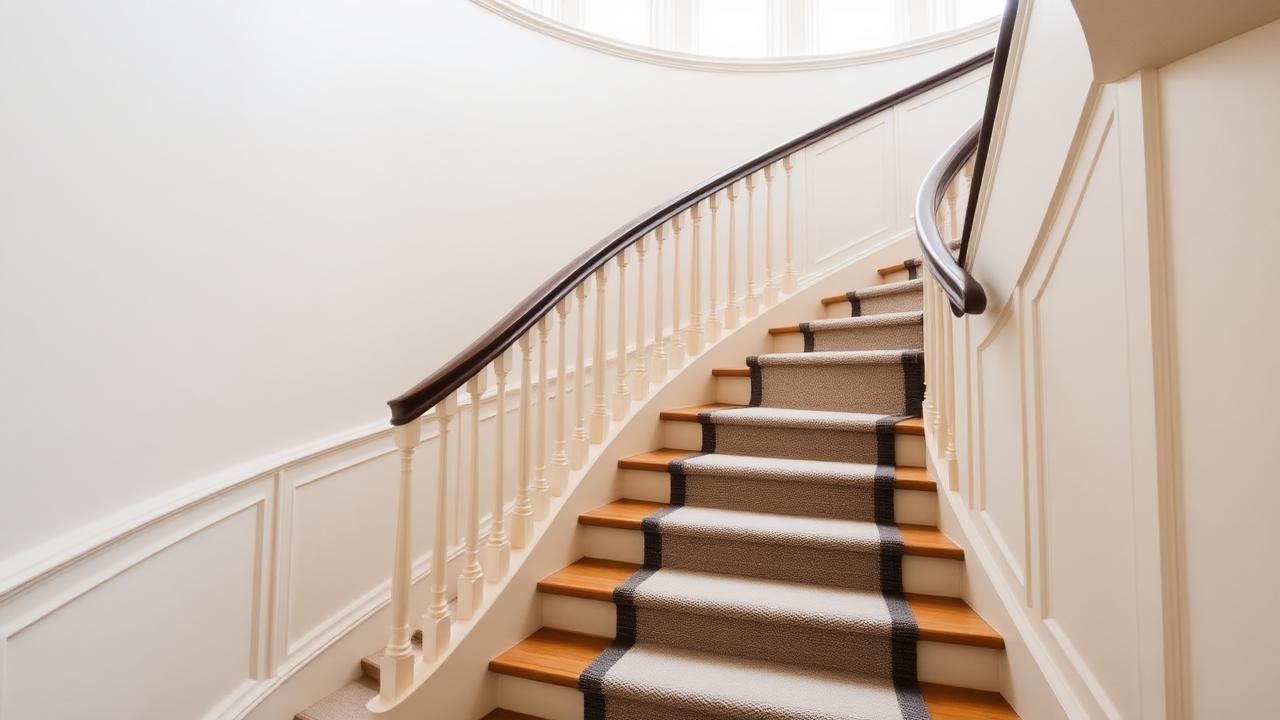
Why winders change everything
A winder tread is pie-shaped: narrow at the inside newel, wide at the outer wall. A rectangular runner cannot follow that shape, so each winder is cut as its own tapered piece and set individually. That means more material, more labour and more visible joints.
Always measure winders at the widest point
The runner must cover the deepest part of the tread. A winder with a 24in widest tread uses more than twice the material of a 10in straight step.
Two ways to run a runner through a turn
| Method | Look | Notes |
|---|---|---|
| Tapered pieces per winder | Runner follows the turn, width varies | Most common; needs skilled cutting |
| Constant width, centred on the walking line | Runner stays the same width | Cleaner look, leaves uneven reveal |
The constant-width approach is usually the better-looking of the two, because the eye reads the runner width, not the stair edge. Discuss it with your fitter before they cut — it changes how the pieces are set out.
Know your numbers in 30 seconds
Enter your step count, tread depth and riser height — the stair runner calculator gives you the exact length to order, in metres and feet, with waste included.
Open the stair runner calculatorWaste and budget
- Allow 15–20% waste rather than the usual 10%.
- Expect $30–$60 per winder in labour rather than $15–$25 per straight step.
- Add a pattern repeat per winder group if the runner is patterned.
- Order everything in one dye lot — piecing makes colour variation obvious.
Curved and spiral staircases
A continuously curved flight has no straight runs at all, so every tread is templated. On a true spiral, most fitters will recommend full-width carpet or individual tread pieces instead of a runner, because a constant-width ribbon cannot follow a tightening curve without wrinkling on the inside edge.
Patterns on curved stairs
Keep it simple. Plain, tonal or small all-over textures work; stripes and strong geometrics will fight the curve and draw attention to every joint. If you want a pattern on a winding staircase, choose one with no obvious direction.
Cost comparison: winders vs full carpet
| Option | Typical material cost | Typical labour | Best for |
|---|---|---|---|
| Runner with tapered winder pieces | Medium-high | High — skilled templating | Keeping timber reveal either side |
| Runner, constant width centred | Medium | High | A cleaner, more contemporary look |
| Full-width fitted carpet | Lower per step | Lower — no piecing | Simplicity and lower long-term cost |
Worked example: a quarter-turn staircase with three winders
A flight of 8 straight steps turns through three winders (widest points 18in, 22in, 24in) before continuing for 5 more straight steps, with a 10in tread and 7.5in riser on the straight sections.
| Section | Maths | Length |
|---|---|---|
| Lower straight flight | 8 × 17.5in | 140in |
| Three winders | (18+22+24) + 3×7.5 | 86.5in |
| Upper straight flight | 5 × 17.5in | 87.5in |
| Subtotal | — | 314in (7.98m) |
| Waste at 18% | 314 × 0.18 | 56.5in |
| Total to order | — | 370.5in ≈ 9.4m / 30ft 10in |
Tools and skills needed
- Card or thin plywood for templating each individual winder tread.
- A sharp utility knife and spare blades — winder cuts blunt blades faster than straight cuts.
- A flexible curved gripper strip for any bullnose or curved nosing within the turn.
- Patience: a winder turn typically takes two to three times longer to fit than the same number of straight steps.
Common mistakes on winder installations
- Measuring one winder and assuming the rest of the turn matches it.
- Choosing a bold directional pattern without accepting the visible distortion it will show through the turn.
- Underestimating waste and running short mid-installation, which risks a dye-lot mismatch on the top-up piece.
- Using straight gripper on a curved nosing instead of a proper curved gripper product.
Maintaining a winder staircase runner
Winder treads see twisting foot traffic as people lean into the turn, which wears the inside edge of each piece faster than a straight tread wears evenly. Check winder sections for lifting or flattening at least twice a year, and keep a labelled offcut of each winder piece so a future repair can be cut to match the exact template rather than guessed at.
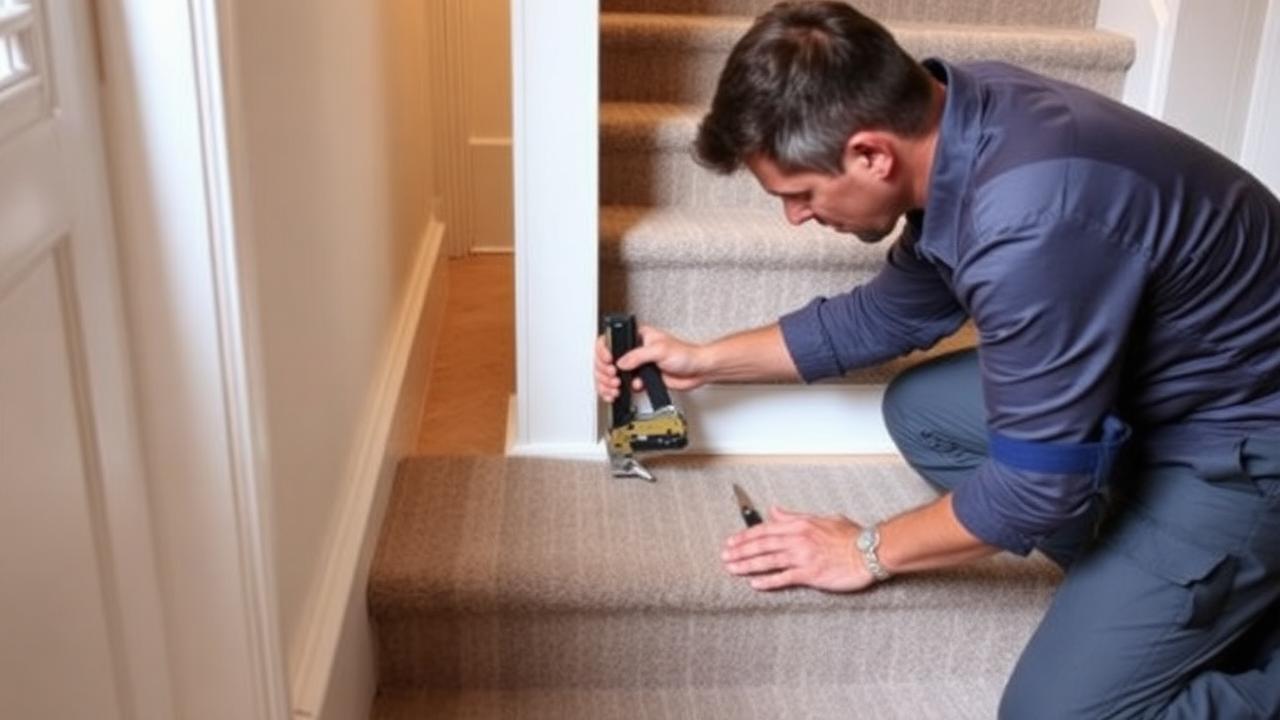
When full stair carpet beats a runner on winders
If a staircase has four or more consecutive winders, or the layout is a continuously curved stair with no straight run at all, full-width fitted carpet is often the more sensible choice. It avoids the labour cost of piecing tapered runner sections through a long turn, hides the geometry changes completely, and in many cases costs less overall once the extra winder labour on a runner is factored in — even though the material itself covers more of the tread.
Getting quotes for a winder staircase
Always get a fitter to survey a winder or curved staircase in person before quoting — photos and a tape measure rarely capture the true geometry of a turn. Ask specifically for a breakdown of straight steps versus winders in the quote, since lumping them together at one per-step rate makes it hard to compare quotes from different fitters. A wide variance between quotes on a winder staircase usually reflects genuine differences in how much templating and piecing each fitter is planning, not just a pricing markup.
Material choice for curved and winder sections
A dense, low-to-medium pile natural or wool-blend fibre with a stable backing holds a tapered cut cleanly without fraying at the narrow inside point of each winder — the part of the piece under the most stress. Very loosely woven or high-pile runners can distort visibly once cut into a wedge shape, so if your chosen runner is a loose flatweave, ask your fitter whether it is suitable for winders before committing, rather than after the first piece is cut.
Why winders eat material
A winder tread is a wedge, so its widest edge can be half again as long as its narrow edge. The runner has to cover the walking line — which sits toward the wide end — and it has to do so without the fabric bunching at the narrow end. In practice that means either cutting and rejoining the runner on each winder, or easing a single piece around the turn and accepting some pleating on the inside. Either route uses noticeably more carpet than the same number of straight treads: allow 25 to 40 per cent extra on the winder section alone.
| Turn type | Treads involved | Extra allowance | Technique |
|---|---|---|---|
| Quarter turn, 2 winders | 2 | +25% | Cut and rejoin at each riser |
| Quarter turn, 3 winders | 3 | +30% | Cut and rejoin, pattern reset |
| Half turn, 6 winders | 6 | +40% | Piece per tread, bound edges |
| Continuous curve | All | +40-50% | Templated pieces per tread |
Templating a curved flight
On a genuinely curved stair the only reliable method is to template each tread in paper or thin card, mark the walking line and the inside and outside edges, and cut from the template. Number every template and every piece as you go, and keep them in order — two adjacent winder treads are rarely identical and a swapped pair shows immediately. Where the runner has a pattern, mark the pattern datum on each template before cutting so the repeat continues around the turn rather than restarting at each tread.
Bind the exposed edges
Cut winder pieces have raw edges on the inside of the turn where the geometry changes. Have them bound or serged — an unbound cut edge on a winder frays faster than anywhere else on the staircase because it is walked on obliquely.
Whatever you decide, get the numbers first: the stair runner calculator doubles as a stair runner length calculator, adding nosing wrap, landings, winders, pattern repeat and waste so you order the right length the first time.
Still deciding on material, width or pattern? Our hub on stair runners compares weaves, widths, backings and fitting styles side by side, then hands the numbers straight to the calculator.
Frequently asked questions
Can you put a runner on curved stairs?
Yes, but each tread is cut and fitted individually, which increases material, waste and labour. On a tight spiral, full-width carpet or individual tread pieces is often the better answer.
How do you measure winder steps for a runner?
Measure each winder at its widest point and add the riser height, exactly as you would for a straight step. Count winders separately from straight steps and allow 15–20% waste.
Is it much more expensive to fit a runner on winders?
Yes — expect $30-60 per winder in labour versus $15-25 per straight step, plus 15-20% material waste rather than the usual 10%, because each winder is cut and fitted as an individual tapered piece.
How much extra runner do winders need?
Allow 25 to 40 per cent extra across the winder section, more on a continuous curve, and have every cut edge bound — winder edges fray faster than anywhere else on a staircase.
Know your numbers in 30 seconds
Enter your step count, tread depth and riser height — the stair runner calculator gives you the exact length to order, in metres and feet, with waste included.
Calculate a winder staircaseReady for real prices?
Get quotes from vetted stair runner suppliers and fitters near you. Free, no account, no obligation.
Every guide is written from hands-on measuring and fitting experience, checked against the calculator’s own maths, and re-reviewed whenever prices or methods change. Read our editorial standards.