
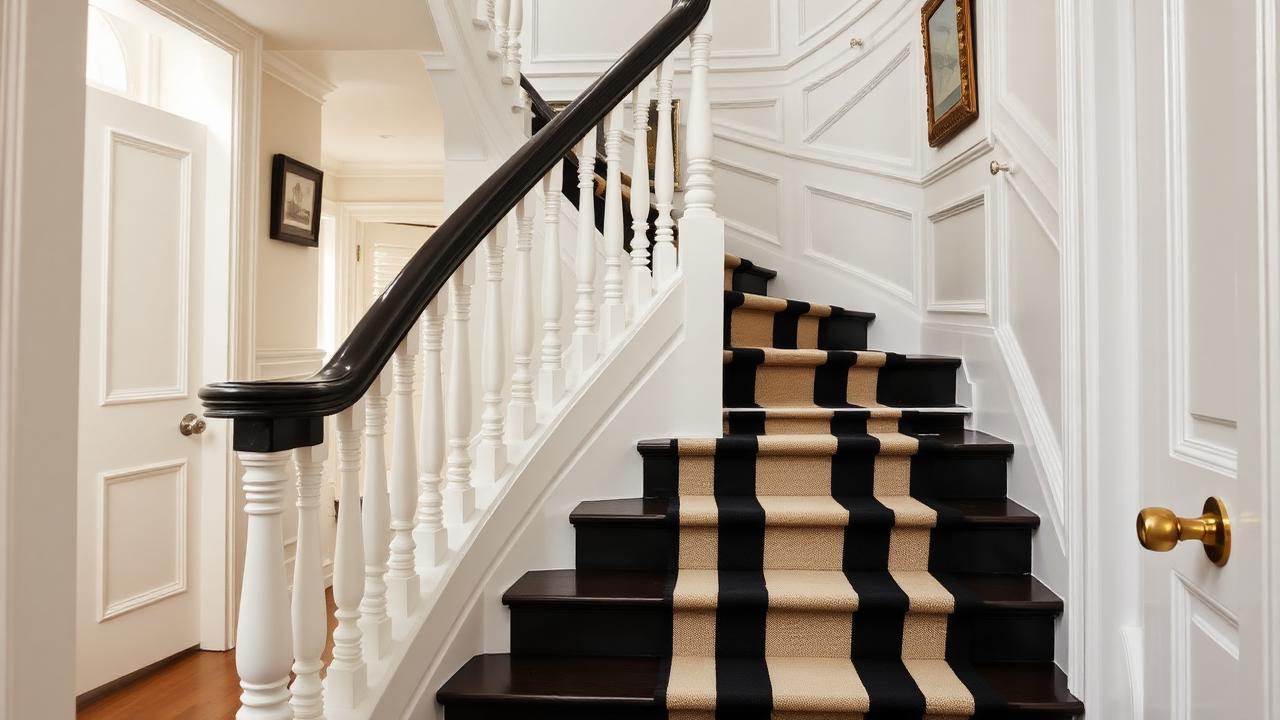
What makes a stair runner read as modern
A modern stair runner is defined more by restraint than by any single material. Three choices consistently separate a contemporary result from a traditional one: a solid or near-solid colour rather than a busy pattern, a narrower runner width that shows more of the surrounding timber or painted stringer, and hardware kept invisible rather than decorative. Where a period staircase carries a Persian or floral design pinned down with polished brass rods every step, a modern staircase usually runs a plain wool or wool-blend flatweave with no rods at all, held by gripper strip so nothing interrupts the line of the flight.
Colour does most of the heavy lifting. Contemporary interiors tend to pair a light timber or painted white staircase with a dark runner — charcoal, graphite or deep navy — or a dark stained staircase with a pale stone or ivory runner. The high-contrast pairing reads as deliberate and architectural, while a runner that closely matches the stair colour reads as an afterthought. Mid-tone beiges and busy multicolour patterns, by contrast, are the two choices most associated with a dated, traditional look, so a modern scheme generally avoids both.
Colours that photograph as modern in 2026
| Colour | Best staircase pairing | Mood |
|---|---|---|
| Charcoal / graphite | Pale oak or white-painted stringers | Sharp, architectural |
| Deep navy | Light oak, white risers | Confident, tailored |
| Warm stone / greige | Mid-tone or dark timber | Calm, Scandinavian |
| Off-white / ivory | Dark walnut or black-painted stairs | Gallery-like, minimal |
| Forest green | Natural oak, brass fixtures | Grounded, editorial |
Within any of these colours, a subtle tonal texture — a fine herringbone weave, a low corduroy rib or a heathered wool fleck — reads as more current than a flat, glossy synthetic surface. The texture should be visible only up close; from three or four steps away the runner should still look close to solid.
Modern stair runner width and reveal
Modern schemes tend to run slightly narrower than traditional ones, with a bigger reveal of exposed timber or paint on each side. Where a traditional runner might leave 3-4in of timber showing, a modern runner often leaves 5-7in, which reads as more graphic and intentional, especially on a light-coloured staircase where the contrast between the dark runner and the pale timber becomes part of the design.
- 30in stair: 20-22in runner, 4-5in reveal each side.
- 36in stair: 24-26in runner, 5-6in reveal each side.
- 42in stair: 28-30in runner, 6-7in reveal each side.
- Very wide stairs (48in+): consider a runner width nearer 30-32in so it does not read as a narrow strip.
The reveal has to be identical on both sides of every tread, or the whole effect collapses back into looking uneven rather than deliberate. Run the numbers through the stair runner width calculator before ordering, since a modern runner has no busy pattern to distract the eye from a crooked edge.
Modern stair runner carpet: material choices
For a modern stair runner carpet, low-pile constructions dominate for two reasons: they photograph flatter and cleaner than a deep pile, and they wear more evenly at the nosing edge. Wool and wool-blend flatweaves are the most common premium choice; a fine wool loop or berber in a solid colour is a durable mid-price option; and a tight, low-pile synthetic (nylon or solution-dyed polypropylene) is the practical choice for households with heavy traffic or pets.
| Material | Look | Durability | Approx. cost per step (US) |
|---|---|---|---|
| Wool flatweave | Matte, tailored, subtle texture | Very good | $28-55 |
| Wool loop / berber | Fine, even texture | Very good | $22-42 |
| Wool-blend (80/20) | Close to pure wool look | Good, more stain-resistant | $18-34 |
| Solution-dyed nylon | Crisp, uniform colour | Excellent, fade-resistant | $12-24 |
| Flatweave sisal-look synthetic | Textured, natural-look | Good | $14-26 |
Know your numbers in 30 seconds
Enter your step count, tread depth and riser height — the stair runner calculator gives you the exact length to order, in metres and feet, with waste included.
Open the stair runner calculatorFitting a modern runner
Waterfall fitting — where the runner simply falls straight down over each nosing to the next tread rather than being pulled tight into the angle behind it — is the near-universal choice for a modern look, because it keeps the line of the runner unbroken and avoids the small shadow lines that a Hollywood fit creates at every step. Fixing is almost always hidden: staples or gripper strip rather than exposed stair rods, since visible rods pull a scheme back toward a traditional register even in a plain colour.

- Waterfall fit for an unbroken, architectural line down the flight.
- Gripper strip or concealed staples rather than decorative rods.
- A firm underlay pad so the runner keeps a crisp, flat profile rather than sagging.
- Consistent reveal, checked at the top, middle and bottom of the flight before fixing.
Modern stair runner cost
Because modern schemes favour solid colours over pattern-matched broadloom, waste is usually lower than on a patterned runner, which keeps costs slightly more predictable. Expect the material and fitting to land within the ranges below for a standard 13-step, 36in-wide staircase.
| Item | Typical range (US) | Typical range (UK) |
|---|---|---|
| Wool flatweave runner, 13 steps | $360-715 | £290-575 |
| Wool-blend runner, 13 steps | $235-440 | £190-355 |
| Solution-dyed nylon, 13 steps | $155-310 | £125-250 |
| Underlay pad, 13 steps | $50-90 | £40-75 |
| Professional fitting | $235-455 | £195-365 |
Run your own dimensions through the stair runner length calculator before pricing samples, since a modern runner's narrower width and lower waste mean the total is often a little lower than the equivalent traditional patterned runner on the same staircase.
Modern stair runner mistakes to avoid
- Choosing a busy pattern and expecting it to read as modern purely because it is grey — pattern pulls a scheme traditional regardless of colour.
- Fitting decorative rods on a minimal colour scheme; the hardware then becomes the loudest element in the room.
- Running the same width as the previous traditional runner instead of widening the reveal.
- Skipping underlay to save cost — a thin, unpadded runner looks flat and cheap rather than deliberately minimal.
- Matching the runner too closely to the stair colour, which erases the contrast that makes a modern scheme read as intentional.
Contrast, not colour, is the real modern signal
Two staircases with identical charcoal runners can look completely different depending on the stair colour beneath them. High contrast between runner and timber consistently reads as modern; low contrast reads as safe or dated, whatever the shade.
Living with a modern runner
Solid colours show dust, pet hair and footprints more readily than a busy pattern, so a modern scheme generally needs more frequent vacuuming to stay looking crisp — weekly on a low setting is realistic for most households. Choose a stain-resistant fibre if the staircase gets heavy traffic, since a single visible stain on a solid dark or pale runner is far more noticeable than the same mark would be on a patterned one.
Whatever you decide, get the numbers first: the stair runner calculator doubles as a stair runner length calculator, adding nosing wrap, landings, winders, pattern repeat and waste so you order the right length the first time.
Frequently asked questions
What colour stair runner looks modern?
Solid, high-contrast colours read as modern: charcoal or navy on a pale staircase, or stone and ivory on a dark one. Busy multicolour patterns and mid-tone beiges tend to read as more traditional.
Should a modern stair runner have a pattern?
Generally no. A solid colour or a very subtle tonal texture — fine herringbone or heathered wool — keeps the look contemporary. Bold florals, Persian designs and stripes pull a scheme toward traditional.
How wide should a modern stair runner be?
Slightly narrower than a traditional runner, leaving a bigger reveal of exposed timber — typically 5-7in per side rather than 3-4in — which reads as more graphic and deliberate.
Should a modern stair runner use rods?
Most modern schemes skip decorative rods and fix with gripper strip or hidden staples so nothing interrupts the clean line of the flight. Rods pull the look back toward traditional even in a plain colour.
What is the best material for a modern stair runner?
Low-pile wool flatweave or wool loop is the premium choice for a matte, tailored finish. Solution-dyed nylon is the practical, budget-friendly alternative with excellent fade and stain resistance.
How much does a modern stair runner cost?
A wool flatweave runner for a standard 13-step staircase typically runs $360-715 (£290-575) in material, with solution-dyed nylon options as low as $155-310 (£125-250).
Waterfall or Hollywood fit for a modern runner?
Waterfall is almost always preferred for a modern look because it keeps an unbroken line down the flight. Hollywood fitting creates small shadow lines at each nosing that suit a more traditional, tailored look.
Does a modern stair runner need underlay?
Yes. A firm pad keeps the runner sitting flat and crisp rather than sagging, which matters more on a plain colour where any unevenness is immediately visible.
Know your numbers in 30 seconds
Enter your step count, tread depth and riser height — the stair runner calculator gives you the exact length to order, in metres and feet, with waste included.
Measure my stairsReady for real prices?
Get quotes from vetted stair runner suppliers and fitters near you. Free, no account, no obligation.
Every guide is written from hands-on measuring and fitting experience, checked against the calculator’s own maths, and re-reviewed whenever prices or methods change. Read our editorial standards.