

Classic nautical patterns for stairs
The nautical look leans on a handful of dependable motifs: navy and white or navy and cream horizontal stripes, anchor or rope-cable jacquard weaves, and natural fibres like sisal or seagrass bound with a contrasting cotton or canvas edge. Ticking stripes in navy or a deep marine blue give a crisp, tailored coastal look, while a woven rope-cable texture in a solid cream or oatmeal offers texture without needing an obvious 'theme' motif, which suits homeowners who want coastal character without leaning into novelty.
Choosing stripe orientation and scale
Horizontal stripes running across the width of each tread are the traditional nautical choice and read clearly even from a distance. Vertical stripes running the length of the staircase are less common but can visually lengthen a short flight. Stripe width matters for waste calculations: a narrow 1-2 in (2.5-5 cm) stripe repeat is fairly forgiving, but a wide 4-6 in (10-15 cm) stripe needs careful planning so that a full stripe, not a partial sliver, lands at the nosing of each step.
How much runner do I need?
For a 13-step flight: 10 in tread + 7.5 in riser + 0.75 in nosing wrap = 18.25 in per step, times 13 steps is 237.25 in, plus a 24 in finishing allowance, giving 261.25 in, or 21.77 ft. Striped patterns typically need a 10-12% waste margin to keep stripes aligned across the nosing of every step, bringing your order to around 24.5 ft. Metric: 45.9 cm per step, times 13 is 596.7 cm, plus 60 cm finishing is 656.7 cm, and with 10-12% waste, roughly 7.4 m.
| Measurement | US (in/ft) | UK (cm/m) |
|---|---|---|
| Per-step total | 18.25 in | 45.9 cm |
| 13 steps | 19.77 ft | 5.97 m |
| With finishing | 21.77 ft | 6.57 m |
| With stripe-match waste | 24.5 ft | 7.4 m |
Know your numbers in 30 seconds
Enter your step count, tread depth and riser height — the stair runner calculator gives you the exact length to order, in metres and feet, with waste included.
Open the stair runner calculatorOrder extra for wide stripes
Wide stripes need more waste allowance than narrow ones because the fitter has less flexibility to shift the pattern slightly at each step. Confirm the exact stripe width with your supplier before finalising your order length.
Natural fibres and coastal texture
Sisal, jute, and seagrass runners suit the nautical aesthetic beautifully with their rope-like texture, and a canvas or striped cotton binding along the edges reinforces the coastal theme. Bear in mind that natural fibres are less forgiving of moisture, so if your staircase is near an entryway that sees wet shoes or beach gear, consider a wool or synthetic look-alike with a similar texture but better stain resistance.
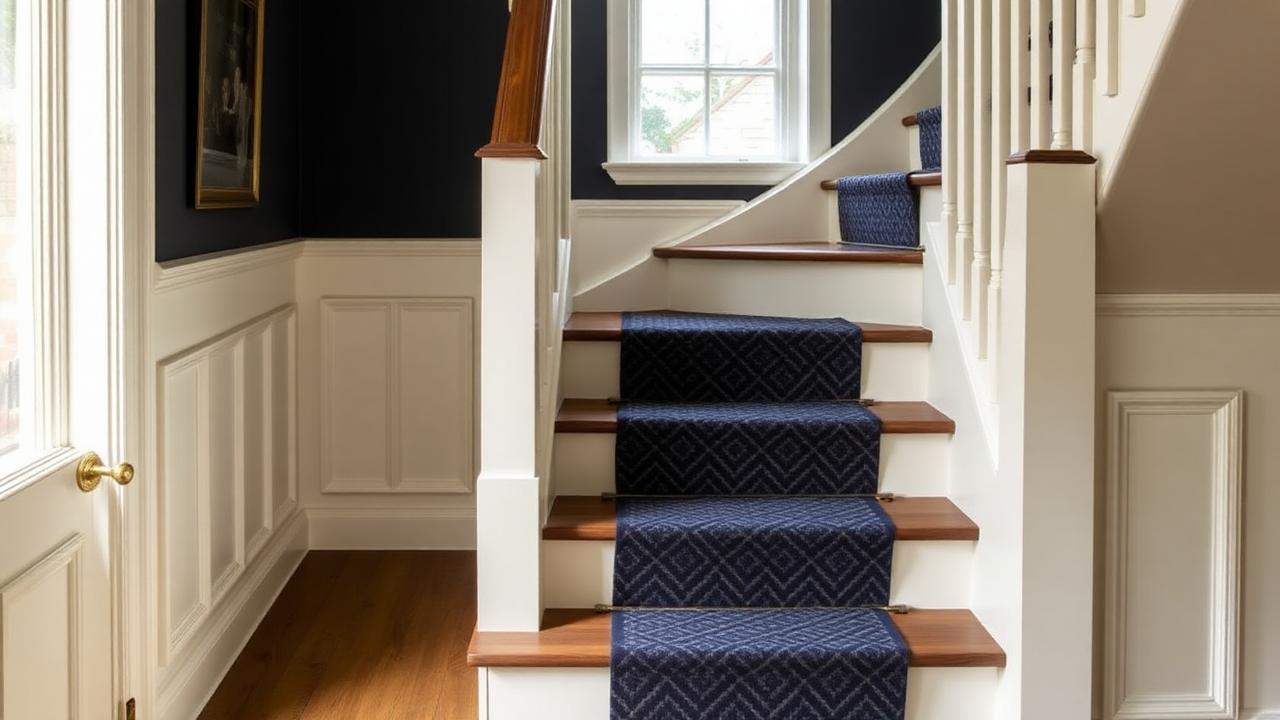
- Navy and white ticking stripes are the classic nautical choice.
- Rope-cable weaves add texture without an obvious theme.
- Horizontal stripes are traditional; vertical stripes lengthen a short flight.
- Add 10-12% waste for stripe alignment at each nosing.
- Natural fibres suit the look but need protection from moisture.
Hardware and finishing touches
Polished nickel or brushed chrome stair rods pair well with crisp navy-and-white stripes, echoing ship railings and portholes, while aged brass suits a warmer, more vintage coastal look with natural fibre runners. A rope-effect edge binding or a simple canvas trim finishes the look without overdoing the theme.
A nautical stair runner is one of the easiest style themes to execute well because navy, white, and natural texture combinations are inherently timeless. Use the stair runner length calculator to plan for stripe alignment, and choose fibre based on how exposed your entryway is to moisture and grit.
Spec checklist for stripe alignment
Ask your supplier for the exact repeat measurement of the stripe pattern in both inches/cm and confirm whether it's a symmetric or directional design, since a directional stripe (one that only looks right one way up) needs extra care when the runner is cut and rejoined at a turn or landing. For a standard 4 in (10 cm) stripe repeat on a 13-step flight, you want the repeat to divide evenly, or close to it, into your 18.25 in (46 cm) per-step total, so a full stripe band lands right at the nosing rather than a sliver of the next color. If it doesn't divide evenly, ask the fitter whether they can shift the starting point slightly to hide the mismatch at the top of the flight, under the landing, where it's least visible.
| Stripe width | Recommended waste margin | Notes |
|---|---|---|
| 1-2 in (2.5-5 cm) | 8-10% | Forgiving, easy to align |
| 3-4 in (7.5-10 cm) | 10-12% | Standard ticking stripe |
| 5-6 in (13-15 cm) | 12-15% | Needs careful repeat planning |
Maintenance in entryway locations
Nautical runners often sit at the base of stairs near a front or mudroom entry, which means more grit, sand, and moisture than a stairway in the middle of the home. Use a walk-off mat just outside the base of the runner to catch the worst of the debris before it ever reaches the stairs, and vacuum the first two or three steps more frequently than the rest of the flight, since that's where grit concentrates first. If you've chosen sisal or jute for the coastal texture, treat it with a fibre protector spray rated for natural materials, and blot any spill immediately since natural fibres can water-stain permanently within minutes.
- Confirm stripe repeat length and whether the design is directional.
- Aim for a full stripe band to land at each nosing, not a partial sliver.
- Use a walk-off mat at the base to reduce tracked-in grit.
- Vacuum the bottom two or three steps more often than the rest.
- Treat natural fibres with a protector spray and blot spills instantly.
Whatever you decide, get the numbers first: the stair runner calculator doubles as a stair runner length calculator, adding nosing wrap, landings, winders, pattern repeat and waste so you order the right length the first time.
Still deciding on material, width or pattern? Our hub on stair runners compares weaves, widths, backings and fitting styles side by side, then hands the numbers straight to the calculator.
Frequently asked questions
What is the most classic nautical stair runner pattern?
Navy and white or navy and cream horizontal ticking stripes are the most classic choice.
Do stripes need extra material to fit properly?
Yes, budget 10-12% extra waste to keep stripes aligned across each step's nosing.
Is sisal a good choice for a nautical staircase?
It suits the aesthetic well but is less moisture-resistant, so consider location before choosing.
Should stripes run horizontally or vertically on stairs?
Horizontal is the traditional nautical choice; vertical can visually lengthen a short flight.
What stair rod finish suits nautical stripes?
Polished nickel or brushed chrome complements crisp navy-and-white designs particularly well.
How much runner do I need for a 13-step nautical staircase?
Roughly 24-24.5 ft (7.3-7.4 m) including waste for stripe alignment.
Can I mix rope-cable texture with a striped runner?
It's best to choose one dominant motif; combining both can feel busy rather than tailored.
Is a nautical runner suitable for non-coastal homes?
Yes, navy and white stripes work as a classic, versatile pattern in almost any interior style.
Know your numbers in 30 seconds
Enter your step count, tread depth and riser height — the stair runner calculator gives you the exact length to order, in metres and feet, with waste included.
Size your runner with the stair runner calculatorReady for real prices?
Get quotes from vetted stair runner suppliers and fitters near you. Free, no account, no obligation.
Every guide is written from hands-on measuring and fitting experience, checked against the calculator’s own maths, and re-reviewed whenever prices or methods change. Read our editorial standards.