

Why oak stairs need careful runner selection
Oak treads are often left partially exposed on either side of the runner, so the colour and finish of the carpet needs to complement rather than clash with the wood tone. Warm honey oak pairs well with muted greens, warm greys, and soft blues, while lighter, whitewashed oak can handle bolder colours and patterns without looking overwhelming.
Protecting the wood during fitting
Oak stairs, especially older or reclaimed ones, can be easily marked by staples or tacks used in some fitting methods. Ask your installer whether they plan to use a staple-free or rod-and-hook system that minimises damage to the exposed wood. This is particularly important if the stairs are original to a period property and cannot be easily refinished.
How much runner do I need?
For a 13-step oak staircase: 10 in tread + 7.5 in riser + 0.75 in nosing wrap = 18.25 in per step, totalling 237.25 in over 13 steps. Add around 24 in for finishing at the top and bottom, giving 261.25 in (21.77 ft). With an 8% waste allowance, order roughly 23.5 ft. Metric: 25 cm + 19 cm + 1.9 cm = 45.9 cm per step, 596.7 cm over 13 steps, plus 60 cm finishing = 656.7 cm, plus 8% waste, roughly 7.1 m.
| Measurement | US (in/ft) | UK (cm/m) |
|---|---|---|
| Per-step total | 18.25 in | 45.9 cm |
| 13 steps | 19.77 ft | 5.97 m |
| With finishing | 21.77 ft | 6.57 m |
| With 8% waste | 23.5 ft | 7.1 m |
Know your numbers in 30 seconds
Enter your step count, tread depth and riser height — the stair runner calculator gives you the exact length to order, in metres and feet, with waste included.
Open the stair runner calculatorChoosing the right width
A common approach on oak stairs is to leave 3-4 in (7.5-10 cm) of exposed wood on each side, which showcases the grain and lets the natural material breathe visually alongside the runner. If your staircase has a particularly striking oak stringer or newel post, a narrower runner width can help keep the focus on the woodwork.
Match undertones, not just colour
Oak can have warm gold, honey, or grey undertones depending on the stain. Bring a runner sample to your staircase in daylight to check the undertones align rather than clash.
- Choose colours that complement your oak's undertone.
- Confirm your fitter's method won't damage exposed wood.
- Leave 3-4 in of exposed oak on each side for a balanced look.
- Add underlay to protect both the runner and the treads.
Maintaining the look over time
Vacuum regularly and check the exposed oak edges periodically for scuffing, refreshing the wax or oil finish as needed. A well-maintained oak staircase with a quality runner can look sharp for well over a decade.
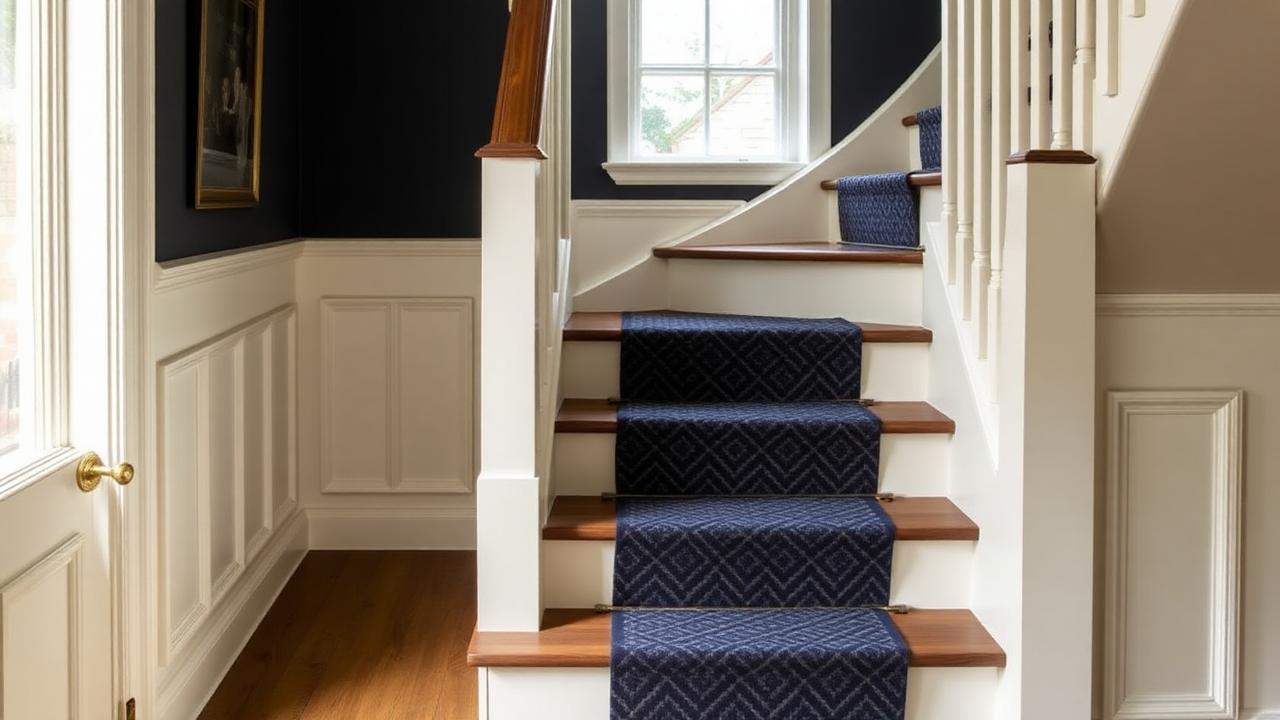
Spec checks before fitting on oak
Ask your fitter which fixing method they plan to use and confirm it is compatible with your specific oak finish. Oiled oak, waxed oak, and lacquered oak all respond differently to adhesive tapes and staples, and a lacquered surface can sometimes be marked by certain double-sided tapes left in place too long. Request that any test fixing be applied to an inconspicuous area, such as under the nosing of the bottom step, before the full installation proceeds.
Also check the tread nosing profile. Oak stairs commonly have either a squared nosing or a rounded bullnose, and the amount of runner needed to wrap the nosing differs slightly between the two: a squared nosing typically needs around 0.75 in (1.9 cm) of wrap, as used in the calculation above, while a pronounced bullnose can need up to 1.25 in (3.2 cm), adding roughly 6.5 in (16.5 cm) to the total length across a 13-step flight.
Cost bands for oak staircase runners
Wool-blend runners suited to oak staircases typically run $35-55 per linear ft ($115-180 per linear m) in a solid or lightly flecked design. Natural sisal or jute options sit lower, at $18-30 per linear ft ($59-98 per linear m), while premium wool herringbone weaves that complement fine oak grain can reach $60-90 per linear ft ($197-295 per linear m).
| Fibre type | US price (per linear ft) | UK price (per linear m) |
|---|---|---|
| Sisal/jute | $18-30 | £59-98 |
| Wool-blend, flecked | $35-55 | £115-180 |
| Premium wool herringbone | $60-90 | £197-295 |
| Staple-free fitting labour (avg) | $4-7 per step | £10-18 per step |
- Test any tape or fixing method on an inconspicuous area first.
- Confirm your tread nosing profile before finalising length.
- Add extra wrap allowance for a pronounced bullnose nosing.
- Choose a staple-free fitting method to protect exposed oak.
Matching runner width to staircase style eras
Oak staircases built in different periods tend to suit different runner proportions. Victorian and Edwardian oak staircases, often narrower with more elaborate turned balusters, generally look best with a traditional 27-30 in (69-76 cm) runner leaving a generous margin of exposed wood either side, echoing the proportions common when these staircases were originally built. Mid-century and more contemporary oak staircases, which tend to be wider with simpler, cleaner balustrades, can carry a wider 32-36 in (81-91 cm) runner without looking out of proportion, and often look better with less exposed wood on either side to keep the overall look streamlined.
If you are unsure which category your staircase falls into, look at the newel post and balustrade detailing for clues. Heavily turned or carved newel posts generally indicate an older build that suits a narrower, more traditional runner width, while simple square or slim metal balusters suit a wider, more contemporary runner proportion.
Refinishing exposed oak around an existing runner
Over time, the exposed oak on either side of a runner will wear differently to the covered section beneath the carpet, since it receives direct UV exposure and foot traffic at the very edges. If you notice the exposed strips looking noticeably lighter, darker, or more worn than the protected oak under the runner, a light sand and re-oil or re-wax of just the exposed sections can even out the appearance without needing to remove the runner entirely. Always test any refinishing product on a small, hidden area first, such as the underside of a tread nosing, to confirm the colour match before treating the full exposed length.
If your oak staircase is due a full refinish, plan this before ordering a new runner rather than after, since sanding and refinishing typically raises a small amount of dust and requires the treads to be fully accessible. Fitting a brand-new runner and then needing to refinish the surrounding wood shortly afterwards risks marking or soiling the new carpet during the refinishing process.
Whatever you decide, get the numbers first: the stair runner calculator doubles as a stair runner length calculator, adding nosing wrap, landings, winders, pattern repeat and waste so you order the right length the first time.
Still deciding on material, width or pattern? Our hub on stair runners compares weaves, widths, backings and fitting styles side by side, then hands the numbers straight to the calculator.
Frequently asked questions
What runner colours suit oak stairs?
Muted greens, warm greys, and soft blues generally complement honey oak tones well.
Will stapling a runner damage oak treads?
It can leave small marks; ask your fitter about staple-free or rod-and-hook systems for exposed wood.
How much exposed oak should I leave on each side?
Around 3-4 in (7.5-10 cm) on each side is a common and balanced choice.
How much runner do I need for a 13-step oak staircase?
Roughly 23-24 ft (7-7.3 m), including nosing wrap, finishing allowance, and waste margin.
Should I match the runner to warm or cool oak undertones?
Yes, always check the undertone of your specific oak stain before choosing a runner colour.
Is a stair runner calculator useful for wood staircases?
Yes, the calculation method is the same regardless of the staircase material.
Do I need underlay on oak stairs?
Yes, underlay protects both the runner and the wood treads from wear.
How often should I check the exposed oak edges?
Inspect every few months and refresh the wood finish as needed to keep it looking sharp.
Know your numbers in 30 seconds
Enter your step count, tread depth and riser height — the stair runner calculator gives you the exact length to order, in metres and feet, with waste included.
Measure your oak staircase with the stair runner calculatorReady for real prices?
Get quotes from vetted stair runner suppliers and fitters near you. Free, no account, no obligation.
Every guide is written from hands-on measuring and fitting experience, checked against the calculator’s own maths, and re-reviewed whenever prices or methods change. Read our editorial standards.