

Which way should the gradient fade?
There are two common directions for an ombre stair runner, and the right choice depends on your staircase's light and layout. Fading from dark at the bottom to light at the top is the more common and generally more successful choice, because it echoes the way most staircases get brighter as they rise toward an upper landing or skylight, and because a darker base tone at floor level also hides scuffing and dirt where it accumulates most. Fading from light at the bottom to dark at the top can work in staircases where the top landing is deliberately moodier or darker in its own decor, but it needs the rest of the upstairs hallway decor to support that darker note, or the runner will look like it is fading into a mismatch.
| Direction | Best when | Risk |
|---|---|---|
| Dark at bottom, light at top | Standard bright-upstairs staircases; most homes | Low — the safest, most universally flattering option |
| Light at bottom, dark at top | Moodier, darker-decorated upper landing | Needs upstairs decor to match or the runner looks disconnected |
Colour pairings that read well as an ombre
- Charcoal to dove grey — the most versatile and widely available ombre combination.
- Deep navy to powder blue — calm, coastal-adjacent, works with light oak.
- Forest green to sage — grounded and natural, suits both traditional and modern stairs.
- Plum to blush pink — softer, more decorative, suits period or feminine-leaning interiors.
- Charcoal to warm terracotta — an unconventional but striking two-hue transition for bold schemes.
Mapping the gradient against your tread count
Because an ombre effect is achieved either by dyeing a long custom run of carpet in a continuous gradient or by joining several discrete colour bands, the number of visible colour 'steps' in the gradient needs to be planned against your actual tread count. A 13-step staircase dyed as a smooth continuous gradient will show roughly one perceptible shade shift every 1-2 treads; a banded ombre (distinct blocks of colour rather than a smooth blend) typically uses 4-6 bands across a standard flight, each covering 2-3 treads.
Fibre and how gradients are achieved
| Method | Look | US cost/step | UK cost/step |
|---|---|---|---|
| Custom continuous dye gradient (wool) | Smoothest, most premium fade | $38-70 | £31-56 |
| Banded/pieced colour blocks (wool or wool-blend) | Distinct bands, still reads as ombre from a distance | $28-52 | £23-42 |
| Printed synthetic gradient | Budget option, less depth of colour transition | $16-30 | £13-24 |
Custom-dyed continuous gradients are typically special-order items with 4-8 week lead times because each runner is dyed to the exact flight length; banded versions can sometimes be assembled faster from stock colour ranges, which is worth asking about if you're working to a tighter timeline.
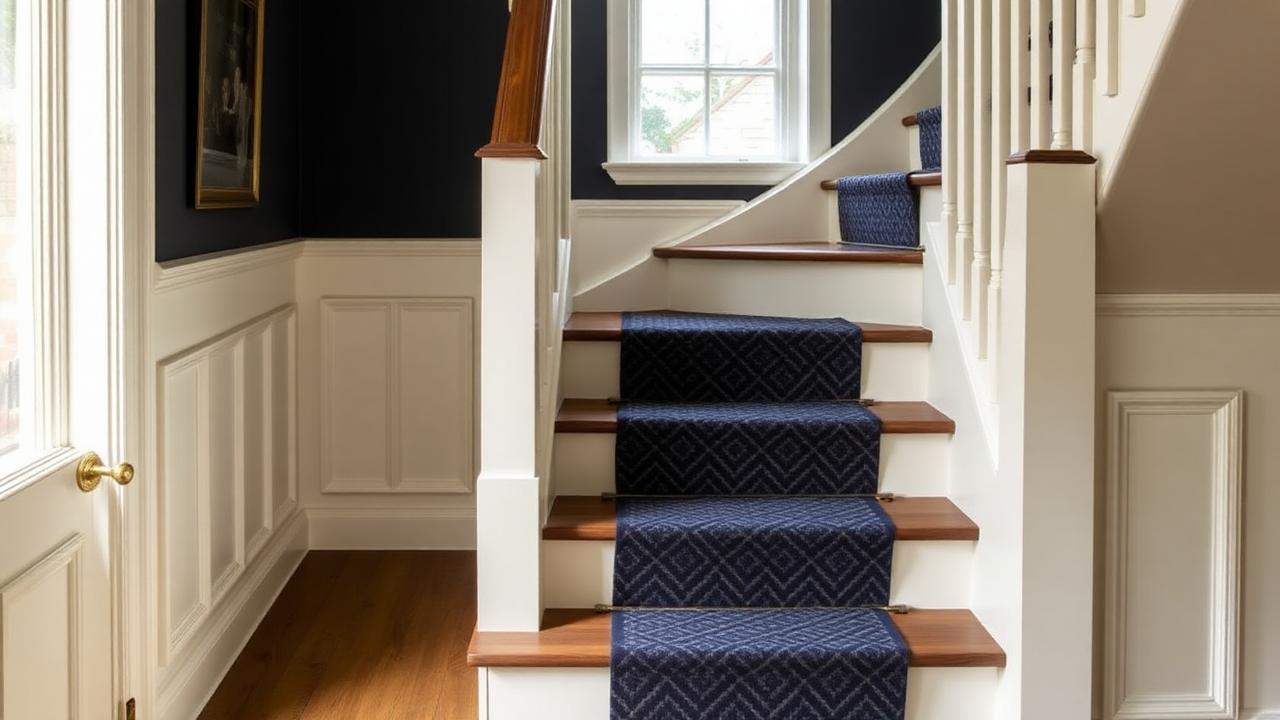
Order swatches at both ends and the middle
Because the whole point of an ombre runner is the transition, a single swatch tells you almost nothing useful. Request samples of the darkest end, the lightest end and the midpoint colour so you can judge the full range before committing.
Fitting and cost
Waterfall fitting is strongly preferred for an ombre runner because it keeps the gradient flowing in one unbroken line down the flight — Hollywood fitting's fold at each nosing can create small visual breaks that disrupt a smooth colour transition. For a standard 13-step, 36in staircase, budget $495-910 (£395-730) for a custom continuous wool gradient, $365-675 (£295-540) for a banded wool-blend version, or $210-390 (£170-315) for printed synthetic, plus fitting. Confirm your total footage with the stair runner length calculator before requesting a custom quote.
Ombre runners on a landing or split-level staircase
A split-level or two-flight staircase with a landing partway up presents a specific challenge for an ombre design, since the gradient needs to either complete itself before the landing (with the second flight starting a fresh, shorter fade) or continue as one long gradient across both flights and the landing. Continuing one long gradient generally looks more sophisticated and deliberate, but it requires the supplier to calculate the fade rate against the combined length of both flights plus the landing, so always provide the full combined measurement, not just the lower flight length, when requesting a custom quote.
Ombre versus painted or dip-dyed sisal for a similar effect
Homeowners sometimes ask whether a plain sisal or jute runner can be dip-dyed on site to create a similar gradient effect at lower cost. This is achievable for a DIY project but rarely produces a smooth, even fade comparable to a factory-dyed gradient — natural fibres absorb dye unevenly, and the transition zone often shows visible blotching rather than a clean blend. A factory continuous-dye gradient in wool, while more expensive, gives a far more polished and even result for a feature staircase.
Matching ombre wall paint or stair paint to the runner
| Runner gradient | Stringer/riser paint pairing |
|---|---|
| Charcoal to dove grey | White or off-white stringers, keeping contrast at the dark end |
| Navy to powder blue | Pale grey or white risers; avoid competing blue tones on the woodwork |
| Forest green to sage | Warm white or cream stringers to avoid a fully green stairwell |
| Plum to blush | Soft dove grey or warm white woodwork, avoiding strong contrasting colours |
Know your numbers in 30 seconds
Enter your step count, tread depth and riser height — the stair runner calculator gives you the exact length to order, in metres and feet, with waste included.
Open the stair runner calculatorWhatever you decide, get the numbers first: the stair runner calculator doubles as a stair runner length calculator, adding nosing wrap, landings, winders, pattern repeat and waste so you order the right length the first time.
Still deciding on material, width or pattern? Our hub on stair runners compares weaves, widths, backings and fitting styles side by side, then hands the numbers straight to the calculator.
Frequently asked questions
Should an ombre stair runner be dark at the top or bottom?
Dark at the bottom fading to light at the top is the more common and generally safer choice, since it echoes how most staircases get brighter toward an upper landing and hides ground-floor scuffing better.
How many colour bands does an ombre stair runner need?
A banded ombre typically uses 4-6 distinct colour bands across a standard 13-step flight, each spanning 2-3 treads; a continuous dyed gradient shifts more gradually, roughly every 1-2 treads.
How long does a custom ombre stair runner take to order?
Custom continuous dye gradients typically have 4-8 week lead times since each runner is dyed to the exact flight length; banded versions can sometimes be assembled faster from stock.
Waterfall or Hollywood fit for an ombre runner?
Waterfall is strongly preferred because it keeps the gradient flowing in one unbroken line; Hollywood fitting's fold at each nosing can create small visual breaks in the colour transition.
How much does an ombre stair runner cost?
For a 13-step, 36in staircase, custom continuous wool gradients typically run $495-910 (£395-730); banded wool-blend versions run $365-675 (£295-540).
What colours work best for an ombre stair runner?
Charcoal-to-dove-grey is the most versatile and widely available; navy-to-powder-blue and forest-to-sage are also common, cohesive two-tone transitions.
Know your numbers in 30 seconds
Enter your step count, tread depth and riser height — the stair runner calculator gives you the exact length to order, in metres and feet, with waste included.
Measure my stairsReady for real prices?
Get quotes from vetted stair runner suppliers and fitters near you. Free, no account, no obligation.
Every guide is written from hands-on measuring and fitting experience, checked against the calculator’s own maths, and re-reviewed whenever prices or methods change. Read our editorial standards.