
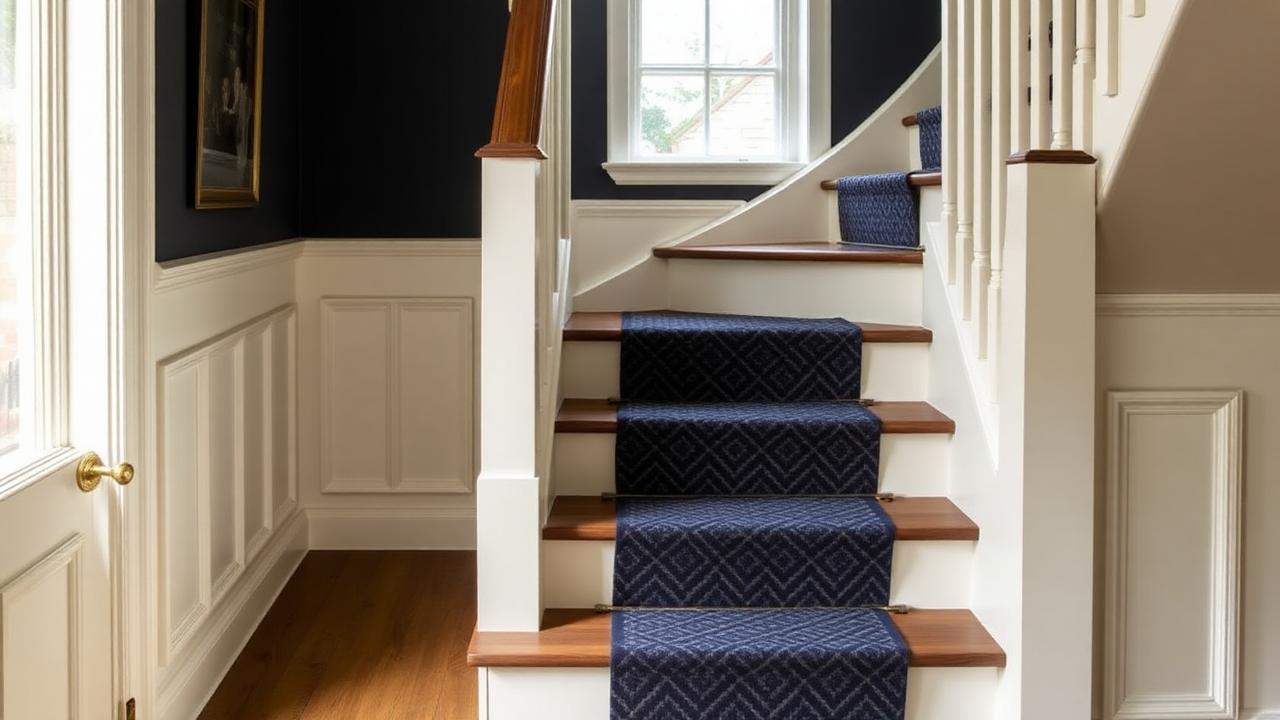
Oriental is an umbrella, not one pattern
In the flooring trade, "oriental" describes rugs and runners originating from or styled after weaving traditions across Asia and the Caucasus — most commonly Persian (Iran), Chinese, Caucasian (Turkey, Armenia, Azerbaijan) and Indian (Agra, Jaipur). Each has a distinct visual signature: Persian designs favour dense florals and medallions in red and indigo; Chinese designs favour cleaner fields with dragon, cloud or floral-spray motifs, often on softer blue, gold or cream grounds; Caucasian designs favour bold, angular geometric medallions in high-contrast colour; and Indian Agra designs sit between Persian floral density and a slightly softer, more pastel palette.
Retailers often use "oriental stair runner" loosely to mean any patterned, non-Western-looking runner, so it is worth confirming which specific sub-style you are actually buying — the fitting and colour advice differs meaningfully between a bold Caucasian geometric and a soft Chinese floral spray.
Sub-style comparison
| Sub-style | Visual signature | Typical ground colour | Best pairing |
|---|---|---|---|
| Persian | Dense medallion/herati florals | Red, indigo, ivory | Formal period hallways, dark timber |
| Chinese | Dragon, cloud, floral-spray motifs | Blue, gold, cream | Lighter, more transitional interiors |
| Caucasian | Bold angular geometric medallions | Red, rust, black | Contemporary-traditional crossover |
| Indian Agra | Softer florals, pastel-leaning | Rose, sage, cream | Softer, romantic period schemes |
Choosing scale for your flight
Pattern scale matters more on a narrow, long stair runner than it does on a full-size rug, because a runner is viewed mostly in a strip 24-30in wide over a 12-15ft run. Oversized medallions designed for a floor rug can look cramped or oddly cropped when compressed onto a narrow runner width, so look specifically for designs marketed or woven as runners rather than a rug pattern simply cut down to size.
- Small-to-medium allover patterns (herati, small florals) scale down to a runner most successfully.
- Large single medallions work best as a repeating tread-by-tread motif rather than one giant centred medallion.
- Border-focused designs (a plain or lightly textured field with a decorative border strip) are the most forgiving option if you are unsure about scale.
Sizing and fitting
Oriental-style runners are typically sold in 26-36in widths, with 27in and 30in the most common stock sizes among US and UK stair carpet retailers. Confirm your flight's width with the stair runner width calculator, keeping a 3-4in reveal of timber on each side, which is the standard traditional reveal that suits most oriental patterns.
| Item (13-step, 30in oriental runner) | US price range | UK price range |
|---|---|---|
| Machine-woven wool-blend runner | $260-520 | £215-430 |
| Woven wool runner | $480-980 | £400-815 |
| Stair rods (13 sets) | $260-650 | £215-540 |
| Professional fitting (Hollywood) | $260-480 | £215-400 |
Border alignment at corners and landings
On stairs with a 90-degree turn or half-landing, an oriental border pattern must be mitred or deliberately broken at the turn point. Confirm with your fitter how the border will resolve at any turn before ordering, since an unplanned break looks noticeably worse on a bordered pattern than on a plain runner.
Know your numbers in 30 seconds
Enter your step count, tread depth and riser height — the stair runner calculator gives you the exact length to order, in metres and feet, with waste included.
Open the stair runner calculatorCare and longevity
Wool oriental-style runners generally outlast synthetic printed equivalents by a wide margin — a genuine woven wool runner can last 15-25 years on a moderate-traffic stair, while a printed wool-blend or synthetic version typically needs replacing within 8-12 years as the printed pattern fades and the pile flattens. Rotate small entrance mats to reduce grit being carried onto the first few treads, since grit abrasion is the leading cause of premature wear on patterned wool runners.

Matching an oriental runner to a period of house
The style era of a house genuinely changes which oriental sub-style reads as correct rather than mismatched. A Victorian or Edwardian terrace with dark stained banisters and deep skirting suits a dense Persian medallion in red and indigo, since the density echoes the period’s taste for richly patterned interiors. A 1930s-40s house with lighter oak and simpler joinery pairs better with a Chinese floral-spray design on a cream or pale gold ground, which sits lighter against plainer woodwork. A contemporary new-build with painted white stairs is the easiest to place a bold Caucasian geometric on, since strong contrast reads as a deliberate design choice rather than a period mismatch.
Quick period-matching reference
| House era | Recommended sub-style | Ground colour to look for |
|---|---|---|
| Victorian/Edwardian (pre-1910) | Persian, dense medallion | Deep red, indigo, ivory |
| Arts and Crafts/1920s | Caucasian or Indian Agra | Rust, sage, warm gold |
| 1930s-1950s | Chinese floral-spray | Cream, pale gold, soft blue |
| Contemporary/new-build | Caucasian geometric | Black, charcoal, rust |
Getting an accurate quote before you order
Oriental-pattern runners are usually priced per linear foot or per metre once width is fixed, so an accurate quote depends entirely on an accurate flight measurement. Count every step including winders, measure the going and rise of at least three steps rather than assuming they are identical, and add any half-landing run as a separate figure. Feeding these numbers into the stair runner calculator before contacting a supplier means you request a quote for the real total rather than a rough guess, which avoids a second, more expensive order later if the first piece falls short. Suppliers selling genuine woven stair runners will also want to know whether you plan a Hollywood or waterfall fit, since Hollywang needs roughly 1.5-2in extra length per step folded into the riser angle.
Information to have ready when requesting a quote
- Total step count, including any winders and half-landings.
- Going and rise measured on at least three separate steps.
- Desired reveal (timber showing on each side) in inches or cm.
- Preferred fitting method - Hollywood, waterfall, or rug-and-rods.
- Sub-style preference (Persian, Chinese, Caucasian, Indian Agra) if known.
Common mistakes buyers make with oriental runners
The most frequent mistake is buying based on a small swatch or a thumbnail photo, which makes it almost impossible to judge how a medallion or border will actually repeat down a 12-15ft flight. A second common mistake is under-measuring the top or bottom step, which on many staircases has a different depth to the rest of the flight and can throw off a pattern-matched border by several inches if not measured individually. A third is ignoring stair width tapering on older properties, where the same nominal stair width can vary by half an inch or more between the top and bottom of the flight, enough to make a symmetrical border look slightly off if the runner was cut assuming a perfectly constant width throughout.
Working from full-size measurements, checked at the top, middle and bottom of the flight, and ideally seeing a full sample length rather than a small swatch, avoids the vast majority of returns and re-orders reported by stair runner carpet retailers on patterned oriental-style products.
Whatever you decide, get the numbers first: the stair runner calculator doubles as a stair runner length calculator, adding nosing wrap, landings, winders, pattern repeat and waste so you order the right length the first time.
Frequently asked questions
What is the difference between Persian and oriental stair runners?
Persian is one specific sub-style of oriental design, characterised by dense medallion and herati florals in red or indigo. Oriental is the broader umbrella covering Persian, Chinese, Caucasian and Indian Agra styles.
What width do oriental stair runners come in?
Most stock designs are sold in 26-36in widths, with 27in and 30in the most common; confirm the exact width needed against your stair using a width calculator before ordering.
How much does an oriental stair runner cost?
Machine-woven wool-blend runners for 13 steps typically cost $260-520 (£215-430); genuine woven wool versions run $480-980 (£400-815).
Do oriental stair runners need stair rods?
They are traditionally fitted with the Hollywood method and stair rods, though a waterfall fit with hidden fixings is possible for a slightly more understated look.
How long does a wool oriental stair runner last?
A genuine woven wool oriental runner typically lasts 15-25 years on moderate traffic; printed or synthetic versions usually need replacing within 8-12 years.
How is an oriental runner's border handled at a stair turn?
The border pattern must be mitred or deliberately broken at any 90-degree turn or half-landing; discuss this with your fitter before ordering to avoid an unplanned, mismatched break.
Know your numbers in 30 seconds
Enter your step count, tread depth and riser height — the stair runner calculator gives you the exact length to order, in metres and feet, with waste included.
Measure my stairsReady for real prices?
Get quotes from vetted stair runner suppliers and fitters near you. Free, no account, no obligation.
Every guide is written from hands-on measuring and fitting experience, checked against the calculator’s own maths, and re-reviewed whenever prices or methods change. Read our editorial standards.