
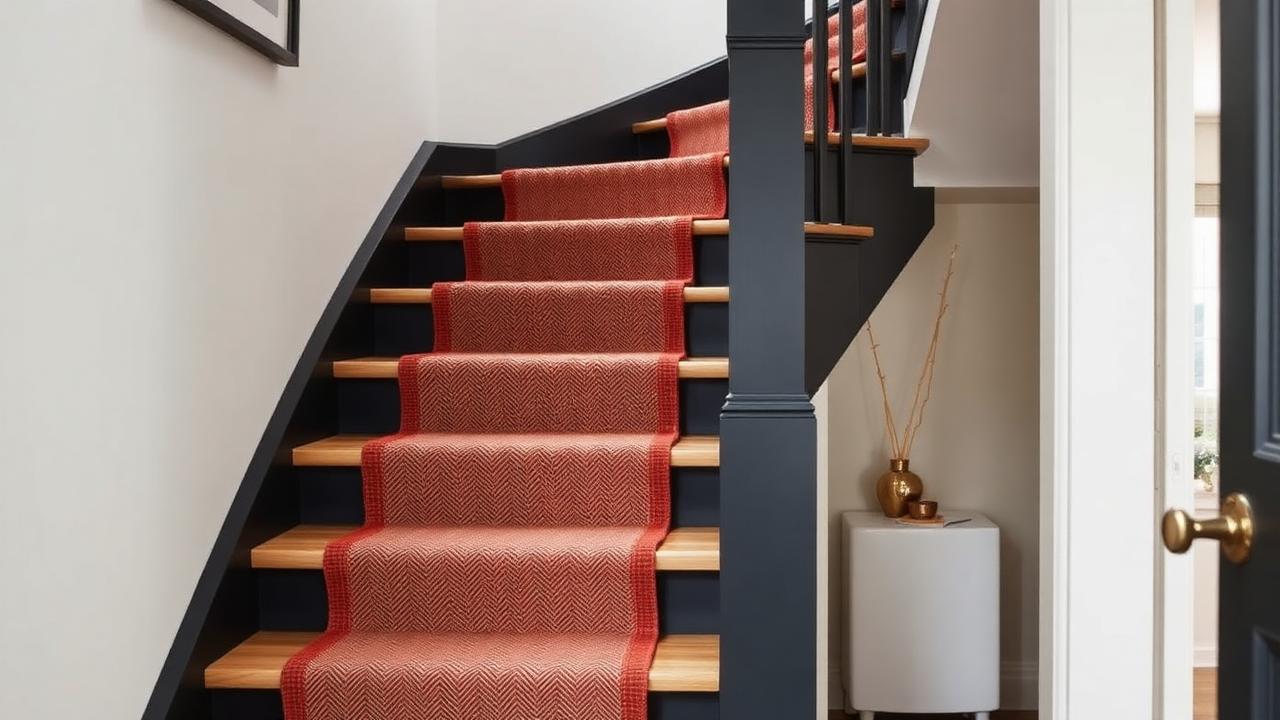
What defines a Persian pattern on a runner
Persian carpet design is built from a small set of recurring motifs adapted to a long, narrow runner format: a repeating central medallion (often a stretched or partial version of the medallion found in a full-size Persian rug), a herati (fish-and-rosette) allover field pattern, a boteh (paisley) repeat, or a formal border-and-field composition with a Persian palmette running along both edges. Manufacturers producing Persian-style stair runners typically compress or repeat these motifs at intervals matched to standard tread depths — usually every 10-12in — so the design lines up naturally with the rise and run of a typical staircase.
Colour palettes are traditionally built around a dominant red, indigo, or deep green ground with an ivory or camel border, though contemporary Persian-pattern runners increasingly appear in muted, desaturated colourways — dusty rose, sage, charcoal — that keep the motif but soften the traditional richness for a more transitional interior.
Persian stair runner styles compared
| Style | Field pattern | Typical ground colour | Best setting |
|---|---|---|---|
| Classic medallion | Central medallion repeated per tread | Deep red, navy | Formal period hallways |
| Herati allover | Small repeating fish/rosette motif | Ivory, camel, red | Long straight flights |
| Boteh (paisley) | Repeating teardrop motif | Indigo, burgundy | Traditional and eclectic interiors |
| Border-only Persian | Plain or textured field, patterned border strip | Any solid ground with red/gold border | Transitional homes wanting subtlety |
Sizing and pattern placement
Persian runners are usually sold in fixed widths — 26in, 27in, 30in and 36in are the most common — with the design pre-set to that width, so width flexibility is more limited than with plain or striped runners. Confirm your required width with the stair runner width calculator before selecting a pattern, since resizing a Persian design after the fact (rather than choosing the correctly sized weave from the start) usually means cropping the border unevenly.
- 30in stair: order a 22-24in Persian runner, 3-4in reveal each side to keep the border framed by visible timber.
- 36in stair: order a 26-28in runner, matching the standard traditional reveal.
- 42in stair: order a 30-34in runner; very wide medallion repeats can start to look busy above 34in, so consider a border-only design instead.
Fitting method and hardware
Persian-pattern runners are almost universally fitted using the Hollywood (cap-and-band) method with polished brass, antiqued brass or black stair rods at every riser — the rods complement the formal pattern and are a near-standard pairing rather than an optional extra. Waterfall fitting is possible but is rarely chosen for a genuinely Persian-patterned runner, since it removes the crisp step-by-step framing that Hollywood fitting and rods create.
| Item (13-step, 27in wool Persian runner) | US price range | UK price range |
|---|---|---|
| Runner, woven wool | $450-950 | £375-790 |
| Runner, printed wool-blend | $220-450 | £185-375 |
| Stair rods (13 sets, brass) | $260-650 | £215-540 |
| Professional Hollywood fitting | $260-480 | £215-400 |
Use the stair runner length calculator to total the flight length including landing turns before pricing rods, since each additional turn or half-landing typically needs its own rod and adds one full stair-rod unit to the count.
Genuine hand-knotted vs printed
A hand-knotted wool Persian-pattern runner can cost three to four times a machine-woven or printed equivalent of the same size, but it holds colour and definition far longer under UV exposure near stairwell windows. Ask specifically whether a runner is knotted, woven, or printed before comparing prices.
Know your numbers in 30 seconds
Enter your step count, tread depth and riser height — the stair runner calculator gives you the exact length to order, in metres and feet, with waste included.
Open the stair runner calculatorLiving with a Persian stair runner
Rich, dark Persian colourways are genuinely practical for a busy staircase because the dense pattern hides everyday soiling far better than a plain or pastel runner — this is one of the reasons the style has remained the default choice for grand and heavily used staircases for well over a century. Vacuum with the pile direction and avoid steam cleaning on natural-dyed antique or hand-knotted pieces, since heat and moisture can cause dye migration between adjacent colour blocks.
Knot count and weave density: what the numbers actually mean
Hand-knotted Persian-pattern runners are graded by knot count, usually quoted as knots per square inch (KPSI) in the US or knots per square decimetre in parts of Europe. Village and tribal weaves typically run 80-120 KPSI, workshop-quality pieces run 150-250 KPSI, and the finest city workshop weaves (Isfahan, Nain, Qum style) can exceed 300-500 KPSI. Higher knot count generally means finer pattern detail and a longer-wearing pile, but on a stair runner specifically, knot count matters less than overall pile density and the tightness of the foundation weave, because a stair takes direct compression and abrasion that a floor rug in a low-traffic room never sees.
For a stair application I would rather specify a 150-200 KPSI wool runner on a tight cotton foundation than a 400 KPSI silk-wool blend, since silk content looks superb on a wall-hung rug but crushes and shows traffic lines within a couple of years on a stair tread. If a supplier quotes only knot count and not fibre content or foundation material, ask directly - both numbers matter more than knot count alone when the runner is going on stairs rather than a floor.
Knot count vs recommended use
| Knot count (KPSI) | Typical origin style | Recommended stair use |
|---|---|---|
| 80-120 | Tribal, village weaves (Baluch, Hamadan style) | Good for busy family stairs, bold pattern hides wear |
| 150-250 | Workshop weaves (Tabriz, Kashan style) | Best balance of detail and durability for most homes |
| 300-500+ | Fine city workshop (Isfahan, Nain, Qum style) | Better reserved for low-traffic or formal display stairs |
Border width and how it changes the visual proportion on stairs
A Persian runner's border is not just decoration - its width directly changes how wide the field pattern reads once the runner is fitted and a reveal of bare timber is showing on both sides. On a 27in-wide runner, a narrow 2-3in border keeps most of the width for the medallion field and suits a bold single-medallion repeat. On the same width, a wide 4-6in border (common on formal border-and-field Persian designs) leaves a much narrower strip for the field pattern, which works better with a smaller, denser repeat like herati rather than a large medallion that would get visually cropped.
- Measure your actual usable stair width first using the stair runner calculator, then subtract your planned reveal (commonly 3-4in total, split evenly) to get the runner's true finished width.
- Match border width to runner width: keep the border under 15% of total width for a bold medallion design, or up to 25% for a formal border-led design.
- Check that the border colour has enough contrast with your stair stringer or skirting paint colour, since a border that is too close in tone to the woodwork disappears visually.
- Confirm whether the border wraps the full width at the top and bottom of the flight (a finished end) or is simply cut off, since a cut border looks noticeably less considered on a period staircase.
Runner width and border width are ordered together, not separately
Because the border is woven into the runner rather than added afterward, you cannot change border proportion after ordering. Confirm both figures on the same order form, and keep a written note of which width option you chose if you plan to order a matching landing piece later.
Persian-pattern stair runners remain one of the most requested categories among the stair runners we hear about from readers each year, largely because the dense repeat genuinely does disguise everyday footfall soil better than a plain weave. If you are choosing between two border widths on the same base pattern, err toward the narrower border on a tighter stair (under 30in) and the wider, more formal border on anything 36in or above.
Whatever you decide, get the numbers first: the stair runner calculator doubles as a stair runner length calculator, adding nosing wrap, landings, winders, pattern repeat and waste so you order the right length the first time.
Frequently asked questions
What is a Persian stair runner?
A wool carpet runner woven or printed with classic Persian motifs — medallions, herati or boteh repeats — usually on a red, indigo or ivory ground, fitted to a staircase using the Hollywood method with stair rods.
What width does a Persian stair runner come in?
Most are sold in fixed widths of 26in, 27in, 30in or 36in, with the pattern pre-set to that width, so width choice is more limited than plain runners.
Should a Persian stair runner use stair rods?
Yes, almost universally. Persian patterns are fitted with the Hollywood method and brass or black stair rods, which frame the pattern at each riser.
How much does a Persian stair runner cost?
A woven wool Persian runner for 13 steps typically costs $450-950 (£375-790); printed wool-blend versions run $220-450 (£185-375).
How is a Persian pattern centred on stairs?
The medallion or herati repeat is aligned to fall consistently on the same point of every tread, matched roughly to the 10-12in tread depth common on residential stairs.
Is hand-knotted or machine-woven better for a stair runner?
Hand-knotted holds colour and pattern definition longer under UV light but costs three to four times more; machine-woven or printed wool-blend is the practical mid-range choice for most homes.
Know your numbers in 30 seconds
Enter your step count, tread depth and riser height — the stair runner calculator gives you the exact length to order, in metres and feet, with waste included.
Measure my stairsReady for real prices?
Get quotes from vetted stair runner suppliers and fitters near you. Free, no account, no obligation.
Every guide is written from hands-on measuring and fitting experience, checked against the calculator’s own maths, and re-reviewed whenever prices or methods change. Read our editorial standards.