
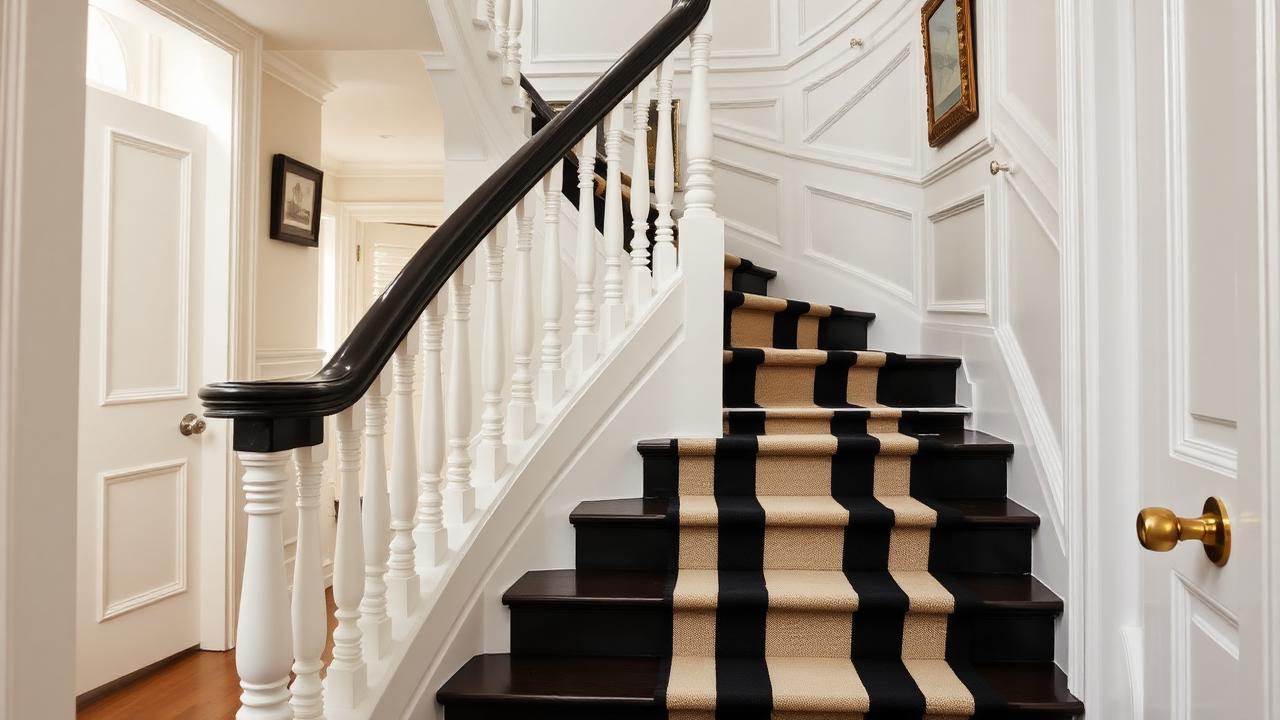
Why patterned runners need extra maths
A plain runner can be cut to almost any length because there is nothing on it that needs to line up. A patterned runner is printed or woven with a repeating motif at a fixed interval — the pattern repeat — and that repeat has to land in a consistent, deliberate place on every step for the flight to look intentional rather than accidental. If the repeat does not divide evenly into your flight length, you either buy extra to allow the pattern to fall correctly, or you accept that the motif will sit differently on the last step or two, which is the single most common complaint about DIY patterned runner installs.
Pattern repeats on stair runners typically range from as little as 100mm (4in) for a small geometric or stripe to 600mm (24in) or more for a large-scale floral or damask design. Manufacturers state the repeat on the product spec sheet, usually as a single figure for a straight repeat or two figures for a drop (offset) repeat; always ask if it is not listed, because guessing wrongly here is the most expensive mistake you can make on a patterned order.
The repeat maths, step by step
- Measure your total flight length using the stair runner calculator, including the tucking allowance at each end.
- Divide that length by the stated pattern repeat. If it divides evenly, order the calculated length plus your normal 10% waste allowance.
- If it does not divide evenly, round up to the next full repeat — this is the extra length you must add purely to keep the pattern aligned.
- For a motif you want centred on every tread (common with medallions and florals), add half a repeat at each end as tucking allowance rather than the standard flat figure.
- For a drop-match pattern, calculate the vertical repeat and the horizontal offset separately, since fitters usually need to shift the starting point by the offset amount to keep the design centred down the runner's width as well as its length.
| Flight length | Pattern repeat | Repeats needed | Length to order |
|---|---|---|---|
| 6.2m / 20.3ft | 0.3m / 12in repeat | 20.67 repeats | 6.3m / 20.7ft (21 repeats) |
| 6.2m / 20.3ft | 0.45m / 18in repeat | 13.78 repeats | 6.3m / 20.7ft (14 repeats) |
| 7.0m / 23.0ft | 0.6m / 24in repeat | 11.67 repeats | 7.2m / 23.6ft (12 repeats) |
Know your numbers in 30 seconds
Enter your step count, tread depth and riser height — the stair runner calculator gives you the exact length to order, in metres and feet, with waste included.
Open the stair runner calculatorOrder one repeat more than the maths says
Even after rounding to a full repeat, order one additional repeat's worth of runner as a buffer. Cutting mistakes and stairwell irregularities are unforgiving on a patterned runner in a way they are not on a plain one, because there is nowhere to hide a short cut.
Matching pattern scale to your staircase width
Pattern scale needs to relate to runner width, not just to personal taste. A large floral or bold geometric repeat that looks striking on a 32in (81cm) runner across a wide 42in (107cm) hallway staircase can look cramped and cut-off on a narrow 24-27in (60-68cm) runner, where the edges of the motif get sliced by the runner's own borders on almost every tread. As a working rule, keep the widest element of a repeating motif to no more than 60-70% of the runner's finished width so there is always a visible plain or border margin either side.
| Runner width | Recommended max motif width | Suits |
|---|---|---|
| 24in / 60cm | 14-17in / 36-43cm | Small geometrics, narrow stripes, tight florals |
| 27in / 68cm | 16-19in / 41-48cm | Mid-scale florals, medallions, tartan setts |
| 30-32in / 76-81cm | 18-22in / 46-56cm | Large florals, bold geometrics, wide stripes |
Stripes, geometrics and florals compared
Stripes running across the width of the tread (transverse stripes) are the easiest patterned option to fit because there is no length-wise repeat to align — only the stripe width needs to stay consistent, which most weavers guarantee automatically. Stripes running the length of the runner (longitudinal stripes) need almost no repeat maths either, but they show any deviation from a straight centre line instantly, since even a 5mm drift is obvious along a continuous stripe.
Geometric patterns — diamonds, chevrons, Greek key, herringbone — usually have a compact, regular repeat, often 150-300mm (6-12in), which keeps the extra yardage needed relatively small, typically 3-8% above the base flight length. Florals and damask-style patterns tend to have the largest, least regular repeats, sometimes with an asymmetric layout that only truly aligns once every two or three repeats, so they can need 10-20% extra yardage and benefit most from professional fitting to get the placement right on winders and half landings.
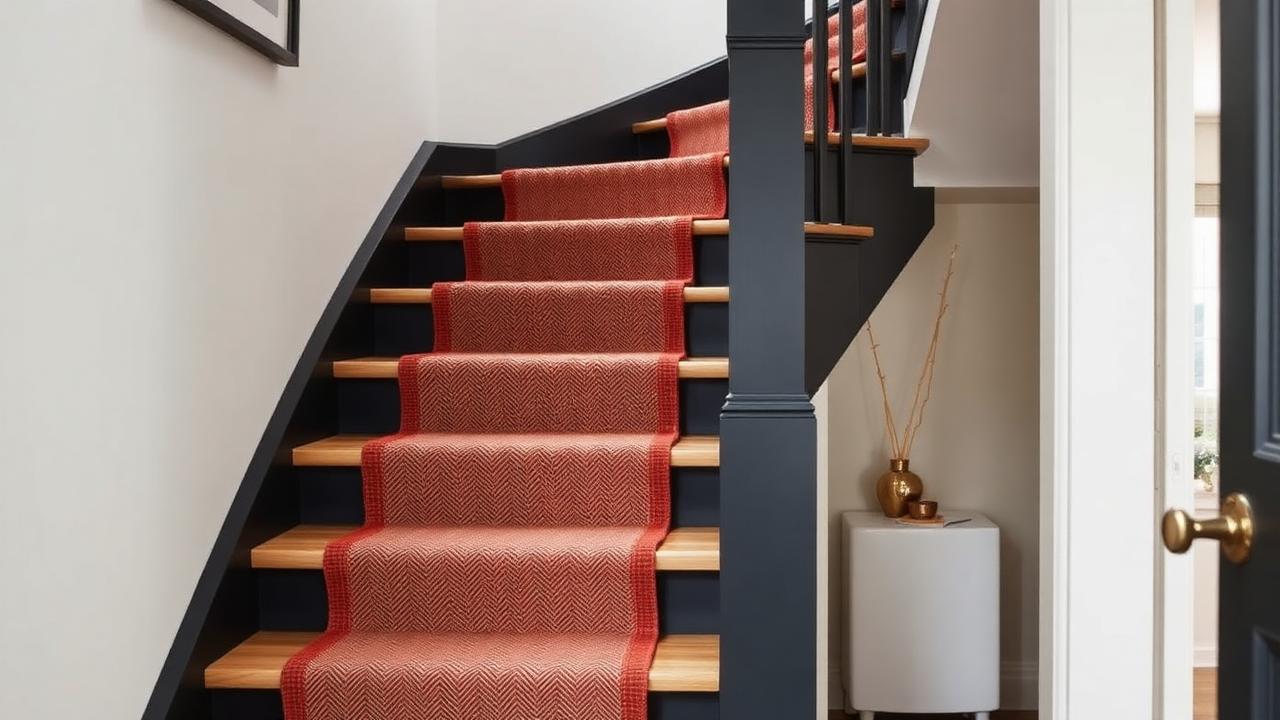
Matching the pattern per tread
The visual goal on any patterned runner is for the motif to sit in the same relative position on every tread — for example, always centred, or always with a full flower head visible rather than a half-cut one. Fitters achieve this by working out the pattern placement before cutting, marking where each repeat will fall against the tread positions, and adjusting the starting cut at the bottom of the flight so the pattern lands correctly rather than wherever the roll happens to start.
On winders and turns this gets harder, because the tread widths vary across the turn and a straight repeat cannot simply continue at the same rate. Most fitters cut and rejoin the pattern at the winder, treating each wedge-shaped tread as its own small panel and re-centring the motif rather than trying to force one continuous repeat through a changing width. This is one of the few areas of stair runner fitting where DIY installers most often struggle, and it is worth budgeting for professional fitting on a patterned runner if your flight includes a turn.
- Always dry-lay the full length on the floor first and check where each repeat falls before cutting.
- Mark tread positions in chalk on the back of the runner before the first cut.
- Keep a full spare repeat in case a tread needs re-cutting after a placement error.
- On a Hollywood fit, remember the pattern needs to wrap the nosing cleanly too, not just sit flat on the tread.
Cost of pattern versus plain
Patterned wool runners typically cost 15-35% more per linear metre than an equivalent plain weave, reflecting both the more complex loom setup and the extra yardage most orders require once the repeat is factored in. In the UK, a mid-range patterned wool runner commonly runs £45-£95 per linear metre versus £30-£65 for a comparable plain weave; in the US, expect $55-$120 per linear yard for patterned versus $35-$80 for plain. Add the pattern-repeat overage calculated above on top of those per-metre or per-yard figures before comparing quotes, since a supplier quoting only the bare flight length is understating the real cost of a patterned order.
Whatever you decide, get the numbers first: the stair runner calculator doubles as a stair runner length calculator, adding nosing wrap, landings, winders, pattern repeat and waste so you order the right length the first time.
Frequently asked questions
What is a pattern repeat on a stair runner?
A pattern repeat is the fixed distance along the runner's length at which the woven or printed motif recurs. Repeats range from around 100mm (4in) for small geometrics to 600mm (24in) or more for large florals, and the figure is used to work out how much extra yardage to order so the pattern aligns sensibly on every tread.
How much extra runner do I need for a pattern?
Round your calculated flight length up to the next full pattern repeat, then add one further repeat as a buffer. Small geometric repeats typically add 3-8% extra yardage; large floral or damask repeats can add 10-20%, so always check the specific repeat figure before ordering.
Do stripes need the same pattern-repeat maths as florals?
Not usually. Transverse stripes running across the tread need almost no length-wise repeat calculation, and even longitudinal stripes need only careful straight-line fitting rather than repeat maths. Florals and geometrics with a length-wise motif need the full repeat calculation described above.
Can a patterned runner be fitted on stairs with a turn or winders?
Yes, but it is harder than fitting a plain runner because the pattern has to be re-centred on each wedge-shaped winder tread rather than continuing as one straight repeat. Most fitters cut and rejoin the pattern at each winder, and this is one area where professional fitting is genuinely worth the cost.
How do I choose the right pattern scale for my staircase?
Keep the widest element of the repeating motif to no more than 60-70% of the runner's finished width, so there is always a visible plain margin either side. Narrow runners suit smaller geometrics and tight florals; wider runners can carry bolder, larger-scale patterns without looking cramped.
Is a patterned stair runner more expensive than a plain one?
Yes, typically 15-35% more per linear metre or yard, reflecting the more complex weaving setup and the extra yardage most patterned orders need to keep the repeat aligned. Always factor the pattern-repeat overage into your budget, not just the base flight length.
Know your numbers in 30 seconds
Enter your step count, tread depth and riser height — the stair runner calculator gives you the exact length to order, in metres and feet, with waste included.
Work out my runner lengthReady for real prices?
Get quotes from vetted stair runner suppliers and fitters near you. Free, no account, no obligation.
Every guide is written from hands-on measuring and fitting experience, checked against the calculator’s own maths, and re-reviewed whenever prices or methods change. Read our editorial standards.