

What most leases actually restrict
Standard residential leases in both the US and UK typically prohibit permanent alterations, which is usually interpreted to include nailing, stapling or screwing into structural or finish surfaces such as stair treads, stringers and risers. Adhesive products marketed as removable, temporary rugs held only by their own weight, and clamp-style hardware that grips rather than penetrates a surface generally fall outside that restriction, but the wording varies enough that it is worth checking your specific lease or asking the landlord in writing before fitting anything, since some leases restrict any change to flooring regardless of method.
In the UK, many tenancy deposit disputes over flooring hinge on whether a change is 'reversible without trace' — a stair runner fixed with stair-rated tape and removed within the tenancy generally satisfies this, whereas one stapled down and later removed, leaving staple holes in the tread, does not, and can trigger a deposit deduction.
Comparing renter-friendly fixing methods
| Method | Lease risk | Grip on stairs | Approx. cost, 13 steps |
|---|---|---|---|
| Stair-rated double-sided tape | Low, if removed within ~12 months | Very good | $155-300 / £130-250 |
| Tension stair rods | Very low — no adhesive or screws | Good, needs firm pad underneath | $220-420 / £185-350 |
| Loose-lay rubber-backed rug | Very low — no fixing at all | Fair; best on carpeted or low-traffic stairs | $230-500 / £195-410 |
| Command-strip style stair clips | Low, product-dependent | Fair, works best on lighter runners | $180-330 / £150-275 |
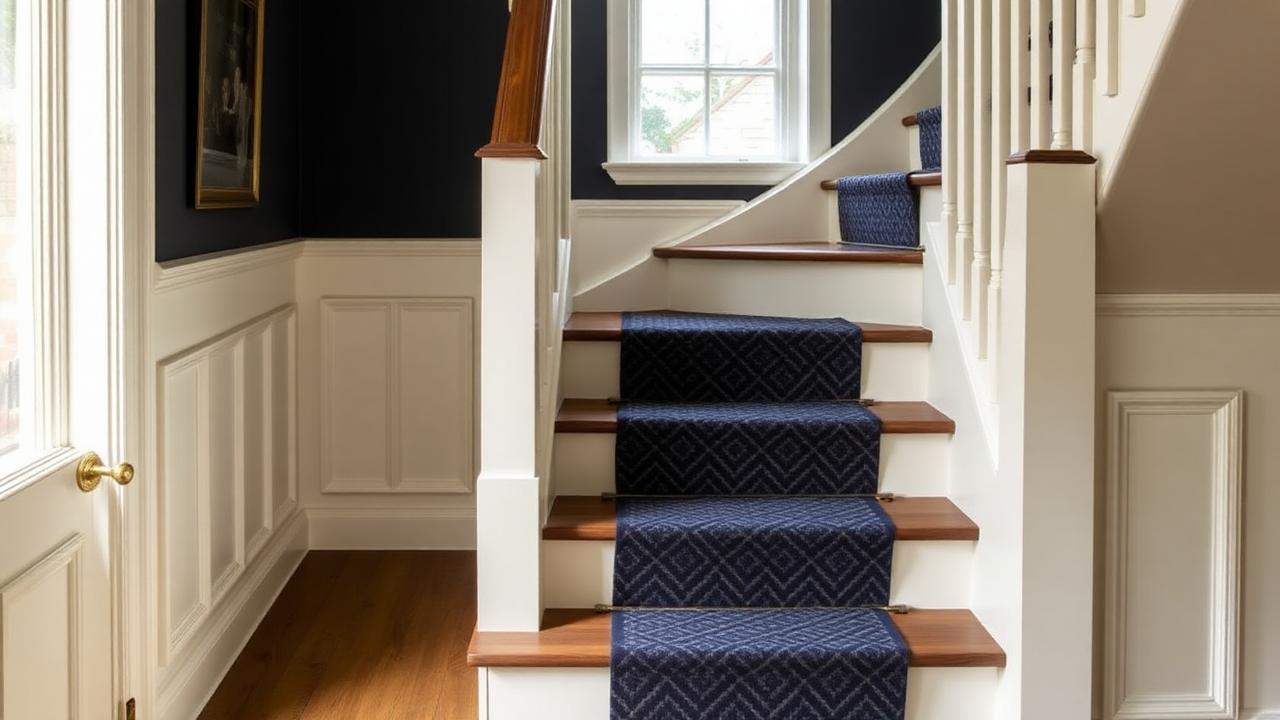
Tension rods deliver the most convincingly 'permanent' look — brass or black-finish rods across every step — while remaining fully reversible, which makes them a common choice for tenants who want the traditional Hollywood-fit appearance without breaching a lease. They rely on spring pressure against the stringers, so they need to be sized precisely to the stair width; too loose and they rattle or drop, too tight and they can mark painted stringers over time.
Sizing and fitting steps
- Measure tread depth, riser height, and full flight length, then check width using the stair runner width calculator.
- Choose runner width 2-4in narrower than the stair on each side (US convention: 6-9in total gap; UK: 4-6in total gap).
- Buy 3-5% extra length as a buffer since a taped or tensioned fit is harder to reposition after the first attempt.
- Apply a firm rug pad first if using tape, to add grip and cushion without transferring adhesive to the tread.
- Fit tension rods from the top of the flight down, checking each one sits snugly before moving to the next.
Materials that suit a rental
Synthetic fibres (solution-dyed nylon or polypropylene) are generally the better renter choice over natural fibres like sisal or jute, because they tolerate the occasional repositioning, tape removal and storage between tenancies without fraying or splitting at the backing. A mid-pile, densely woven construction also grips a tension rod or tape more reliably than a very thin flatweave, which can slip under a rod if the pile is too low.
Document the stairs before and after
Photograph the bare staircase before fitting anything and again immediately after removal. This protects your deposit if a landlord later claims damage that was already present, and it is standard practice recommended by UK deposit protection schemes.
When to just ask the landlord
For a longer tenancy (a year or more) it is often worth simply asking the landlord for written permission to staple or use gripper strip, since a properly stapled runner performs and looks better than any temporary fix and most landlords are receptive if you offer to restore the stairs at the end of the tenancy or leave the runner in place as a value-add for the next tenant.
If permission is refused or you are on a rolling short-term lease, stick to tape, tension rods or a loose-lay rug, and treat the fitting as fully temporary from the outset — plan your removal method before you install, not after.
Working out how much runner a rental flight actually needs
Tenants often under-order because they measure only the visible tread and forget the wrap allowance a tension rod or Hollywood fold needs at every riser. Run the flight through the stair runner length calculator rather than estimating from a single tape-measure reading at the bottom step, since a rental fit gives you almost no slack to patch a short length later — there is no gripper strip to hide a seam, and most landlords will notice a visibly pieced runner faster than a stapled professional one.
A quick pre-purchase checklist for tenants
- Photograph the lease clause on alterations and keep a copy with your purchase receipts.
- Measure stringer-to-stringer width at the top, middle and bottom step, since older rental properties are rarely perfectly uniform.
- Confirm your chosen fixing method (tape, tension rod, or loose-lay) works on the actual stair surface — painted softwood behaves differently to sealed hardwood or existing carpet.
- Order 3-5% extra length as a buffer, and keep the receipt in case a landlord asks for proof of a non-permanent product.
Security deposits in both the US and UK are usually resolved by photographic evidence rather than argument, so the checklist above is worth five minutes at the start of a tenancy even if the runner itself only takes an afternoon to fit.
Know your numbers in 30 seconds
Enter your step count, tread depth and riser height — the stair runner calculator gives you the exact length to order, in metres and feet, with waste included.
Open the stair runner calculatorNegotiating with a landlord or letting agent
A short, specific written request usually gets a better response than a vague one. Rather than asking generally whether you can “put down a runner,” describe the exact product and fixing method — for example, a named stair-rated tape brand with a stated residue-free rating, or a specific no-drill tension rod product — and offer to remove it and restore the stairs at the end of the tenancy at your own cost. Landlords and letting agents are far more likely to approve a specific, reversible proposal than an open-ended one, and having the request and approval in writing (even a simple email exchange) protects both sides if a dispute arises later over the deposit.
What UK deposit protection schemes actually look at
The three main UK deposit protection schemes (DPS, MyDeposits and TDS) generally assess flooring changes against a “betterment vs damage” standard: a reversible addition that leaves the property in the same condition as check-in is not damage, even if it was not explicitly pre-approved, provided it is removed cleanly. Where disputes arise, they typically hinge on photographic evidence from the check-in and check-out inventory rather than on the tenancy wording alone, which is why documenting the bare staircase thoroughly before fitting anything, as covered above, carries more practical weight in an actual dispute than the lease clause itself.
US security deposit law and stair runners
US security deposit rules vary significantly by state, but most states apply a similar “normal wear and tear” standard that a properly removed, non-damaging stair runner addition would not breach. Some states require landlords to provide an itemised list of deductions with supporting evidence, which again puts photographic documentation in the tenant's favour. If your state has a specific security deposit statute (many publish these online through the state attorney general's office), it is worth a five-minute read before assuming a stair runner counts as an “alteration” in the way the lease's general language might suggest.
Sizing accurately matters even more in a shared or managed property
In a rental, getting the length and width right the first time carries extra weight, because there is no scope for a second attempt without leaving evidence of a botched first try — an extra staple hole, a patch of tape residue from a too-short piece, or a visibly re-cut edge. Run your measurements through a stair runner calculator before ordering anything, double-check the numbers against the actual staircase rather than a floor plan, and buy the small waste allowance recommended above so a single miscut piece does not force you into an awkward, more visible repair on a property you do not own.
How much runner do I need for a typical rental flight
On a common US rental staircase with 13 steps, a 10in going and 7.5in rise, total flight length comes out at roughly 13 x (10 + 7.5) = 227.5in (about 19ft) once the tread-and-riser wrap is included, and with a 5-10% waste buffer that rounds up to about 20-21ft of runner. The UK equivalent, 13 steps at 25cm going and 19cm rise, gives 13 x (25 + 19) = 572cm (about 5.9m), and with the same waste allowance you should order close to 6.3-6.5m. Running these figures through a stair runner calculator before ordering matters more in a rental than almost anywhere else, since there is no gripper strip to disguise a runner cut a few inches short.
| Flight length | US runner needed (with waste) | UK runner needed (with waste) |
|---|---|---|
| 11 steps | ~17-18ft | ~5.2-5.4m |
| 13 steps | ~20-21ft | ~6.3-6.5m |
| 15 steps | ~23-24ft | ~7.1-7.4m |
How landlords in practice tend to react to a written request
Anecdotally, most letting agents and private landlords react more favourably to a request that names the exact product and fixing method than to a general question about whether flooring changes are allowed at all. A message describing a specific stair-rated tape or a named tension-rod product, together with an offer to restore the stairs at move-out, reads as low-risk and considered, whereas a vague request forces the landlord to imagine the worst-case version of what you might do. This is worth doing even for a fixing method that clearly falls outside any alterations clause, since it creates a written record that removes ambiguity if a dispute over the deposit ever arises.
Still deciding on material, width or pattern? Our hub on stair runners compares weaves, widths, backings and fitting styles side by side, then hands the numbers straight to the calculator.
Frequently asked questions
Can I put a stair runner in a rental without breaching my lease?
Yes, using stair-rated tape, tension (no-drill) rods, or a loose-lay rubber-backed rug generally avoids the permanent alterations most leases prohibit, since none of these penetrate the tread or stringer surface.
Do tension stair rods damage the stairs?
Properly sized tension rods rely on spring pressure against the stringers and typically leave no marks if removed within a year or two; oversized or overtightened rods can occasionally mark painted stringers over long periods.
Will carpet tape void my deposit?
Stair-rated, residue-free tape removed within about 12 months rarely causes deposit deductions in the UK, since it is generally considered reversible without trace; leaving it down for years increases residue risk.
What is the cheapest renter-friendly stair runner option?
A loose-lay rubber-backed runner rug is usually the cheapest at $230-500 (£195-410) for 13 steps, since it needs no tape, pad or rod hardware, though it grips less securely than taped or tensioned options.
Should I ask my landlord before fitting a stair runner?
For tenancies longer than about a year, yes — many landlords will permit a properly stapled runner in writing, which performs better than any temporary method and can become a value-add left for the next tenant.
Do stair runners increase or reduce noise complaints in a rented flat above another unit?
A carpeted stair runner over hard stairs generally reduces impact noise transmitted to neighbours below, since the fibre and any pad cushion footfall; a bare or rubber-only stair transmits far more of that noise, which is worth mentioning if a landlord is weighing a request against noise complaint history.
Should I insure a renter-friendly stair runner separately?
Most tenant contents insurance covers a stair runner as ordinary personal property, the same as any other rug or furnishing you own, so a separate policy is not usually needed; check your specific policy wording if the runner is a high-value piece.
Can I take a renter-friendly stair runner with me when I move?
Yes, that is one of the main advantages of tape, tension rods or a loose-lay rug over a stapled install — the runner is designed to lift off intact and can be refitted in a new property, provided the new stairs are a similar width.
Know your numbers in 30 seconds
Enter your step count, tread depth and riser height — the stair runner calculator gives you the exact length to order, in metres and feet, with waste included.
Measure my stairsReady for real prices?
Get quotes from vetted stair runner suppliers and fitters near you. Free, no account, no obligation.
Every guide is written from hands-on measuring and fitting experience, checked against the calculator’s own maths, and re-reviewed whenever prices or methods change. Read our editorial standards.