

How peel and stick stair runners actually work
Peel-and-stick stair products come in two main formats. The first is individual carpet or vinyl stair treads with a factory-applied adhesive backing, each sized to a standard tread depth (commonly 8-10in in the US, 22-25cm in the UK) and applied one at a time down the flight, leaving the risers exposed or painted. The second is a continuous runner with a peel-away adhesive strip along the underside, applied in one motion down the full flight much like a giant sticker. Individual peel-and-stick treads are more common for a budget or DIY refresh, since gaps between treads are simply the exposed staircase; a continuous peel-and-stick runner gives the classic unbroken-runner look but is a less widely available product than taped or tensioned alternatives.
The adhesive itself is typically a pressure-sensitive acrylic similar to heavy-duty double-sided tape, engineered to bond well to sealed wood, laminate and painted surfaces but to release without residue if peeled within the manufacturer's recommended window — usually somewhere between 6 and 18 months depending on the brand and how much UV or foot traffic the area gets.
Peel and stick vs other no-damage methods
| Method | Install time (13 steps) | Adhesive lifespan | Look |
|---|---|---|---|
| Peel-and-stick individual treads | 45-75 min | 6-18 months | Segmented, gaps between treads |
| Peel-and-stick continuous runner | 60-90 min | 8-14 months | Unbroken runner |
| Stair-rated double-sided tape (separate product) | 60-100 min | 6-12 months | Unbroken runner |
| Tension stair rods | 45-90 min | No adhesive to expire | Classic Hollywood look with visible rods |
Peel-and-stick products generally cost slightly more per square foot than buying a plain runner and separate tape, because the adhesive backing is factory-applied and part of the manufacturing cost, but they save labour time and reduce the chance of misaligned tape.
Sizing peel-and-stick treads and runners
Individual peel-and-stick treads are sold in fixed sizes, so measure your tread depth and width precisely with the stair runner width calculator before ordering — a tread pack sized for an 8in depth will not adequately cover a 10.5in tread, leaving an unfinished strip at the back edge near the riser. For a continuous peel-and-stick runner, measure total flight length exactly as you would for any other runner using the stair runner length calculator, since most peel-and-stick runner rolls are sold by the foot or metre and cut to order.
- Measure tread depth from nosing edge to the base of the riser above.
- Measure stair width stringer-to-stringer and choose runner or tread width with an even reveal each side.
- Confirm the total flight length including any winders or landings before ordering a continuous runner.
- Order a small extra quantity (one or two spare treads, or 3-5% extra runner) for mistakes during application.
Application steps
- Clean and dry each tread thoroughly; adhesive will not bond to dust, wax or residual cleaning product.
- Dry-fit the tread or runner section first without removing the backing, to check alignment and centring.
- Peel back a few inches of backing at a time, pressing firmly as you go rather than removing the full backing at once.
- Use a roller or firm flat tool to press out air bubbles and ensure full contact at the edges and nosing.
- Wait the manufacturer's recommended cure time (often 24 hours) before heavy foot traffic.
Peel-and-stick is not a permanent substitute for gripper strip
Even the strongest peel-and-stick adhesives are rated as a medium-term solution. For a runner intended to stay 3+ years, staples or gripper strip will outperform adhesive, which can loosen at the nosing edge — the highest-wear point on any stair — well before the rest of the bond fails.
Cost and where peel-and-stick fits
| Item | US price | UK price |
|---|---|---|
| Peel-and-stick tread pack, 13 treads | $110-260 | £90-215 |
| Peel-and-stick continuous runner, 13 steps | $180-360 | £150-300 |
| Standard runner + separate stair tape, 13 steps | $165-310 | £140-260 |
Know your numbers in 30 seconds
Enter your step count, tread depth and riser height — the stair runner calculator gives you the exact length to order, in metres and feet, with waste included.
Open the stair runner calculatorCommon installation mistakes that shorten adhesive life
Most premature peel-and-stick failures trace back to the same handful of avoidable mistakes rather than a faulty product. Applying the tread or runner before the surface is completely dry — including after cleaning, where residual moisture from a damp cloth can sit under the adhesive for hours — is the single most common cause of early lifting, since the bond never fully forms in the first place. Pressing down only at the centre of each tread rather than working outward with even pressure, especially at the corners and the nosing edge, leaves small unbonded pockets that widen with foot traffic. And applying peel-and-stick treads to fresh paint that has not fully cured, typically within 2-4 weeks of painting, often lifts the paint film along with the backing when it is eventually removed.
Peel and stick on stairs with existing damage or unevenness
Peel-and-stick adhesive bonds best to a flat, continuous surface, and it performs noticeably worse over small dents, old nail holes, chipped paint or slightly warped boards, since the adhesive cannot maintain full contact across an uneven surface and tends to lift first at the low points. If your treads have visible damage or unevenness, filling and sanding smooth before applying anything peel-and-stick is worth the extra hour of prep, because the alternative is a runner that looks fine on day one but starts lifting at the exact spots the surface was already compromised, often within weeks rather than months.
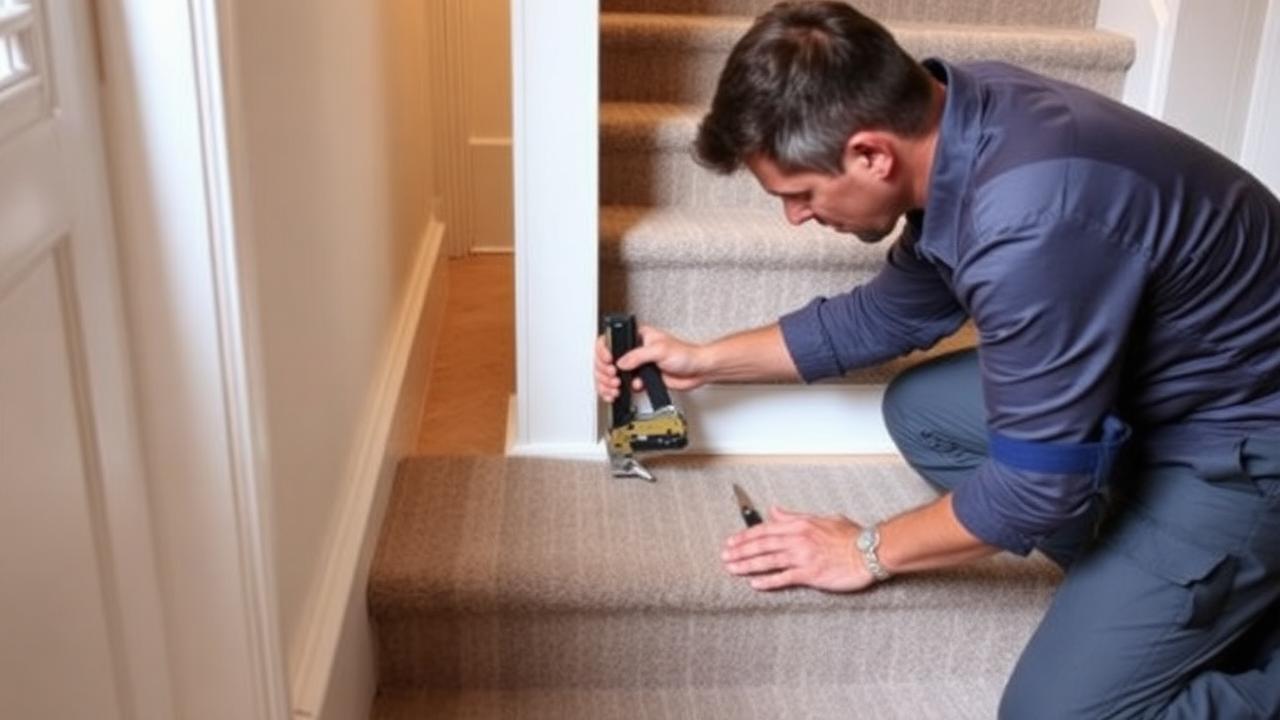
Choosing between multiple peel-and-stick brands
The peel-and-stick stair market includes a wide range of quality levels, and the adhesive formulation is the single biggest differentiator between a budget product and a genuinely reliable one, more so than the face material itself. Look specifically for products that state a tested lifespan or warranty period on sealed hardwood, rather than generic marketing language, and check independent reviews for reports of lifting specifically at stair nosings rather than on flat floor applications, since a product tested only for flat flooring may not carry the same rating for the flex a stair nosing experiences. A slightly more expensive, well-reviewed peel-and-stick brand is usually the better investment over a cheaper one that needs reapplying within months.
Sizing peel-and-stick correctly against your actual stairs
Because peel-and-stick products are frequently sold in a narrower range of fixed sizes than made-to-order carpet, it pays to check your measurements against the specific product's dimensions before ordering rather than assuming any stair runner carpet product will fit. Run your tread depth, riser height and total flight length through a stair runner calculator first, then compare that output against the exact tread and runner sizes the peel-and-stick supplier offers, since a small mismatch of even half an inch is more visible and harder to disguise with an adhesive product than it would be with a gripper-fitted runner that a professional can adjust slightly on site.
How much peel-and-stick material a typical flight needs
For a continuous peel-and-stick runner on a 13-step US flight with a 10in going and 7.5in rise, total length works out to roughly 227.5in (about 19ft) before waste, and because peel-and-stick backing cannot be repositioned once pressed down the way tape can, it is worth adding a slightly larger 8-10% waste allowance rather than the standard 5%, landing around 20.5-21ft. On a UK flight of 13 steps at 25cm going and 19cm rise, the base length is about 5.9m, and with the larger waste allowance you should order close to 6.4-6.6m. For individual peel-and-stick treads, order one tread per step plus one or two spares, since a single miscut tread is common on a first attempt and the adhesive backing cannot be reused once pressed and lifted.
Peel-and-stick over a stair nosing with a rounded bullnose profile
A rounded bullnose nosing is the hardest profile for any peel-and-stick product to bond to reliably, because the adhesive has to hold against a curved surface where the material naturally wants to spring back to flat rather than follow the curve. On a pronounced bullnose, look specifically for a peel-and-stick product marketed for stair nosings rather than flat flooring, since flat-flooring adhesive tape is rarely rated for the constant flex a rounded nosing edge experiences underfoot. If the bullnose is unusually deep or rounded, a stair-rated tape or individual pre-shaped tread designed for that nosing profile will generally outperform a generic peel-and-stick runner cut to fit.
| Nosing profile | Peel-and-stick suitability | Better alternative if unsuitable |
|---|---|---|
| Square or slightly eased edge | Good | N/A — peel-and-stick works well |
| Standard bullnose (rounded, moderate) | Fair | Stair-rated tape with firm pressure at the curve |
| Deep or pronounced bullnose | Poor | Pre-shaped tread cover or tension rods |
| Metal or reinforced nosing strip | Poor | Mechanical fixing (screws or clips) rather than adhesive |
Weighing peel-and-stick against stair runners fitted the traditional way
For anyone comparing formats before buying, the honest trade-off is speed against longevity. Peel-and-stick products let a single person finish a 13-step flight in well under two hours with no specialist tools, which is unmatched by any of the traditionally fitted stair runners that need gripper strip, a knee kicker or professional stretching. In exchange, most peel-and-stick adhesive is rated for a fraction of the lifespan a stapled or gripper-fitted runner achieves. If the staircase is a main household flight you expect to keep for many years, it is usually worth the extra time and cost of a traditional fit; if it is a short-term refresh, a rental, or a staging job, peel-and-stick is the more sensible choice and a stair runner calculator will confirm the same sizing logic applies either way.
Frequently asked questions
How long does a peel and stick stair runner last?
The adhesive bond typically holds for 6-18 months depending on the brand, foot traffic and UV exposure; the carpet material itself can outlast the adhesive if reapplied or supplemented with tension rods.
Can peel and stick stair treads be removed without damage?
Yes, if removed within the manufacturer's recommended window (usually under a year), most peel-and-stick adhesives release cleanly from sealed wood and laminate without residue.
Is peel and stick as strong as staples for a stair runner?
No. Peel-and-stick adhesive is a medium-term solution best suited to 1-2 year use; staples or gripper strip are far more secure for a runner intended to stay in place for several years.
Do peel and stick stair treads work on carpeted stairs?
Generally no — the adhesive needs a smooth, sealed surface like hardwood or laminate to bond properly and will not adhere reliably to existing carpet fibre.
How much does a peel and stick stair runner cost for 13 steps?
Individual peel-and-stick tread packs typically run $110-260 (£90-215) for 13 steps, while a continuous peel-and-stick runner runs $180-360 (£150-300).
Do I need underlay under a peel and stick runner?
Most peel-and-stick products are designed to sit directly on the tread without underlay, since a padded layer would prevent proper adhesive contact; check the specific product instructions before adding a pad.
Can peel-and-stick be used on a stair nosing with a rounded bullnose edge?
It works reasonably well on a gentle bullnose but performs poorly on a deep, pronounced curve, where the adhesive cannot maintain full contact; a stair-rated tape or pre-shaped tread cover is generally a better choice for a strongly rounded nosing.
Should I buy extra peel-and-stick material compared with a taped runner?
Yes, add an 8-10% waste allowance rather than the usual 5%, since peel-and-stick backing cannot be repositioned once pressed down, making a first-attempt miscut more likely than with removable tape.
Know your numbers in 30 seconds
Enter your step count, tread depth and riser height — the stair runner calculator gives you the exact length to order, in metres and feet, with waste included.
Measure my stairsReady for real prices?
Get quotes from vetted stair runner suppliers and fitters near you. Free, no account, no obligation.
Every guide is written from hands-on measuring and fitting experience, checked against the calculator’s own maths, and re-reviewed whenever prices or methods change. Read our editorial standards.