
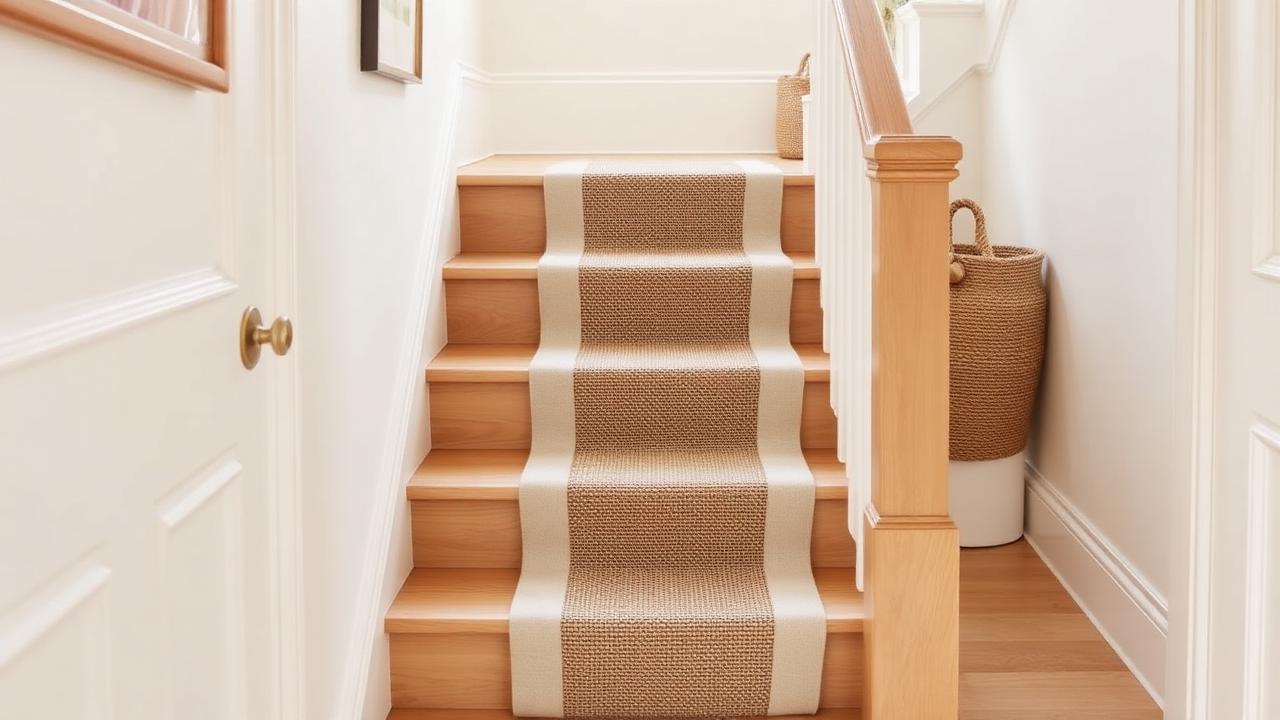
Where a rubber stair runner makes sense
Rubber runners solve problems that carpet fibre cannot: they are fully waterproof, they wipe clean of mud, oil and salt residue, and their surface texture — usually a raised rib, coin, or diamond pattern — provides slip resistance even when wet, which is why rubber stair treads are standard in commercial kitchens, garages, basement stairs and industrial stairwells. They are a poor fit for a formal living space, since the surface reads as utilitarian rather than decorative and lacks the acoustic cushioning of carpet, so most homeowners choose rubber specifically for basement, garage, exterior-adjacent or workshop staircases rather than a main household flight.
Rubber runner types and where each fits
| Type | Surface texture | Best location | Approx. cost per step (US) |
|---|---|---|---|
| Ribbed rubber runner | Raised parallel ribs | Basement and garage stairs | $12-24 |
| Coin-pattern rubber runner | Raised round studs | Workshops, utility stairs | $14-26 |
| Diamond-plate rubber runner | Raised diamond grid | Industrial or commercial back stairs | $15-28 |
| Smooth rubber with grit additive | Flat with embedded abrasive texture | Wheelchair-accessible ramps and stairs | $16-30 |
Thickness matters as much as pattern. A 2mm rubber runner is adequate for light residential basement traffic, while a 3-4mm runner with reinforced backing is more appropriate for heavy commercial or workshop use where dropped tools or repeated cart traffic would quickly wear through a thinner product.
Sizing and fitting a rubber runner
Rubber runners are typically sold in continuous rolls of a fixed width (commonly 24, 30, 36 or 48in / roughly 60, 75, 90 or 120cm) rather than custom-woven to order, so confirm your stair width against available roll sizes using the stair runner width calculator before ordering, since a rubber runner cannot be seamed invisibly the way carpet edges can be bound. Measure total flight length with the stair runner length calculator, accounting for full tread-and-riser wrap if using a continuous Hollywood-style rubber runner rather than individual stair treads.
- Confirm available roll widths match your stair width before ordering; custom widths often cost significantly more.
- Choose individual nosing-profile treads rather than a continuous runner on stairs with pronounced bullnose edges.
- Use contact adhesive plus mechanical stair nosing strips for the most secure commercial-grade fit.
- Allow the rubber to acclimate to room temperature for 24-48 hours before fitting, since cold rubber is stiffer and harder to lay flat.
Rubber vs carpet stair runner
| Factor | Rubber runner | Carpet runner |
|---|---|---|
| Slip resistance when wet | Excellent | Poor to fair unless treated |
| Water resistance | Fully waterproof | Absorbs moisture |
| Cleaning | Wipe clean, hose-down capable | Vacuum, occasional deep clean |
| Comfort underfoot | Firm, cool | Soft, warm |
| Noise dampening | Minimal | Good |
| Typical lifespan | 10-20 years | 8-15 years |
Cost of a rubber stair runner install
| Item | US price | UK price |
|---|---|---|
| Ribbed rubber runner, 13 steps | $155-310 | £130-260 |
| Diamond-plate rubber runner, 13 steps | $195-360 | £165-300 |
| Contact adhesive and nosing strips | $40-80 | £33-65 |
| Professional install | $150-320 | £125-265 |
Know your numbers in 30 seconds
Enter your step count, tread depth and riser height — the stair runner calculator gives you the exact length to order, in metres and feet, with waste included.
Open the stair runner calculatorCheck fire and slip-resistance ratings for commercial use
Commercial and multi-family buildings in both the US and UK typically require rubber stair coverings to meet a minimum slip-resistance (coefficient of friction) and fire-retardancy rating. Confirm the product spec sheet meets local building code before purchasing for anything other than a private residence.
Rubber runner thickness and backing explained
Rubber stair runners are built from either solid vulcanised rubber or a rubber-topped composite over a fibre or foam backing, and the two behave differently underfoot even at the same nominal thickness. Solid vulcanised rubber, the type used in most commercial ribbed and diamond-plate runners, is dense and heavy, holds its shape under point load from a heel or a dropped tool, and shows almost no long-term compression over years of use. Composite rubber-topped products, often marketed for residential basements, use a thinner rubber wear layer bonded to a firmer foam or fibre core, which keeps weight and cost down but compresses slightly more over time at the nosing, the highest-load point on any stair covering. Neither is wrong for a home basement stair, but knowing which you are buying changes the maintenance expectation: solid rubber needs almost no attention beyond cleaning, while a composite product benefits from an annual check for any softening or delamination at the nosing edge.
Rubber runner colour and how it ages
Rubber stair coverings are sold in a narrower palette than carpet, typically black, grey, charcoal and a handful of earth tones, because the rubber compound itself carries the colour rather than a dyed fibre, and bright or pale colours are far less common since they show scuffing and staining more readily on a firm surface. Black and dark grey remain the most popular choices for exactly this reason: scuff marks, salt residue and grit are far less visible against a dark, matte rubber surface than against a pale one. Over years of use, rubber tends to develop a slight sheen at the centre of the tread where feet land most often, which is a cosmetic change rather than a sign of wear, and it buffs out with a standard rubber floor cleaner.

Noise and impact on a rubber-covered staircase
One trade-off buyers often underestimate is sound. A rubber stair runner in a basement or utility stairwell transmits footstep impact more than carpet does, both as airborne noise in the stairwell itself and as structure-borne noise into rooms below or adjacent, since rubber has none of the fibrous cushioning that absorbs impact energy in a carpet-and-underlay system. In a basement used for a home gym, workshop or media room directly beneath the stair run, this is worth planning for with a resilient underlayment rated for impact sound if noise transfer matters, rather than assuming a firm rubber runner behaves acoustically like carpet.
When to blend rubber with carpet on the same staircase
It is common, and often the best practical answer, to run rubber on a utility or basement flight and a carpet stair runner carpet on the main household staircase in the same property, rather than treating the choice as all-or-nothing across the whole house. A mudroom or garage-entry stair that constantly sees wet boots and grit is a poor candidate for any fibre runner regardless of fibre choice, while the main flight seen by guests benefits from carpet's warmth, quiet and decorative range. If you're speccing both in the same project, measure each flight separately with a stair runner calculator rather than assuming the same width or length logic applies to both, since basement stairs are frequently a different width and pitch to the main staircase above.
Worked sizing example for a rubber runner
For a 13-step basement flight with a 10in going and 7.5in rise in the US, total flight length is roughly 227.5in (about 19ft) before waste, the same base calculation used for any stair covering, though rubber typically adds a slightly larger cutting allowance of 6-8% rather than carpet’s usual 5%, since rubber cannot be steam-stretched into place the way carpet can if a cut runs slightly short. That puts the order at roughly 20-20.5ft. On a UK equivalent, 13 steps at 25cm going and 19cm rise gives about 5.9m before waste, or roughly 6.25-6.4m with the rubber-specific allowance. Confirm the final figure against the supplier’s available roll width using a stair runner calculator before ordering, since rubber is far less forgiving of a resize after cutting than woven stair runners are.
Rubber runner install labour and tools compared with carpet
| Task | Rubber runner | Carpet runner |
|---|---|---|
| Cutting to length | Requires a sharp utility blade and a straightedge; rubber dulls blades fast | Standard carpet knife and shears, easier to cut cleanly |
| Fixing method | Contact adhesive plus mechanical nosing strips | Staples, gripper strip or tension rods |
| Typical fit time, 13 steps | 2-3 hours, contact adhesive needs careful positioning (no repositioning once bonded) | 1.5-2.5 hours with staples or gripper |
| DIY suitability | Moderate — contact adhesive is unforgiving of mistakes | Good, especially with tension rods |
Contact adhesive is the main reason rubber installs take longer and suit professional fitting better than a confident DIY carpet job: once two contact-adhesive surfaces touch, they bond immediately with no slide-into-place window the way carpet gripper strip allows, so alignment has to be correct on the first attempt at every single step.
Odour and off-gassing from new rubber runners
New rubber stair coverings, particularly solid vulcanised rubber, commonly carry a noticeable rubber odour for the first one to three weeks after installation as residual compounds from manufacturing off-gas at room temperature. This is normal and not typically a sign of a faulty product, but it is worth factoring into timing if you are fitting rubber ahead of moving into a property or hosting guests, since ventilating the stairwell well for the first couple of weeks noticeably speeds up the process. Composite rubber-topped products generally off-gas less strongly than solid vulcanised rubber, which is worth mentioning to anyone particularly sensitive to strong new-material smells.
Frequently asked questions
Is a rubber stair runner better than carpet for basements?
Yes, for a basement or utility stair, rubber's waterproofing and slip resistance generally outperform carpet, which absorbs moisture and can develop mildew in a below-grade space.
How thick should a rubber stair runner be?
2mm suits light residential basement traffic; 3-4mm with reinforced backing is better for heavy commercial, garage or workshop use.
Can a rubber stair runner be fitted over existing carpet?
It is not recommended — rubber needs a firm, flat, clean surface to bond and grip properly, and existing carpet padding compresses unevenly under the adhesive and nosing strips.
How much does a rubber stair runner cost for 13 steps?
A ribbed rubber runner for 13 steps typically costs $155-310 (£130-260) in material, with diamond-plate commercial-grade options running $195-360 (£165-300).
How long does a rubber stair runner last?
A well-fitted rubber stair runner typically lasts 10-20 years, longer than the 8-15 year typical lifespan of a comparable carpet runner, due to its resistance to wear, moisture and staining.
Does a rubber stair runner need underlay?
No. Rubber runners are fitted directly to the tread with contact adhesive and mechanical nosing strips; a soft underlay pad would undermine the firm, grippy surface rubber is chosen for.
Does a rubber stair runner smell when first installed?
Yes, a noticeable rubber odour for one to three weeks is normal, especially with solid vulcanised rubber, as manufacturing compounds off-gas at room temperature; good ventilation speeds this up and it is not usually a sign of a defective product.
Is fitting a rubber stair runner harder than fitting carpet stair runners?
Generally yes for DIY fitters, mainly because contact adhesive bonds immediately with no repositioning window, unlike carpet fitted with gripper strip or tension rods, which forgive small alignment corrections during the fit.
Know your numbers in 30 seconds
Enter your step count, tread depth and riser height — the stair runner calculator gives you the exact length to order, in metres and feet, with waste included.
Measure my stairsReady for real prices?
Get quotes from vetted stair runner suppliers and fitters near you. Free, no account, no obligation.
Every guide is written from hands-on measuring and fitting experience, checked against the calculator’s own maths, and re-reviewed whenever prices or methods change. Read our editorial standards.