
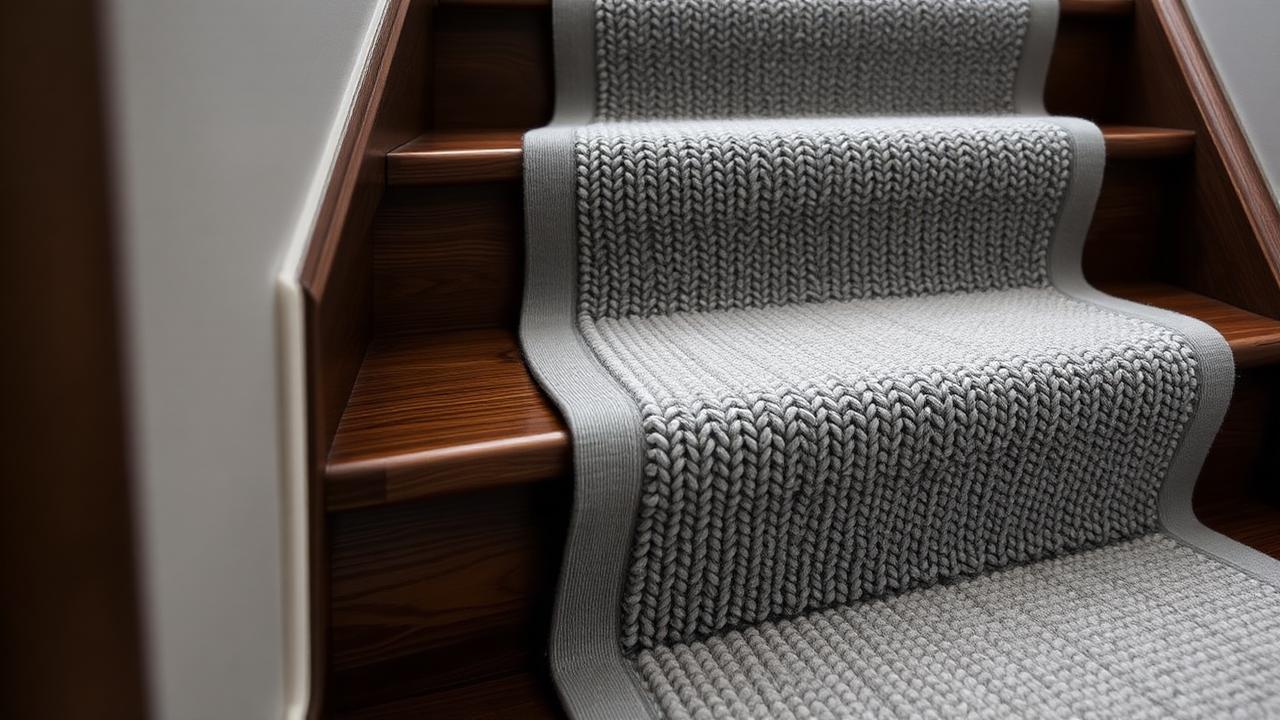
What actually makes a runner non-slip
- How it is fixed — a properly gripped and stapled runner cannot slide, whatever the fibre.
- Pile height — low pile gives a stable footing; deep pile lets your foot roll on the nosing.
- Surface texture — loop and flatweave constructions grip a shoe sole better than smooth cut pile.
- Backing — a latex or rubber backing stops the runner creeping on the tread.
- Underlay — a firm pad keeps the nosing edge defined so your foot lands predictably.
Fixing beats fibre
The most slip-resistant fibre in the world is dangerous if the runner is loose-laid. If safety is the goal, fix the runner properly and do not rely on grip alone.
Fibre ranking for grip
| Material | Grip | Comment |
|---|---|---|
| Wool loop pile | Excellent | Textured, resilient, defined nosing |
| Nylon loop | Excellent | Tough and grippy, easy to clean |
| Sisal | Very good | Coarse texture grips well |
| Wool cut pile | Good | Fine at low pile height |
| Seagrass | Fair | Naturally smooth and slick |
| High-pile shag / viscose | Poor | Avoid on stairs entirely |
Know your numbers in 30 seconds
Enter your step count, tread depth and riser height — the stair runner calculator gives you the exact length to order, in metres and feet, with waste included.
Open the stair runner calculatorPractical safety measures
- Choose a low-pile loop or flatweave construction.
- Use a firm, dense underlay so the nosing edge stays crisp.
- Fit with gripper and staples, never adhesive tape alone.
- Keep the runner tensioned — re-staple any step that ripples.
- Consider a contrasting nosing colour so the step edge is visible.
- Make sure the lighting shows the tread edges from both directions.
What about non-slip stair treads?
Individual tread pads are a valid alternative where a full runner is not practical — rentals, open-riser staircases or temporary needs. They grip well and lift for cleaning, but they look less considered and their adhesive backing eventually fails and needs replacing.
How pile height changes underfoot safety in practice
The critical zone on any stair tread is the nosing, the rounded front edge where your foot first lands going down and pushes off going up. A pile taller than about 3/8in compresses unevenly under the ball of the foot right at that edge, which is exactly where you cannot afford unpredictability. A low, dense loop pile compresses the same small amount everywhere, so the nosing feels identical every time you step on it. That consistency, more than any grip rating on a spec sheet, is what your brain and feet learn to trust.
Underlay: the safety component nobody sees
| Underlay type | Effect on safety | Notes |
|---|---|---|
| Firm rubber crumb pad | Best — keeps nosing sharply defined | Recommended for most stairs |
| Felt pad | Good | Softer feel, slightly less edge definition |
| No underlay | Poor | Runner wears faster and nosing edge is less distinct |
| Thick, soft domestic underlay | Poor on stairs | Fine on flat floors, dangerous on a nosing |
Who should hire a professional for a safety-critical install
Households with young children, anyone with mobility issues, or a staircase used by elderly residents should treat installation as a safety job, not a decorating one, and use an experienced fitter. A DIY install is entirely reasonable on a straightforward straight flight if you follow a proper method and check tension on every step; it is not the place to cut corners on a curved staircase, a steep pitch, or a household where a slip has real consequences.

A quick safety check for an existing runner
Walk the full flight in socks. Any step that gives underfoot, ripples, or feels different in height to its neighbours needs re-fixing before it needs anything else.
Common mistakes that undermine grip
- Choosing a deep-pile or shag runner because it feels luxurious in the showroom.
- Fitting over old, compressed underlay to save cost.
- Using double-sided tape instead of gripper on the top and bottom steps.
- Letting a runner go two or three years without re-tensioning.
- Skipping a contrasting nosing strip in a poorly lit stairwell.
Slip ratings and what they mean in practice
Some manufacturers publish a coefficient of friction or a pendulum test rating for flooring products, but very few domestic stair runners are tested this formally, so in practice buyers rely on construction description rather than a certified number. Ask suppliers directly whether a runner has been tested for use on stairs specifically, since a rating intended for flat flooring does not translate directly to a sloped, edge-loaded nosing.
Extra measures for higher-risk households
- Add a contrasting nosing tape or strip on each step, particularly at the top and bottom.
- Fit a continuous handrail on both sides where the staircase width allows it.
- Increase lighting at the top and bottom of the flight, where shadows most often hide the first and last step.
- Re-check tension every six months rather than waiting for a visible problem to appear.
How much runner do I need? Worked example for a safety-first install
Safety-focused buyers still need to get the yardage right, because a runner that runs short at the top landing defeats the point of fitting one. Take a typical 13-step straight staircase: US measurements of 10in going and 7.5in rise per step give 13 x 17.5in = 227.5in of pitch-line run; UK measurements of 25cm going and 19cm rise give 13 x 44cm = 572cm. Add roughly 1.5in (4cm) of nosing wrap per tread for a low-pile loop construction, which brings the raw figure to about 247in (628cm), then add a 7% waste allowance for cutting and any pattern alignment, landing at approximately 264in or 6.7m of running length for a standard 27in / 70cm wide runner. A stair runner calculator handles this arithmetic automatically and also flags any winders or half-landings on the flight, which is exactly where safety-critical measurement errors happen most often, since winder treads are rarely a consistent depth.
Know your numbers in 30 seconds
Enter your step count, tread depth and riser height — the stair runner calculator gives you the exact length to order, in metres and feet, with waste included.
Open the stair runner calculatorChoosing non-slip material by household risk profile
| Household profile | Best material choice | Pile height target |
|---|---|---|
| Elderly resident, mobility concerns | Low-pile wool or nylon loop, firm underlay | Under 3/8in (10mm) |
| Young children | Low-pile loop, contrasting nosing strip | Under 3/8in (10mm) |
| Busy family, no specific mobility risk | Wool-nylon blend loop | 3/8in to 1/2in (10-12mm) |
| Rental with transient tenants | Polypropylene loop, firmly gripped | Under 3/8in (10mm) |
| Steep or narrow period staircase | Sisal or wool flatweave | Flatweave to 1/4in (6mm) |
- Measure the full flight tread by tread rather than assuming uniform steps, particularly on older properties.
- Enter those measurements into a stair runner calculator to get an accurate yardage before ordering underlay and gripper alongside the runner.
- Choose a fibre and pile height from the safety table above based on who actually uses the stairs day to day.
- Specify a firm, dense underlay to the fitter by name rather than accepting whatever is in stock.
- Ask the fitter to double-staple the top two and bottom two steps, which take the most direct load from a foot landing off-balance.
Why safety-conscious buyers should not skip the sizing step
It is tempting to focus entirely on fibre and pile height when safety is the priority and treat measurement as an afterthought, but a runner that has been cut a fraction too narrow to sit centrally on a tread, or that runs out one step short of the top landing, creates exactly the kind of inconsistent edge that undermines everything else you have specified. Stair runners installed without an accurate plan are the single most common cause of an otherwise well-chosen safety runner underperforming in practice. Spend the ten minutes it takes to measure every tread and run the numbers through a proper calculator before ordering fibre, backing or underlay, because no amount of grip rating fixes a runner that physically does not reach where it needs to.
Whatever you decide, get the numbers first: the stair runner calculator doubles as a stair runner length calculator, adding nosing wrap, landings, winders, pattern repeat and waste so you order the right length the first time.
Frequently asked questions
Do stair runners make stairs safer?
A properly fitted low-pile runner over a firm underlay makes bare timber stairs considerably safer by adding grip and a defined tread edge. A loose or high-pile runner can make them more dangerous.
Which stair runner material grips best?
Low-pile wool or nylon loop constructions and sisal grip best. Avoid smooth, high-pile or viscose runners on stairs.
What pile height is safest for a staircase?
Aim for under 3/8in of pile height. Anything deeper compresses unevenly at the nosing and makes footing less predictable, especially descending.
Is a thick, soft underlay safer on stairs?
No. A thick, soft underlay is right for a bedroom floor but wrong for a staircase — it blurs the nosing edge. Use a firm, dense stair-specific pad instead.
Should I get a professional to fit a runner for safety reasons?
If the household includes young children, elderly residents or anyone with mobility issues, or the staircase is curved or steep, a professional fitter is worth the cost. A straightforward straight flight is a reasonable DIY project if fixed and tensioned correctly.
Do stick-on stair tread pads work as well as a full runner?
They grip well and suit rentals or temporary situations, but their adhesive backing fails over time and needs periodic replacement, and they cover less of the tread than a properly fitted runner.
Know your numbers in 30 seconds
Enter your step count, tread depth and riser height — the stair runner calculator gives you the exact length to order, in metres and feet, with waste included.
Plan a safe runner installReady for real prices?
Get quotes from vetted stair runner suppliers and fitters near you. Free, no account, no obligation.
Every guide is written from hands-on measuring and fitting experience, checked against the calculator’s own maths, and re-reviewed whenever prices or methods change. Read our editorial standards.