

What a stair jack is
A stair jack, more commonly called a stringer in general use, is the sawtooth-cut board that supports the treads and risers of a staircase from below or to the side. A stair jack calculator takes your total rise and run and produces a cutting layout, marking exactly where each notch should be cut so the finished stringer produces evenly spaced, code-compliant steps. This is a carpentry tool first and foremost, but it is directly useful to anyone planning a runner because it confirms the exact tread and riser dimensions you will later carpet.
The calculator typically asks for total rise, the floor-to-floor height, and either the number of steps you want or your preferred riser height, then works backward to give you a consistent riser measurement. For a 97.5 in (247.7 cm) total rise divided into 13 risers, each riser comes out to exactly 7.5 in (19 cm), a comfortable, code-compliant height in both the US and UK, where maximum riser height is typically capped around 7.75-8 in (19.7-20.3 cm).
From stringer layout to tread depth
Once the riser height is set, the calculator determines tread depth (also called the going in the UK) based on your chosen comfort formula. A widely used rule is that twice the riser height plus the tread depth should fall between 24 and 25 in (61-63.5 cm), sometimes called the 2R+T rule. With a 7.5 in riser, that puts tread depth at roughly 9-10 in (23-25 cm), matching the industry-standard 10 in (25 cm) tread used throughout this guide.
| Layout Element | US (in) | UK (cm) |
|---|---|---|
| Riser height | 7.5 in | 19 cm |
| Tread depth | 10 in | 25 cm |
| Total steps | 13 | 13 |
| Total rise | 97.5 in | 247.7 cm |
| Total run | 120 in | 305 cm |
Know your numbers in 30 seconds
Enter your step count, tread depth and riser height — the stair runner calculator gives you the exact length to order, in metres and feet, with waste included.
Open the stair runner calculatorTranslating stringer notches into runner length
Every notch cut into the stair jack corresponds to a step your runner needs to wrap over, so the notch count and dimensions from your stair jack calculator feed directly into the runner formula: tread depth plus riser height plus a nosing wrap allowance of about 0.75 in (1.9 cm), multiplied by the total number of steps. With 13 steps at 18.25 in (46.4 cm) per step, that is 237.25 in (602.6 cm). Add a 24 in (60 cm) finishing allowance for tucking under the top landing and finishing at the bottom nosing, giving 261.25 in (663.6 cm), or 21.77 ft (6.64 m). With a 10% waste margin for cutting and fitting, order approximately 24 ft (7.3 m).
Confirm notches before ordering carpet
Never order your runner until the stringers are cut and confirmed on site. Small adjustments during construction, such as compensating for an out-of-level floor, can shift your final step count or dimensions slightly.
Common stringer layout mistakes
The most frequent error in stair jack layout is failing to account for the thickness of the finished tread and riser material when marking notches, which can throw off the final riser height by as much as half an inch if overlooked. A close second is neglecting the thickness of the flooring at the top and bottom of the stairs, since the first and last riser heights need to be adjusted to compensate for the transition between the finished floor levels.
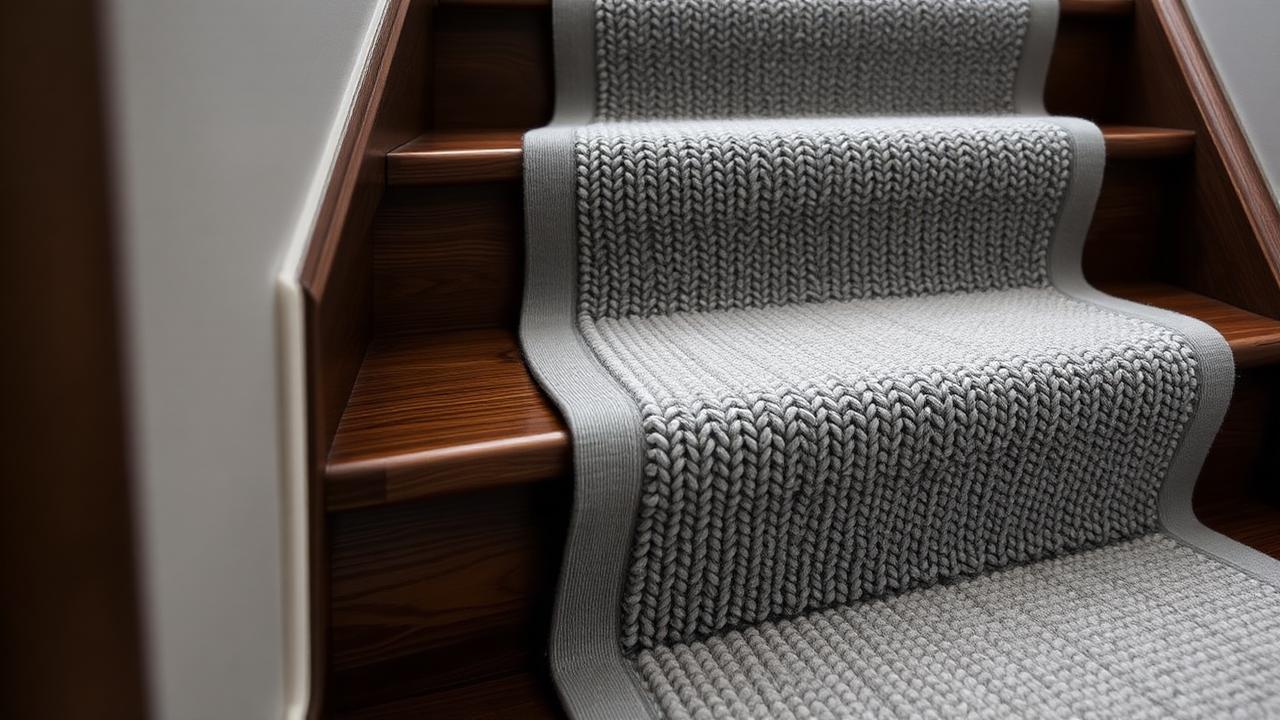
Once the stringers are built and the treads and risers installed, double-check the physical dimensions on site rather than relying purely on the calculator's paper output before finalising your runner order. A tape measure check across at least three steps will confirm whether the finished dimensions match the design, since minor construction variances are common even on carefully planned jobs.
- Set riser height first from your total rise and desired step count.
- Use the 2R+T comfort rule to determine matching tread depth.
- Confirm on-site dimensions after construction before ordering runner.
- Account for flooring thickness at the top and bottom of the flight.
- Add a 10% waste margin when calculating final runner length.
Finishing the job
With your stringers cut and treads installed, the final step is to run your exact on-site measurements through the stair runner length calculator to generate a precise order. This closes the loop between structural carpentry and finished flooring, ensuring the runner you buy fits the staircase you actually built rather than the one on paper.
Open, closed and housed stringers
A stair jack calculator produces the same rise-and-run numbers regardless of stringer style, but the style itself affects how a runner sits once fitted. An open or cut stringer, where the sawtooth profile is visible on the outer face, generally pairs with a runner that stops just short of each edge, leaving the shaped stringer as a visual feature. A closed or housed stringer, common in more formal US and UK builds, hides the joinery behind a solid board and lets the runner run closer to full width, since there is no shaped edge to preserve as a feature.
Housed stringers, where the treads and risers sit in routed grooves rather than resting on top of cut notches, are typically stronger and quieter underfoot but cost more in labour to build. If you are planning a full staircase rebuild rather than a carpet refresh, factor stringer style into your budget alongside the runner cost, since it affects both material and installation labour.
Typical stringer and build cost bands
A basic cut-stringer staircase rebuild in the US, treads, risers and stringers in standard pine, typically runs $1,800-3,500 for a straight 13-step flight before finishing. Hardwood treads on a housed stringer push that to $4,000-7,500. In the UK, expect roughly £1,400-2,800 for a basic pine straight flight and £3,200-6,000 for a hardwood housed-stringer equivalent. These figures are for the structural stair only and do not include the runner, underlay or handrail, which should be budgeted separately using the figures elsewhere in this guide.
| Build type | US cost (13-step) | UK cost (13-step) |
|---|---|---|
| Basic pine, cut stringer | $1,800-3,500 | £1,400-2,800 |
| Hardwood, housed stringer | $4,000-7,500 | £3,200-6,000 |
- Confirm whether your stairs use open, closed or housed stringers before planning the runner width.
- Housed stringers cost more but are quieter and stronger long-term.
- Budget stringer, tread and riser costs separately from runner and underlay costs.
- Get on-site measurements confirmed by the builder before ordering carpet.
- Ask your fitter whether stringer style limits how close the runner can sit to the stair edge.
Still deciding on material, width or pattern? Our hub on stair runners compares weaves, widths, backings and fitting styles side by side, then hands the numbers straight to the calculator.
Frequently asked questions
What is a stair jack?
It is another name for a stair stringer, the sawtooth board that supports the treads and risers.
How many notches does a stringer need?
One per step, so a 13-step flight needs 13 notches, though the top notch is sometimes handled differently depending on the landing design.
What is the 2R+T rule?
A comfort formula stating that twice the riser height plus the tread depth should total between 24 and 25 in (61-63.5 cm).
Does a stair jack calculator help with carpet ordering?
Indirectly, yes. It confirms the tread and riser dimensions you then feed into a stair runner calculator.
What is the maximum riser height allowed?
Typically 7.75-8 in (19.7-20.3 cm) in most US and UK residential codes, though you should confirm your local requirements.
Should I measure the finished stairs before ordering a runner?
Yes, always confirm on-site dimensions rather than relying solely on the paper layout.
How does flooring thickness affect stringer layout?
The top and bottom risers need adjusting to compensate for the thickness of the finished floor at each end of the flight.
Can I use the same calculator for stringers and runner length?
No, use a stair jack or stringer calculator for construction, and a dedicated stair runner calculator for carpet length.
Know your numbers in 30 seconds
Enter your step count, tread depth and riser height — the stair runner calculator gives you the exact length to order, in metres and feet, with waste included.
Plan the carpet with the stair runner calculatorReady for real prices?
Get quotes from vetted stair runner suppliers and fitters near you. Free, no account, no obligation.
Every guide is written from hands-on measuring and fitting experience, checked against the calculator’s own maths, and re-reviewed whenever prices or methods change. Read our editorial standards.