
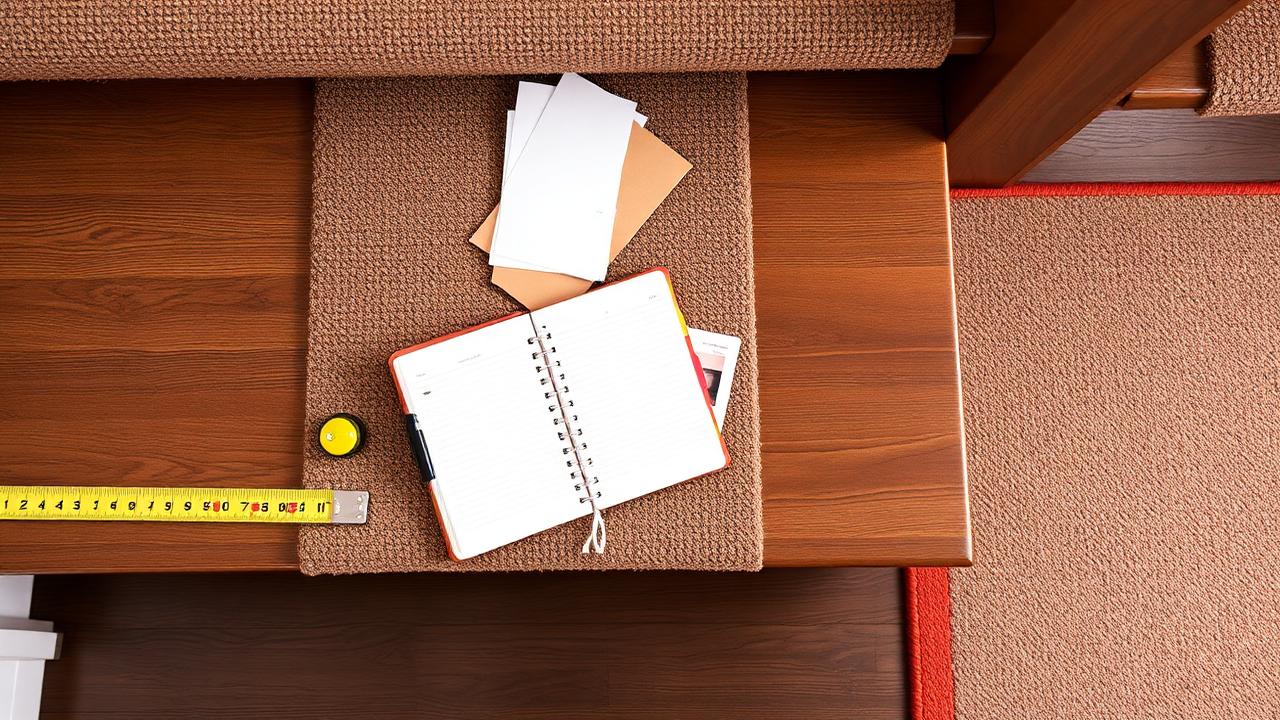
Why riser and tread numbers matter beyond building regs
Riser height and tread depth aren't just a building-code checkbox - they set the rhythm of every step you take on the stairs, and they're the two numbers everything else in a runner order is built from. A staircase with risers that are too tall or treads that are too shallow feels cramped and can actually be less safe, since an uneven or awkward stride pattern is a common contributor to missed steps. Get these two figures measured correctly and both the construction and the carpet sizing that follows become far more reliable.
Riser height is the vertical distance from the top of one tread to the top of the next. Tread depth (sometimes called the 'going' or 'run') is the horizontal distance you actually walk on, measured from the nosing of one step to the nosing of the next, not including any overhang. Both are usually consistent throughout a single flight - building codes in most US and UK jurisdictions require the variation between the largest and smallest riser or tread in a flight to be very small, often under 3/8 in (10 mm), because an inconsistent stride is a genuine trip hazard.
The comfort formula
A widely used rule of thumb for comfortable stairs is that twice the riser height plus the tread depth should total roughly 24-25 in (61-63.5 cm). A staircase with a 7 in (17.8 cm) riser and 10.5 in (26.7 cm) tread, for example, comes to 24.5 in (62.2 cm), landing right in the comfortable zone. Steeper stairs - common in older houses or where floor-to-floor height is tight - trade tread depth for riser height, ending up with a taller riser and shallower tread that feels quicker underfoot but less relaxed to climb.
| Riser height | Tread depth | 2x riser + tread | Feel |
|---|---|---|---|
| 7 in (17.8 cm) | 11 in (28 cm) | 25 in (63.5 cm) | Gentle, spacious |
| 7.5 in (19 cm) | 10 in (25 cm) | 25 in (63.5 cm) | Standard, comfortable |
| 7.75 in (19.7 cm) | 9.5 in (24 cm) | 25 in (63.5 cm) | Slightly brisk |
| 8.25 in (21 cm) | 9 in (23 cm) | 25.5 in (64.8 cm) | Steep, common in older houses |
Check code before finalising
US and UK residential codes both set maximum riser heights and minimum tread depths, typically around 7.75 in (196 mm) maximum riser and 10 in (254 mm) minimum tread in the US, and similar figures under UK Building Regulations Part K - always confirm current local requirements before finalising new construction.
How to measure existing stairs accurately
For an existing staircase, measure riser height by holding a tape vertically from the top surface of one tread to the top surface of the tread above it, ideally against the wall string where the surface is cleanest. Measure tread depth horizontally from nosing to nosing along the walked-on line, not diagonally and not including any decorative overhang beyond the riser face. Take these measurements on at least three different steps - top, middle and bottom of the flight - since older houses sometimes have small inconsistencies that a single measurement would miss.
Nosing - the small rounded or bullnose overhang at the front edge of a tread - typically adds 0.75-1.25 in (2-3 cm) of visual depth beyond the true walked-on tread, and it's important not to include it in your riser/tread comfort calculation, though it does matter for the runner's nosing wrap allowance covered below.
How much runner do I need?
Once you have accurate riser and tread figures, runner length follows directly. Take 13 steps with a 7.5 in (19 cm) riser and 10 in (25 cm) tread depth, a very standard comfort-formula combination. Per step: 10 in tread + 7.5 in riser + 1 in nosing wrap = 18.5 in. Across 13 steps, that's 240.5 in, or 20 ft. Add a 22 in (56 cm) finishing allowance top and bottom and you reach about 21.8 ft. With a 5% waste allowance for a plain runner, order roughly 22.9 ft (7 m). In metric: 25 cm + 19 cm + 2.5 cm = 46.5 cm per step, times 13 is 6.05 m, plus 56 cm finishing is 6.61 m, plus 5% waste is about 6.9 m, matching the imperial result within rounding. This is precisely the calculation a stair runner calculator performs, using whatever riser and tread figures you enter for your own flight rather than the example numbers here.

Steps to get accurate riser and tread numbers
- Measure riser height vertically on at least three steps in the flight.
- Measure tread depth horizontally, nosing to nosing, excluding overhang.
- Check both figures are consistent within the flight (variation under about 3/8 in / 10 mm is normal).
- Apply the 2x riser + tread comfort check if you're planning new construction.
- Feed the confirmed riser and tread numbers into a stair runner calculator for length.
Know your numbers in 30 seconds
Enter your step count, tread depth and riser height — the stair runner calculator gives you the exact length to order, in metres and feet, with waste included.
Open the stair runner calculatorHow riser and tread affect the nosing wrap
The nosing wrap - the small allowance for carpet folding over the front edge of the tread and down the start of the riser - is fairly consistent regardless of riser and tread size, typically 0.75-1.25 in (2-3 cm), but it becomes proportionally more significant on stairs with very shallow treads, since it represents a larger share of the total per-step length. On a 9 in (23 cm) tread, a 1 in nosing wrap is over 10% of the tread depth; on an 11 in (28 cm) tread, it's under 10%. This is a minor effect on total yardage but worth knowing if you're trying to reconcile a chart-based estimate against your own steeper or shallower stairs.
When riser and tread numbers don't match a standard chart
If your measured riser and tread figures fall well outside the standard ranges shown above - very steep stairs, a loft conversion staircase, or an older cottage stair with a mix of odd dimensions - don't force your numbers to match a generic chart. Use your actual measured figures in the per-step formula (tread + riser + nosing wrap, multiplied by step count, plus finishing allowance and waste) and you'll get an accurate length regardless of how unusual the staircase's proportions are. This is exactly the situation a stair runner calculator is designed to handle, since it works from your real inputs rather than an assumed standard tread and riser.
Whatever you decide, get the numbers first: the stair runner calculator doubles as a stair runner length calculator, adding nosing wrap, landings, winders, pattern repeat and waste so you order the right length the first time.
Still deciding on material, width or pattern? Our hub on stair runners compares weaves, widths, backings and fitting styles side by side, then hands the numbers straight to the calculator.
Frequently asked questions
What is a comfortable stair riser height?
Most comfortable residential stairs use a riser height of 7-7.75 in (17.8-19.7 cm). Taller risers make stairs feel steeper and quicker to climb, while shorter risers feel gentler but need more floor-to-floor space to complete the same rise.
What is a standard stair tread depth?
A comfortable tread depth is typically 10-11 in (25-28 cm), measured from nosing to nosing along the walked-on line. Shallower treads, common in older or space-constrained stairs, can feel less secure underfoot, especially in bigger shoes.
How do riser and tread height affect runner length?
Each step's runner consumption is tread depth plus riser height plus a small nosing wrap allowance, multiplied by the number of steps. Taller risers or deeper treads both increase the per-step figure and therefore the total length needed.
What is the 2x riser plus tread rule?
It's a widely used stair comfort formula stating that twice the riser height plus the tread depth should total roughly 24-25 in (61-63.5 cm) for a comfortable climbing rhythm. It's a design guideline, not a legal requirement, though it aligns closely with most building code ranges.
Should I measure riser and tread on every step?
It's good practice to measure at least three steps - top, middle and bottom - since even code-compliant flights can have very slight, allowed variation. Measuring only one step risks missing an inconsistency that would throw off a total length calculation.
Does nosing count as part of tread depth?
No, the walked-on tread depth is measured nosing to nosing, excluding the small overhang. However, the nosing does add a separate small wrap allowance, typically 0.75-1.25 in (2-3 cm) per step, when calculating carpet or runner length.
What riser and tread dimensions do building codes require?
US residential codes commonly cap riser height around 7.75 in (196 mm) and require a minimum tread depth around 10 in (254 mm); UK Building Regulations Part K sets similar limits. Always check current local requirements, since they can vary by jurisdiction and property type.
Can I use a standard runner chart if my stairs are unusually steep?
Not reliably. A chart assumes standard riser and tread dimensions, so unusually steep or shallow stairs should have their own riser and tread figures measured and run through a stair runner calculator directly rather than interpolated from a generic chart.
Know your numbers in 30 seconds
Enter your step count, tread depth and riser height — the stair runner calculator gives you the exact length to order, in metres and feet, with waste included.
Turn your riser and tread numbers into a runner lengthReady for real prices?
Get quotes from vetted stair runner suppliers and fitters near you. Free, no account, no obligation.
Every guide is written from hands-on measuring and fitting experience, checked against the calculator’s own maths, and re-reviewed whenever prices or methods change. Read our editorial standards.