

The equal-riser rule
Every riser on a single flight must be the same height, and the tolerance for variation is tight: UK guidance treats anything over about 5mm variation between the largest and smallest riser on a flight as a defect, and the US IRC allows a maximum variation of 3/8in (9.5mm) between the tallest and shortest riser in the whole flight, with a stricter 3/16in (4.8mm) tolerance permitted between any two adjacent risers in some jurisdictions. The human gait adapts to a rhythm within the first two or three steps, and a step that is even 10mm out of that rhythm is enough to catch a toe or a heel.
This is why riser height is calculated for the whole flight before a single stringer is cut, rather than built step by step and adjusted as you go. Small rounding errors compound: if you build each riser slightly under the target height to be 'safe', by the twelfth step you may have added an entire extra riser's worth of height and thrown off the door clearance or landing level at the top.
How the calculation works
Measure the total rise — the exact vertical distance from the finished floor at the bottom to the finished floor at the top, including the thickness of any flooring that will be added later, since forgetting a floor build-up is a common reason the top step ends up wrong height after decorating. Divide that total rise by a trial number of risers to get a riser height, check it against the regulatory maximum, and adjust the number of risers up or down until the resulting height sits inside a comfortable range: roughly 150-200mm (6-7.9in) for most European guidance, and up to 7.75in (197mm) for US code, though 7-7.5in is the practical sweet spot most US builders use.
| Total rise | Number of risers | Riser height | Compliant? |
|---|---|---|---|
| 2600mm (102.4in) | 13 | 200mm (7.9in) | UK: fail (>190mm typical target) / US: fail (>7.75in) |
| 2600mm (102.4in) | 14 | 185.7mm (7.3in) | Compliant both UK & US |
| 2400mm (94.5in) | 13 | 184.6mm (7.3in) | Compliant both UK & US |
| 2800mm (110.2in) | 15 | 186.7mm (7.35in) | Compliant both UK & US |
Know your numbers in 30 seconds
Enter your step count, tread depth and riser height — the stair runner calculator gives you the exact length to order, in metres and feet, with waste included.
Open the stair runner calculatorUK maximum: 220mm
Approved Document K sets a hard maximum riser height of 220mm for a private stair, with no fixed minimum, though anything under about 150mm starts to feel shuffly rather than stepped. Most UK domestic staircases are built between 170mm and 200mm, which — combined with the 220mm minimum going — keeps the flight inside the traditional '2R + G' comfort formula of roughly 550-700mm.
US maximum: 7.75 inches
IRC R311.7.5.1 caps riser height at 7.75in (197mm) for residential stairs, and most stock stringers and pre-cut stair components in the US are manufactured to deliver a 7-7.25in riser as standard, because it comfortably clears code while giving a slightly gentler climb than the legal maximum. Some older houses built before the current code cycle will have risers up to 8.25in or more; these are grandfathered structurally but are worth flagging if you are planning any alteration, since most permits trigger a requirement to bring the whole flight up to current code.
Tolerance is not a design target
The 5mm (UK) or 3/8in (US) tolerance exists to absorb unavoidable construction variance, not to be used deliberately. Design every riser to the same calculated height and treat any measured deviation as something to fix, not as budget to spend.
Riser height and comfort formulas
Riser height and tread going are not independent: as one goes up, the other should come down to keep the total stride length comfortable. The long-standing rule used by architects on both sides of the Atlantic is 2 x riser + going = 600-650mm (approximately 24-25.5in), sometimes called the Blondel formula. A 180mm riser paired with a 280mm going gives 2(180)+280 = 640mm, which sits comfortably in range; a 200mm riser with a 220mm going gives 620mm, also acceptable but noticeably steeper underfoot despite the similar total.
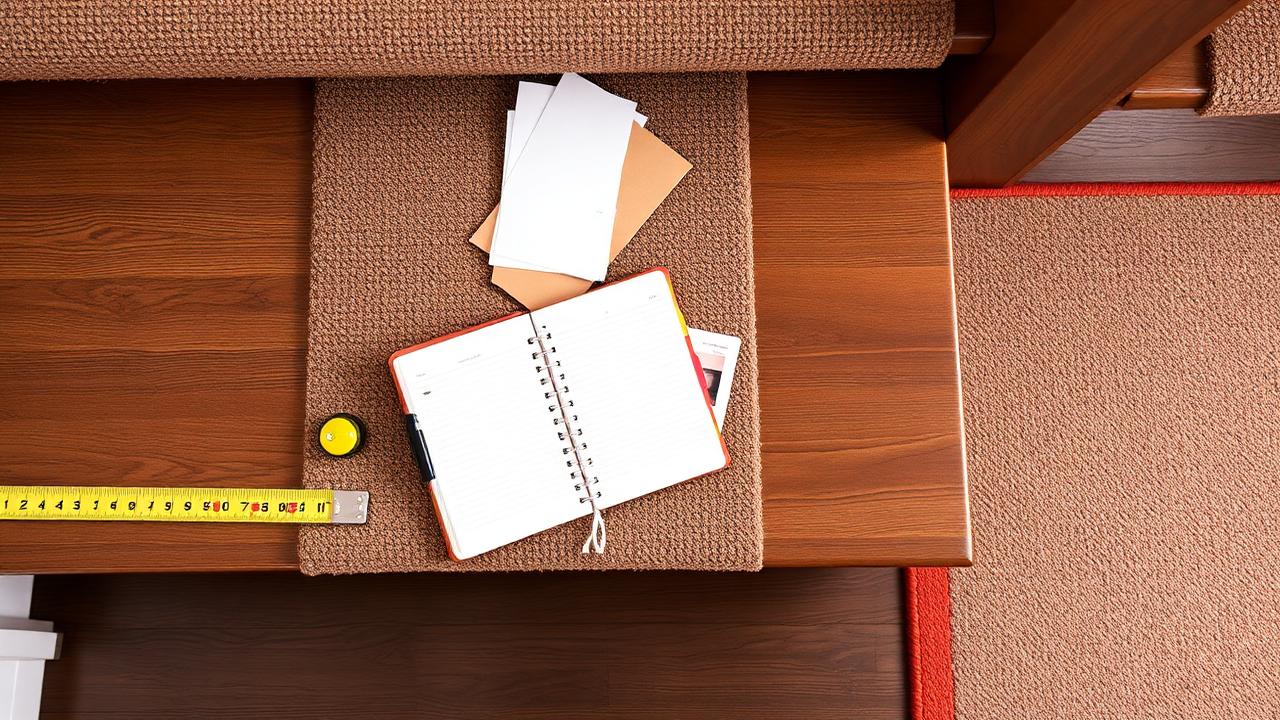
Measuring existing risers accurately
- Measure from the top surface of one tread to the top surface of the next, not from nosing tip to nosing tip, which introduces the nosing overlap error.
- Take the measurement at both ends of the step, since old timber staircases often sag or have been shimmed unevenly.
- Record every riser on the flight individually rather than assuming they match — this is essential before ordering a runner, since an uneven flight needs custom cuts.
- Note the top and bottom risers separately, since these are frequently a different height from the rest where floor finishes have changed over the years.
Riser height and stair runners
Every extra centimetre of riser height adds directly to the amount of runner each step consumes, because the runner has to travel up the riser face as well as across the tread. A flight with 200mm risers uses noticeably more runner over 13 steps than one with 170mm risers, even if the total floor-to-floor rise and the going are identical, simply because there are more risers to cover. This is one of the main variables the stair runner length calculator accounts for, and it is worth measuring your actual riser heights rather than assuming a 'standard' figure, since older houses vary far more than modern builds.
| Riser height | Risers in a 2.6m rise | Approx. runner length needed |
|---|---|---|
| 170mm (6.7in) | ~15 | 22-23ft / 6.7-7.0m |
| 185mm (7.3in) | ~14 | 20-21ft / 6.1-6.4m |
| 200mm (7.9in) | ~13 | 19-20ft / 5.8-6.1m |
Cost of correcting uneven risers
Fixing a genuinely out-of-tolerance riser usually means re-cutting the stringer, which UK joiners price at £400-£1,200 for a single flight depending on access, and US contractors typically quote $500-$1,500 for equivalent work. If the variation is cosmetic rather than structural — for example a worn nosing rather than a true height error — a carpenter can sometimes pack or plane individual steps for a few hundred pounds or dollars, which is worth investigating before committing to a full rebuild.
Know your numbers in 30 seconds
Enter your step count, tread depth and riser height — the stair runner calculator gives you the exact length to order, in metres and feet, with waste included.
Open the stair runner calculatorWhatever you decide, get the numbers first: the stair runner calculator doubles as a stair runner length calculator, adding nosing wrap, landings, winders, pattern repeat and waste so you order the right length the first time.
Still deciding on material, width or pattern? Our hub on stair runners compares weaves, widths, backings and fitting styles side by side, then hands the numbers straight to the calculator.
Frequently asked questions
What is the maximum stair riser height in the UK?
Approved Document K sets a maximum riser height of 220mm for a private domestic stair. Most staircases are actually built between 170mm and 200mm for comfort, with 220mm reserved for tight spaces where floor space is limited.
What is the maximum stair riser height in the US?
IRC R311.7.5.1 sets a maximum residential riser height of 7.75 inches (197mm). Most manufactured stair components are built to deliver 7-7.25in as standard, which clears code with margin while keeping the climb comfortable.
How much can riser heights vary on the same flight?
UK guidance treats more than about 5mm variation between the tallest and shortest riser as a defect. The US IRC allows a maximum of 3/8in (9.5mm) variation across a flight, with some jurisdictions applying a tighter 3/16in tolerance between adjacent steps.
How do I calculate riser height for a new staircase?
Divide the total floor-to-floor rise by a trial number of risers, check the result against the 220mm (UK) or 7.75in (US) maximum, and adjust the riser count until the height falls in a comfortable 150-200mm (6-7.9in) range while still clearing code.
Why does riser height affect how much stair runner I need?
The runner has to travel up the riser face as well as across the tread on every step, so a taller riser consumes more material per step. Two staircases with the same total rise can need noticeably different runner lengths if their riser heights differ.
Does the top or bottom riser need to be a different height?
No, every riser on a flight should be identical, including the first and last. If the top or bottom step measures differently on an existing staircase, it usually means a floor finish has been added or removed since the stair was built, and it should be corrected rather than treated as normal.
Know your numbers in 30 seconds
Enter your step count, tread depth and riser height — the stair runner calculator gives you the exact length to order, in metres and feet, with waste included.
Calculate my riser heightReady for real prices?
Get quotes from vetted stair runner suppliers and fitters near you. Free, no account, no obligation.
Every guide is written from hands-on measuring and fitting experience, checked against the calculator’s own maths, and re-reviewed whenever prices or methods change. Read our editorial standards.